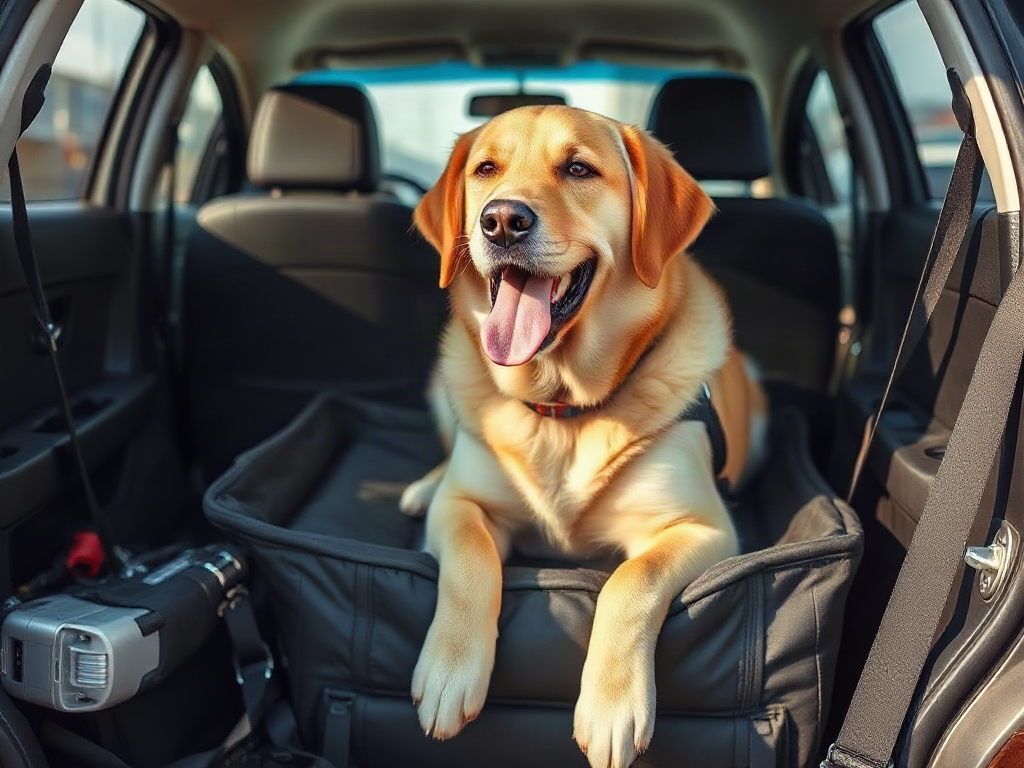
Large-dog car seats compared with travel crates usually offer easier access and less cabin bulk, while a properly secured crate provides a defined enclosure that limits roaming and contains the dog during routine driving. The better choice depends on the dog’s measured body size, the vehicle’s usable anchor points, the restraint system’s instructions, and whether the setup remains stable during braking and turns. A seat-style setup should connect through an appropriate harness rather than a collar, while a crate must fit the dog without blocking visibility or becoming loose cargo. Product labels alone do not establish crash protection, so examine test details, installation requirements, and size limits before buying.
How the Two Restraint Setups Manage Movement
A large-dog car seat and a travel crate manage the passenger space in fundamentally different ways. Most seat-style products create a padded or raised area on an existing vehicle seat and rely on a separate tether or harness connection to limit movement. A crate surrounds the dog and restricts movement through its walls, door, floor, and attachment to the vehicle. Neither format should be treated as protective merely because it keeps muddy paws off the upholstery.
For a seat-style arrangement, the load path matters more than the cushion. A sudden stop transfers force through the dog’s harness, tether, seat belt, buckle, or another specified attachment point. Attaching the tether to a collar concentrates force around the neck and should be avoided. An overly long tether may allow the dog to strike a seatback, door, console, or another passenger before it reaches full extension. An extremely short tether can force an awkward posture and may invite twisting if the dog repeatedly turns.
A crate handles ordinary movement differently. Its enclosure can stop a dog from stepping into the footwell, climbing toward the driver, or moving across the rear bench. The crate itself must still be restrained. An unsecured enclosure can slide, tip, or become a heavy moving object. Soft-sided crates may be convenient to carry and store, but flexible panels offer less structural separation from luggage or interior surfaces than a rigid model. Wire crates provide ventilation but can rattle, snag unsecured gear, and vary widely in construction. Molded or reinforced crates consume more room and may be difficult to load through a narrow hatch.
Consider a 75-pound dog that settles quietly but changes sides at every turn. A broad seat platform paired with a correctly fitted automotive harness may preserve more passenger room and let the dog lie down. If the same dog paws at doors, climbs over barriers, or tangles a tether around its legs, an appropriately sized secured crate may provide more predictable boundaries. Conversely, a crate that barely fits through the hatch or cannot be anchored as directed is not automatically the safer practical choice.
The useful comparison is therefore restraint system versus restraint system, not padded seat versus box. Review the seat, harness, tether, crate, and vehicle attachment points as one installation. Readers comparing Large-dog car seats compared with travel crates should give priority to controlled movement, reliable attachment, and a setup the dog can occupy without being compressed or able to roam.
Fit Limits for Large Dogs and Real Vehicles
Large dogs expose sizing problems that are easy to miss in product photographs. Weight limits do not reveal whether a broad-chested dog can lie naturally, whether a tall dog has adequate head clearance, or whether the product’s base fits fully on the vehicle seat. Start with the dog’s standing height, body length, chest girth, and comfortable lying footprint, then measure the actual installation area inside the vehicle.
For a seat-style product, check base width and depth against the usable bench surface rather than the vehicle’s advertised shoulder room. Contoured cushions, raised side bolsters, recessed buckles, and sloping seatbacks can reduce the flat area. A platform that hangs over the edge may tilt under the dog’s weight. If the design depends on a head-rest strap, confirm that the vehicle position has a compatible adjustable head restraint and that the manufacturer permits that installation.
Crate fit requires two separate checks: fit for the dog and fit through the vehicle. The dog should be able to enter, stand in a normal posture, turn, and settle without being wedged against the walls. Extra interior space is not automatically helpful, however, because it permits more movement and makes the enclosure harder to place and secure. Measure the cargo opening at its narrowest points, including trim, latch projections, roof slope, and the space consumed by the open door. A crate may fit in the cargo floor dimensions yet fail to clear the hatch opening.
A common sport-utility-vehicle scenario illustrates the constraint. A tall crate may fit behind the second row only if it is loaded at an angle, but once upright it could block rear visibility or sit against the hatch glass. Folding the rear seats may solve the height problem while removing passenger positions and changing the available anchors. On a sedan bench, a large crate might span multiple seating positions and sit unevenly across cushion contours. In either case, forcing the product into a marginal location creates instability that its listed weight rating does not address.
Use a simple pre-purchase fit check:
- Measure the dog: Record standing and resting dimensions, not weight alone.
- Map the installation area: Note seat contours, cargo tie-downs, belt geometry, airbag locations, and visibility.
- Check the loading path: Measure doors or hatch openings and allow room to operate the crate door.
- Read the complete instructions: Confirm permitted positions, compatible anchors, and stated size limits.
- Mock up the footprint: Use cardboard or painter’s tape to test space without assuming catalog dimensions will feel workable.
The mistake to avoid is buying by breed label. Two dogs of the same breed and weight can have different torso length, height, and preferred resting posture. Vehicle interiors differ just as sharply. Physical measurements offer a better basis for deciding between a large-dog seat and a travel crate.
Installation, Anchoring, and Common Failure Points
A restraint is only as dependable as its installation and weakest connection. Buyers often focus on thick fabric, metal hardware, or a substantial-looking frame while overlooking how the system attaches to the vehicle. The relevant question is whether every component is used in a manufacturer-approved configuration and remains secure when the dog shifts weight.
With a car-seat setup, distinguish straps that stabilize the seat from the connection intended to restrain the dog. A strap around a head restraint may keep a cushion upright without being designed to carry the dog’s load. Likewise, a tether clipped to a harness is not useful if the harness is intended only for walking, fits loosely around the chest, or allows the dog to back out. Avoid connecting multiple unverified adapters simply to reach a distant buckle; each added connector can change tether length, loading, and compatibility.
Crates require attention to both structure and placement. Tie-downs should contact the points specified by the crate maker rather than door bars, handles, or thin wire sections chosen for convenience. Keep luggage, tools, and folding equipment from pressing against the enclosure or blocking ventilation. If the crate sits in an open cargo area, check whether the vehicle manual restricts use of particular hooks. Some cargo loops are intended to organize light items rather than restrain heavy loads, so their appearance alone is not enough.
After installation, apply firm hand pressure in several directions. A little material flex may be normal, but the whole setup should not slide freely, rotate, release a buckle, or expose a gap the dog can exploit. Place the dog inside while parked and watch a complete cycle of standing, turning, lying down, and exiting. Tether tangling, persistent leaning against a door, unstable footing, or a crate base rocking on folded seats signals that the configuration needs adjustment.
Marketing language also deserves scrutiny. “Crash tested” can describe very different test procedures and does not by itself explain the test speed, dog mass represented, pass criteria, independent oversight, or exact combination of components used. Look for accessible test details and confirm that the tested size matches the model and installation being considered. Do not transfer a claim from one product size to an entire range without documentation.
Recheck the installation after the first few drives and periodically thereafter. Webbing can loosen, buckles can become buried under cushions, crate fasteners can work free, and dogs may chew reachable straps. The comparison in Large-dog car seats compared with travel crates becomes meaningful only when both options are assessed as installed, maintained systems rather than standalone products.
Choosing by Dog, Journey, and Daily Use
The better format is the one that fits the dog’s behavior, the vehicle’s geometry, and the owner’s ability to install it correctly every time. A crate often suits dogs that need a firm boundary, travel with substantial cargo, or are likely to interfere with the driver if left on a bench. A seat-style system may suit a calm, harness-tolerant dog when a full-size crate cannot be loaded or anchored properly.
Behavior changes the practical result. A dog that chews webbing, spins repeatedly, or panics when tethered may defeat a seat setup even if the dimensions look appropriate. A dog with strong crate distress may scratch, bite, or throw its weight against an enclosure, making gradual acclimation necessary before a long drive. Restraint equipment should not be used as a substitute for preparing the dog to enter, settle, and remain calm while the vehicle is stationary and during short practice trips.
Trip pattern matters as well. For frequent short journeys, a permanently installed seat and harness connection can reduce setup errors because the owner is less tempted to skip restraint. For long-distance travel, a crate may provide clearer separation from luggage and fewer opportunities for tether entanglement, provided ventilation, temperature, access, and anchoring remain suitable. A large rigid crate can be impractical if it must be removed daily, stored in a small home, or lifted by one person.
Passenger needs can settle an otherwise close decision. A crate occupying the cargo area may preserve rear seating but reduce luggage capacity. A wide bench product may consume two seating positions and place the dog close to children or another animal. Never share a single tether between dogs or place loose baggage where it can enter the dog’s space during braking. If neither option fits without blocking the driver’s view, interfering with doors, or using questionable anchors, a different vehicle layout or product category is warranted.
Signs that the choice is working include a stable base, unchanged attachment tension, normal resting posture, controlled entry and exit, and no access to the driver. Warning signs include straps rubbing the dog, repeated escape attempts, heavy panting unrelated to temperature or exercise, sliding on turns, bent crate components, opening latches, or anchors that loosen. Stop and correct the cause rather than assuming the dog will simply adapt.
Cost should be evaluated across the full system. A low-priced seat that requires a compatible automotive harness may cost more than its sticker suggests, while a crate may need a vehicle-specific mounting solution and enough cargo-room reorganization to remain usable. Compare verified dimensions, required accessories, replacement parts, cleaning needs, and how often the equipment must be moved. That approach produces a more realistic decision than choosing whichever product looks more substantial online.
Frequently Asked Questions
Is a large-dog car seat safer than a travel crate?
Safety cannot be determined by format alone. Compare documented testing, dog-size limits, vehicle compatibility, harness use, anchor instructions, and the stability of the complete installed system.
Can a large dog use a booster-style seat?
Only if the product specifically accommodates the dog’s weight and dimensions and can sit fully supported in the vehicle. Many raised booster designs are intended for smaller animals.
Should a dog be tethered inside a travel crate?
Do not add an internal tether unless the crate manufacturer expressly directs it. A tether can become an entanglement hazard or alter how the enclosure is designed to be used.
Where should a large dog ride in a vehicle?
Use a rear seating or cargo position permitted by the vehicle and restraint manufacturers. Avoid locations where the setup obstructs the driver, conflicts with airbags, or lacks suitable attachment points.
How can I tell whether the restraint is too small?
The dog should be able to maintain a natural posture and settle without forced bending or compression. Overhang, pressure marks, restricted turning, and persistent inability to lie normally indicate poor fit.
Conclusion
Choose from measured fit and a verified installation plan, not from product labels or breed-based sizing. Map the available seat or cargo area, identify usable vehicle attachment points, and read the instructions for every harness, tether, seat, crate, and mounting component before purchase. Then test the complete arrangement while parked and on short, controlled drives.
A seat-style system earns its space when it stays fully supported, controls the dog through an appropriate harness, and does not permit contact with the driver or hard cabin surfaces. A crate is the stronger practical fit when it provides useful boundaries and can be secured without compromising ventilation, visibility, or passenger needs. If either option slides, tangles, distorts, blocks controls, or depends on improvised hardware, reassess the placement or choose a different system.
Further Reading
Authoritative Sources
- Best Dog Booster & Car Seats
amazon.comDog Car Seat for Small/Medium Dogs, Memory Foam Dog Booster Seat, Travel Safety Per Car Seat with Washable Removable Cover, Storage Pockets for Dogs up to ...
- Do You Need a Dog Car Seat, Dog Seat Belt, Barrier or ...
petmd.comA dog car barrier works especially well for larger cars such as SUVs to keep your dog all the way in the back of the vehicle, but it can also be ...
- Best Dog Car Seats, Carriers, and Restraints, Tested
caranddriver.comA dog crate is generally used for larger dogs and placed in your SUV hatch or truck bed, then secured with tie-down straps to anchor points. A ...
- The best dog car seats in 2026, tried and tested
edition.cnn.comThe sturdy frame means the walls can be less than an inch thick, giving your pet a 16-by-12-inch space in a seat that's barely larger than that.