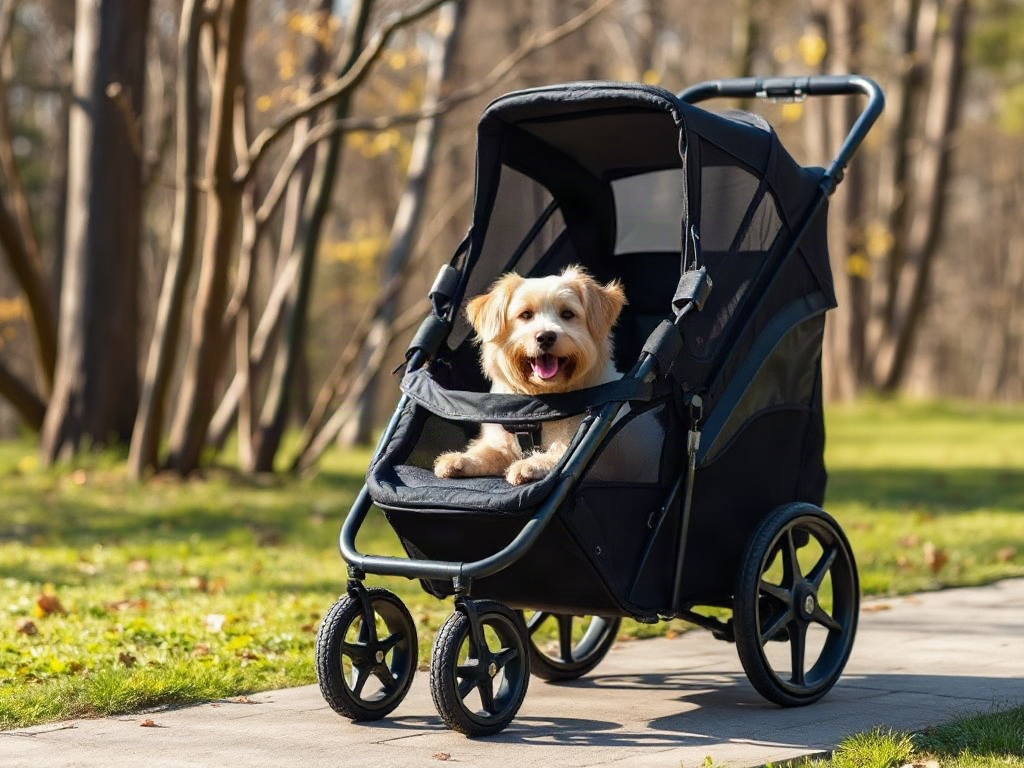
Dog strollers for mobility-limited travel companions work best when the cabin supports the dog’s full resting posture, the weight rating leaves a practical safety margin, and the wheels match the surfaces encountered during a trip. Measure body length and shoulder height rather than shopping by breed label, then check entry height, brake access, ventilation, tether placement, and folded dimensions. Large air-filled tires handle broken pavement more smoothly, while compact swivel wheels are easier inside shops and terminals. A stroller should extend comfortable access without replacing appropriate walking, veterinary evaluation, or a secured vehicle restraint.
Decide Whether a Stroller Fits the Dog’s Mobility Needs
A stroller is most useful when a dog can enjoy an outing but cannot comfortably cover its full distance. An older dog might walk for several minutes, ride through a crowded district, and get out again at a quiet park. A dog recovering from a procedure may need a different plan, including restrictions set by the treating veterinarian. The stroller changes how distance is managed; it does not determine whether exercise, weight bearing, or public outings are medically appropriate.
Look at what happens before, during, and after ordinary walks. Slowing on the return leg, repeated stopping, scuffed nails, reluctance to cross uneven ground, or prolonged fatigue afterward may indicate that the current distance exceeds the dog’s comfortable capacity. Sudden weakness, pain, collapse, breathing difficulty, or a new change in gait calls for veterinary attention rather than an equipment-only solution. A stroller can conceal declining tolerance if the underlying change is never assessed.
The intended role also affects the design. A dog that walks independently but tires later may benefit from a low entrance and quick-access canopy. A companion unable to stand steadily needs a cabin that supports lying down without sliding around turns. A reactive or easily overstimulated dog may find an enclosed mesh cabin calmer, but confinement should not be assumed to resolve fear. Crowds, unfamiliar sounds, heat, and close approaches can remain stressful even when the dog is off the ground.
Compare a stroller with the realistic alternatives. A sling may suit a short transfer but concentrates weight on the handler and may not stabilize a painful dog. A wagon offers space, yet its open sides and pulling motion can make supervision and maneuvering harder. A backpack carrier is compact for a sufficiently small dog, although bending the body into a narrow compartment may be unsuitable for stiffness or spinal discomfort. Coverage of Dog strollers for mobility-limited travel companions should therefore begin with the dog’s posture, tolerance, and transfer needs rather than appearance.
A sensible trial ends while the dog is still comfortable. Notice whether the animal can settle, change position, breathe normally, and remain composed as the stroller starts and stops. Persistent panting unrelated to temperature, frantic digging, repeated attempts to escape, trembling, or an inability to lie naturally means the setup or environment needs adjustment. The useful outcome is not simply completing a longer outing; it is completing it without creating avoidable discomfort or distress.
Measure the Cabin, Entry, and Weight Capacity
Cabin dimensions matter more than breed labels because two dogs of the same stated size can have very different body proportions. Measure the dog from the point of the shoulder to the base of the tail while standing naturally, then check shoulder height and the width occupied while lying in a normal resting position. Compare those measurements with the usable interior, not the stroller’s exterior dimensions. Thick liners, wheel housings, sloped walls, and canopy hardware can reduce the space the dog actually receives.
The cabin should permit a comfortable resting posture and at least a controlled change of position. Extra room is not automatically better: a small dog in an oversized compartment may slide during turns or braking. A fitted, nonslip pad can improve footing, but deep loose bedding may bunch under an unsteady dog or reduce ventilation. For a long-bodied companion, floor length may be the limiting measurement; for a tall dog that prefers sitting, canopy height can become the constraint.
Published weight capacity is a ceiling, not a complete fit test. It does not confirm that the floor dimensions, frame stiffness, center of gravity, or entry method suit the animal. Account for the dog, pad, rain cover, and any items placed in the cabin. Avoid using an under-seat basket as justification for loading the passenger area to its limit. Handling often becomes less responsive as total load rises, especially on slopes, curbs, and soft ground.
Entry height deserves close attention for weak hind limbs, painful joints, or poor balance. A rear or front opening close to the ground may allow a dog to step aboard with less lifting. If lifting is unavoidable, the opening must be wide enough to lower the dog without twisting its spine or catching paws on the frame. Practice the transfer at home while the parking brake is engaged, supporting the chest and hindquarters as appropriate for the individual dog. Ask a veterinarian or rehabilitation professional for handling instruction when the dog has surgical precautions or significant pain.
Before ordering, use a compact fit checklist:
- Resting space: Verify usable floor length, width, and canopy clearance.
- Access: Check opening size, threshold height, and whether the canopy stays out of the way.
- Load: Include the animal and everything carried in or on the stroller.
- Handler fit: Confirm handle height and foot clearance during a normal stride.
- Storage fit: Compare folded dimensions with the vehicle opening and cargo area.
A common mistake is measuring the cargo area but not the path into it. A folded frame may fit inside a trunk yet fail to pass through its opening, clear a parcel shelf, or leave room for other necessary luggage.
Match Wheels and Handling to the Trip
Wheel design determines how much vibration reaches the cabin and how much effort the handler uses to keep the stroller on course. Small hard wheels turn easily on smooth indoor floors but can stop abruptly at pavement seams, gravel, or raised thresholds. Larger wheels roll over irregularities more gradually. Air-filled tires often provide additional cushioning, although they require pressure checks and can puncture. Foam-filled or solid tires reduce maintenance but may transmit more chatter on rough surfaces.
Consider the least forgiving surface on the planned route, not merely the average one. A stroller used around a hotel may still encounter a cobbled block, a station platform gap, or a steep parking ramp. For broken sidewalks and packed trails, larger rear wheels, useful suspension, and a stable front end generally matter more than a very tight turning circle. For shops, elevators, and narrow café approaches, compact dimensions and swiveling front wheels may be more valuable.
A lockable front wheel offers a practical compromise on some models. Swivel mode aids low-speed maneuvering, while fixed tracking can reduce wheel flutter and unintended deflection over rough ground. The handler must stop and change the setting before the terrain demands it. Tilting a loaded stroller backward to force small front wheels over every curb can shift the dog abruptly and place heavy leverage on the handle and rear frame.
Slopes expose weaknesses that a showroom floor will not reveal. Walk behind the handle without hunching, confirm that wrists can reach the brake controls, and determine whether the stroller pulls sideways on a gentle cross-slope. A parking brake is meant to hold a stationary stroller; it should not be treated as a substitute for controlled handling on a descent unless the product specifically provides a suitable hand-operated slowing system. Never release the handle on an incline, even when a wheel brake is set.
For a realistic evaluation, load the cabin with weight comparable to the dog and push it over the surfaces available near home. Listen for frame flex, wheel rubbing, latch movement, or persistent rattling. Check whether the rear axle interferes with the handler’s stride and whether the front wheels remain predictable during brisk turns. Readers comparing Dog strollers for mobility-limited travel companions should prioritize controlled handling under load over unloaded showroom smoothness.
Inspect Restraints, Brakes, Ventilation, and Structure
A stroller cabin should contain the passenger without creating a new entanglement or escape hazard. Interior tethers are intended to limit climbing or jumping, but attachment geometry matters. A tether clipped to a well-fitted harness is generally preferable to placing sudden force on a collar if the dog lunges. Keep it short enough to prevent the dog from reaching a wheel or exiting over the side, yet long enough for a natural resting position. Never use the tether as a reason to leave the dog unattended.
Mesh panels need secure seams, functional zippers, and enough airflow for the expected weather. A rain cover can reduce wetting while also trapping warmth and moisture. Shade changes during a route, and pavement-level heat can differ from the conditions felt by a standing handler. Check the dog frequently for heavy panting, drooling, agitation, unusual quietness, or repeated repositioning. A stroller is not climate control, and closing every panel for perceived protection may make the cabin less comfortable.
Inspect structural parts with the stroller unfolded and loaded. Confirm that frame locks engage completely, the cabin floor remains level, wheel retainers are seated, and fabric does not contact moving components. Apply the parking brake on level ground and gently test movement without relying on excessive force. Repeat basic checks after transport because folding, baggage pressure, and vibration can shift removable wheels or leave a latch partly engaged.
Visibility creates a tradeoff. An open canopy lets a social dog observe its surroundings and may improve airflow, but it increases opportunities to jump or be approached. A zipped cabin provides more containment, though it can restrict direct access during a problem. Choose based on the dog’s behavior and the setting rather than assuming open or closed is universally safer. In a busy terminal, secure enclosure may be sensible; at a quiet rest stop, supervised access may allow easier monitoring.
Do not treat a stroller as a vehicle restraint. Folding frames, detachable cabins, and stroller tethers are not automatically designed to manage crash forces. During road travel, use an appropriate vehicle setup selected for the dog and vehicle, and stow the stroller so it cannot become loose cargo. Likewise, access rules vary among businesses and transport operators; a stroller does not change a pet into a service animal or guarantee admission. Checking the operator’s current rules before departure prevents an unsuitable stroller from becoming the only plan.
Plan Transfers, Vehicle Storage, and Stroller Training
Successful use depends on the transitions around the ride: entering the cabin, passing doors, folding the frame, loading the vehicle, and reversing the sequence at the destination. Rehearse those steps before a long outing. Set the brake, stabilize the frame, open the entry fully, and give the dog time to inspect the cabin. Reward calm voluntary approaches where physically possible; do not roll the stroller while the animal is halfway in or out.
Introduce motion in short, predictable stages. Begin with the dog settled in a stationary stroller, then move a few feet on a smooth surface. Add turns, stops, doors, and mildly uneven ground only after the previous stage produces relaxed behavior. Signs of progress include voluntary entry, a loose body, normal interest in the surroundings, and the ability to rest. Rushing directly into a crowded street can pair the cabin with vibration, noise, and restraint before the dog understands what is happening.
Vehicle logistics can determine whether a technically suitable model is practical. Measure the cargo opening at its narrowest points, note the lift-over height, and estimate whether the handler can raise the folded weight without losing balance. Removable wheels may improve fit but add steps and create parts that must be kept clean and accounted for. A one-hand fold sounds convenient, yet it has limited value if the user must simultaneously steady a dog that cannot stand safely.
For a day trip, separate the operating plan into three roles: the stroller carries the dog during low-tolerance portions, the vehicle restraint manages road travel, and a harness or other appropriate walking equipment supports controlled breaks. Bring water, waste supplies, a familiar nonslip pad, and any medication required under the dog’s existing care plan. Avoid hanging heavy bags from the handle because rearward weight can make a stroller more prone to tipping, particularly when the cabin is lightly loaded.
Have an exit plan for equipment failure or an overwhelmed dog. Know whether the companion can be carried safely, whether another person can assist, and where a quiet stopping point is available. Check wheels, fasteners, fabric, brakes, and fold locks before each substantial trip. Guidance on Dog strollers for mobility-limited travel companions is most useful when it accounts for the whole outing rather than treating the stroller as an isolated purchase.
Frequently Asked Questions
How much room should a dog have inside a stroller?
The dog should be able to lie in a normal posture and reposition without being compressed. Avoid excessive empty space that permits sliding; use a secure nonslip pad rather than loose, bulky bedding.
Are three-wheel or four-wheel dog strollers better?
Neither layout is automatically better. Wheel size, track width, frame geometry, load distribution, and surface conditions affect stability and handling more than wheel count alone.
Can a dog stroller be used on hiking trails?
Only on terrain suited to the stroller’s wheels, clearance, brakes, and rated use. Narrow, steep, rocky, muddy, or root-covered trails may exceed the frame’s capability and create rollover or control risks.
Should the interior tether attach to a collar or harness?
A well-fitted harness generally avoids concentrating restraint force on the neck. Adjust the tether to prevent jumping or wheel access without preventing the dog from lying comfortably.
Can a stroller replace walks for a senior dog?
It can reduce the distance the dog must cover, but it does not automatically replace appropriate movement, sniffing, or toileting opportunities. Ask a veterinarian what activity suits the dog’s health and mobility.
Conclusion
A useful stroller fits the dog in a natural resting posture, handles predictably under the full load, and works with the transfers and storage demands of the actual trip. Measure the cabin and cargo opening, test entry height, examine wheel behavior on realistic surfaces, and inspect every tether, latch, brake, and mesh seam. Introduce movement gradually so discomfort or fear appears during a short practice session rather than at a crowded destination. Keep the stroller’s role clear: it can conserve a companion’s limited walking capacity, but it is not a medical assessment, climate-controlled enclosure, vehicle restraint, or guarantee of public access. The next step is to document the dog’s measurements and intended routes, then compare those requirements against usable dimensions and loaded handling rather than product labels alone.