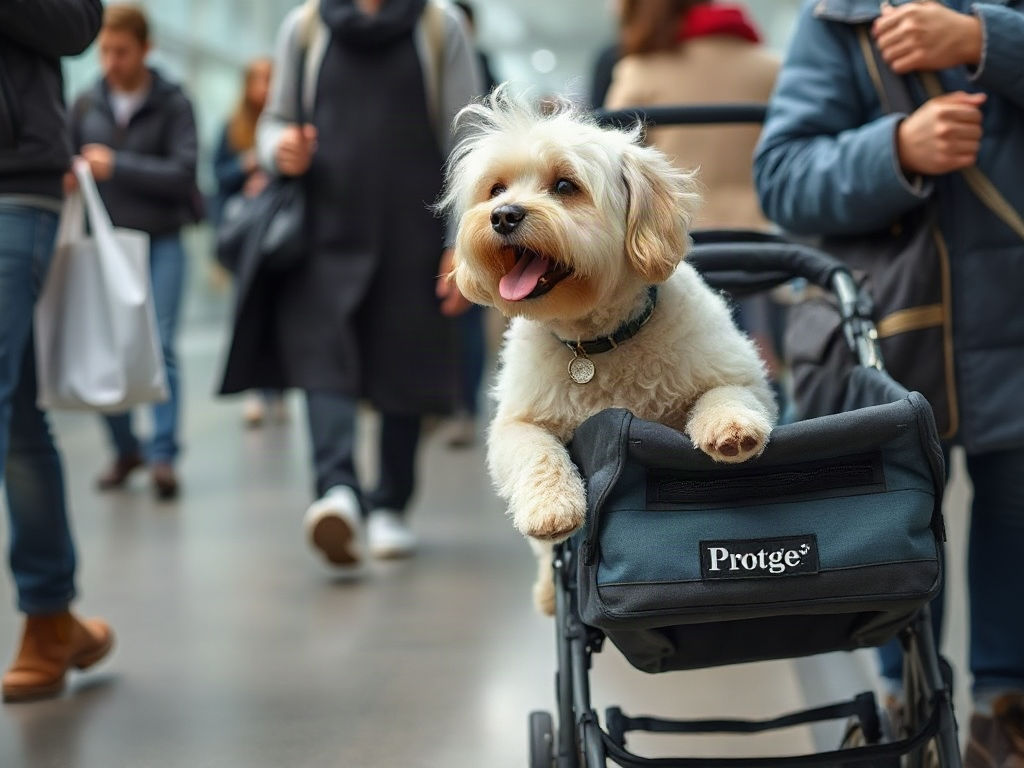
The best dog stroller features for crowded trips are a narrow wheelbase, responsive steering, reliable parking brakes, secure enclosure hardware, and a compact fold that does not obstruct shared spaces. Swiveling front wheels make tight turns easier, while rear-wheel brakes keep the stroller stationary during boarding, queues, and curbside stops. A low, stable cabin reduces tipping risk and lets the dog enter without being lifted as far. Choose dimensions and weight capacity from the manufacturer’s specifications rather than relying on labels such as small or lightweight. Test the fold, brakes, zippers, tether length, and turning clearance with your dog inside before entering a busy setting.
Start With Width, Turning Radius, and Stability
Crowded sidewalks, station platforms, shop aisles, and event entrances expose handling problems that may never appear on an open path. A stroller can roll smoothly in a straight line yet become awkward when its front wheels must pivot around luggage, queue barriers, chair legs, or people who stop unexpectedly. Published overall width matters more than cabin width here. Measure the widest fixed point, which may be the rear wheels rather than the fabric body, and compare it with the narrowest doorway, elevator, or storage area expected on the trip.
A narrow frame improves passage through tight spaces, but width should not be reduced at the expense of stability. Tall cabins, high seating positions, overloaded storage baskets, and bags hanging from the handle can raise or shift the center of gravity. During a sudden turn, that weight shift may make the stroller feel less planted. A lower cabin and a wheelbase that extends far enough beneath the dog generally provide a more controlled platform. The stroller should remain level when the dog changes position instead of rocking sharply toward one wheel.
Wheel configuration changes how the stroller behaves around people. Swiveling front wheels permit quick directional corrections and are usually preferable on smooth indoor floors and busy paved routes. A front-wheel lock can still be useful for rough pavement or longer straight sections, where an unlocked caster may flutter or follow every surface defect. Three-wheel models can feel agile, but agility alone does not guarantee a small footprint or resistance to tipping. Four-wheel designs may offer a broader support pattern, though some require more room to turn. Compare actual dimensions and handling rather than assuming a wheel count determines performance.
Consider a café entrance reached through a narrow door followed immediately by a sharp turn. A long stroller with excellent straight-line tracking may need several back-and-forth movements, blocking the doorway. A shorter model with responsive casters can clear the same turn cleanly, provided it remains stable under the dog’s weight. When researching the Best dog stroller features for crowded trips, place maneuverability ahead of oversized wheels unless the route genuinely includes broken pavement, grass, or gravel.
Prioritize Brakes, Enclosure Security, and Dog Restraint
Control while stopped is as important as control while moving. Crowded trips involve pauses on sloped sidewalks, transit platforms, entry ramps, and queues where a stroller can roll after a minor bump. Look for parking brakes that immobilize both rear wheels or otherwise prevent the stroller from pivoting around a single locked wheel. The controls should be reachable without placing a foot near the dog’s cabin, and their engaged position should be easy to confirm by sight or feel.
A brake should hold the loaded stroller, not merely click into place when the stroller is empty. Before a trip, engage it on a modest incline with the dog aboard while keeping a hand on the handle. Apply gentle forward and backward pressure. Movement, uneven locking, or a brake that releases when nudged indicates a poor setup for a busy environment. Parking brakes are not a substitute for maintaining control near curbs or platform edges; keep hold of the stroller whenever the surroundings could allow it to roll into danger.
The enclosure must account for a dog reacting to close movement. Mesh panels provide ventilation and visibility, but their seams and closures need to tolerate paws, noses, and repeated use. Zippers should close fully without leaving a nose-sized gap, and locking zipper pulls or clips can reduce accidental opening. A dog that presses against the canopy may expose weak attachment points that look adequate in product photos. Inspect the junctions between mesh, fabric, and frame, especially around entry panels.
An internal tether can reduce the chance of an abrupt exit when the canopy opens, but it should connect to a well-fitted harness rather than a collar. Adjust it short enough to prevent jumping over the side and long enough for the dog to sit, lie down, and turn without constant tension. Tethers are not universal crash restraints, and a stroller should not be treated as a vehicle safety device unless the manufacturer explicitly documents that separate use.
A common mistake is hanging a heavy handbag or shopping bag from the handle. The stroller may tip backward when the dog shifts or exits, even if it felt stable moments earlier. Put supplies in a low basket within its stated limit, keep dense items centered, and perform a brief stability check after loading. Secure brakes, a closed canopy, and balanced storage form a system; weakness in any one part undermines the others.
Match Cabin Design to the Dog and the Trip
Cabin fit should be evaluated with the dog in natural positions, not from weight capacity alone. The stated limit indicates how much load the frame is designed to carry, but it does not show whether a long-backed dog can lie down or whether a tall dog can sit without pushing into the canopy. Measure the dog’s standing length and seated height, then compare those measurements with the usable interior. Allow room to turn and settle without buying such a large cabin that the stroller becomes difficult to steer through crowds.
Entry height deserves extra attention for senior dogs, short-legged dogs, and animals recovering from limited mobility. A low rear or front opening reduces the distance the dog must step or be lifted. Some models include a ramp, but a ramp adds value only if it is stable, has usable traction, and can be deployed without blocking an entire walkway. In a busy terminal, a low entry that opens quickly may be more practical than a long ramp requiring clear floor space.
Ventilation should come from more than one panel so that closing a weather cover does not seal most airflow. Fine mesh may block some insects and debris, while heavier mesh may better resist scratching; neither benefit compensates for poor seam construction. A removable, washable liner is useful after muddy routes or accidents, but check what sits beneath it. A rigid, level floor supports secure footing better than a sagging fabric base, particularly when the stroller crosses thresholds or changes direction abruptly.
Visibility is a dog-specific tradeoff. A relaxed dog may benefit from broad mesh panels that allow observation of the surroundings. A dog that becomes overaroused when strangers pass inches away may settle better with partial visual screening and a familiar mat. Covers must not compromise airflow, and improvised blankets should not hang into wheels or trap heat. Stroller use can reduce exposure to feet and uncontrolled greetings, but it does not automatically make a stressful crowd comfortable for every dog.
For two small dogs, verify both combined weight and floor area. Each dog needs enough room to reposition without standing on the other, and separate tether points may reduce tangling. If either dog guards space or becomes tense in close quarters, one shared cabin may be the wrong choice regardless of its load rating. Cabin selection within the Best dog stroller features for crowded trips should reflect behavior, body dimensions, and expected ride duration rather than capacity marketing alone.
Check Folding, Carrying, and Storage Before Departure
A compact fold matters only when it works under trip conditions. Some strollers collapse to a short package but remain wide; others become slim yet too long for a car trunk, train luggage rack, or apartment closet. Record folded length, width, height, and total weight. Then map those figures to the smallest storage point on the route. A model that fits the vehicle but blocks a hotel-room doorway is not genuinely convenient.
One-hand folding is useful when the other hand must control the dog, but product descriptions do not reveal how much force or sequencing the mechanism requires. Check whether the cabin must be emptied, canopy removed, wheels detached, or handle repositioned before folding. Removable wheels can reduce storage size, although loose parts create another task in a crowded curbside area. A self-standing folded position keeps fabric off a dirty floor, while an automatic latch prevents the frame from opening during carrying.
Stroller weight affects more than lifting into a vehicle. Travelers may encounter stairs, broken elevators, raised thresholds, or a gap between transit and the platform. A lighter frame is easier to carry but may use smaller wheels, less rigid tubing, or fewer reinforcements. A heavier model can feel solid on rough surfaces yet become unmanageable when occupied. Never carry the folded stroller with the dog inside unless the manufacturer specifically designed and instructed that use.
Storage features should support balance rather than encourage overpacking. A low under-cabin basket is usually preferable to a large handle organizer for water, wipes, and a compact leash because it keeps weight near the ground. Confirm that the basket remains accessible when the dog is aboard and does not scrape curbs. Cup holders can spill onto the dog or distract the handler if they do not grip containers securely.
Before departure, perform a practical packing sequence: place the folded stroller in its intended storage location, add the rest of the luggage, remove it without unloading everything, and open it fully. Confirm that the frame locks audibly or visibly and that fabric is clear of hinges. If deployment requires setting the dog’s leash down, rearranging several bags, or standing in traffic, the design is poorly matched to the trip even if its folded measurements appear favorable.
Run a Crowded-Trip Test Before Buying or Traveling
A loaded handling test reveals more than a feature list. If store testing is permitted, use weight similar to the dog’s weight and place it where the dog’s body would rest. Better still, test the stroller with the dog in a quiet, controlled place after purchase and while the return period remains available. Check that the frame does not pull to one side, the casters recover smoothly after turns, and the handle height allows upright walking without kicking the rear axle.
Recreate the movements common to a crowded outing. Push through a standard doorway, make a tight turn, stop abruptly at walking speed, reverse a short distance, cross a threshold, and park on a gentle slope. Fold and reopen the stroller while holding the leash. Listen for wheel rubbing and frame clicks, then inspect whether the dog slides on the cabin floor. A successful test looks calm and predictable: the stroller tracks where directed, stops without excessive force, remains level when the dog shifts, and locks completely after unfolding.
Use this compact pre-trip check before entering a busy location:
- Fit: The dog can stand, turn, sit, and lie down without pressing hard against the enclosure.
- Control: Steering is smooth, both parking brakes hold, and no wheel wobbles or drags.
- Containment: Zippers close fully, seams are intact, and the tether reaches a harness without slack for jumping.
- Balance: Supplies sit low, handle bags are removed, and the stroller remains stable as the dog changes position.
- Deployment: The frame opens, locks, folds, and latches without fingers entering pinch points.
Signs of failure include repeated caster flutter, brake pedals that do not stay engaged, a dog panting or pawing despite suitable temperature and ventilation, and a frame that tips noticeably during ordinary turns. Do not assume the dog merely needs to get used to mechanical defects or an undersized cabin. Mechanical problems call for adjustment, repair, or replacement; persistent distress calls for a quieter acclimation plan or a different form of transport.
Introduce the stroller away from crowds with short stationary sessions, rewards, and brief movement on a smooth route. Increase duration only when the dog remains settled. The strongest evaluation of Best dog stroller features for crowded trips combines manufacturer specifications with this real-use test, because neither dimensions nor a quick empty-frame push can show the complete loaded behavior.
Frequently Asked Questions
Are three or four wheels better for a crowded trip?
Neither layout is automatically better. Three-wheel models may turn quickly, while four-wheel models may offer a broader support pattern. Compare total width, turning space, loaded stability, and caster behavior.
How narrow should a dog stroller be?
Choose a stroller narrower than the tightest doorway, aisle, elevator entrance, or storage gap on the planned route, while preserving enough cabin room and wheelbase stability for the dog.
Should the internal tether attach to a collar or harness?
Attach it to a properly fitted harness. A collar can concentrate force on the neck if the dog jumps or the stroller stops suddenly.
Can bags be hung from the stroller handle?
Avoid heavy handle bags because they can shift the balance and contribute to backward tipping. Store supplies low in the basket without exceeding the manufacturer’s stated limits.
How can a dog be prepared for a busy stroller outing?
Begin with the parked stroller in a quiet place, progress to short rides on smooth ground, and add busier surroundings only after the dog remains relaxed during loading, movement, and stops.
Conclusion
A crowd-ready stroller should be judged as a loaded transport system rather than a collection of convenient accessories. Measure its widest point and folded dimensions, confirm that the cabin suits the dog’s body and behavior, and inspect every brake, closure, seam, tether point, and frame lock. Favor predictable steering and low, balanced storage over oversized organizers or features that add bulk without improving the planned route. Before the first busy outing, rehearse doorways, turns, thresholds, stops, folding, and loading in a quiet area. Replace or repair a stroller that rolls under braking, pulls to one side, fails to lock open, or becomes unstable when the dog moves. If the equipment performs correctly but the dog remains distressed, shorten the outing and reassess whether a crowded environment is appropriate.