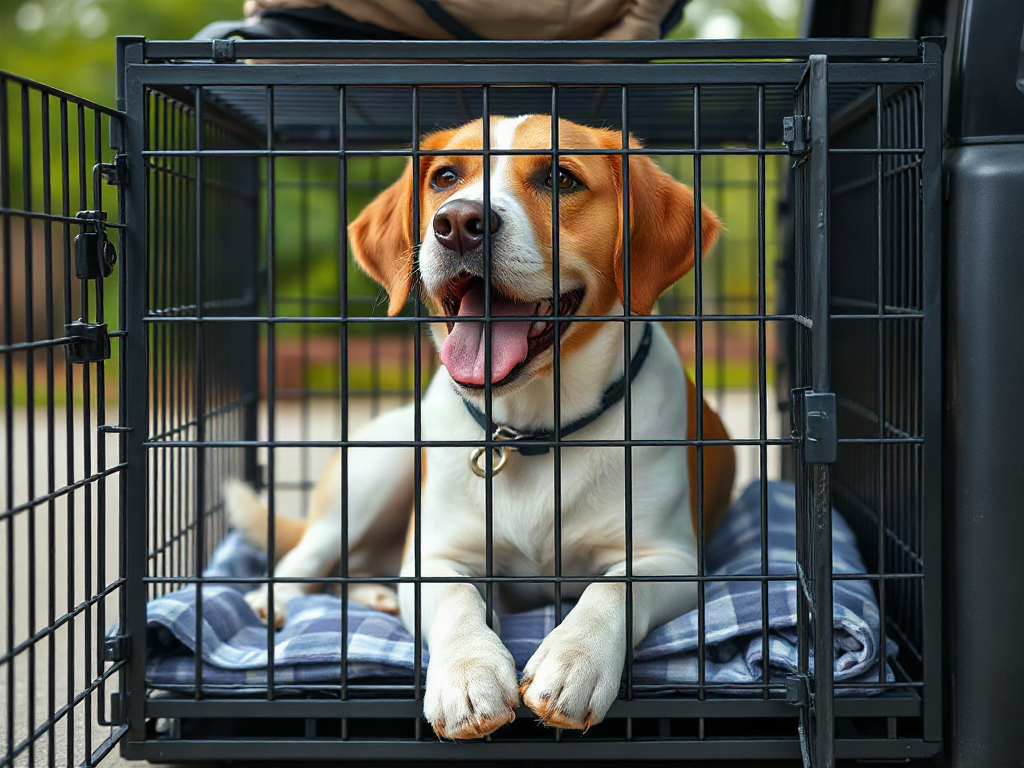
Heavy-duty dog crates for powerful chewers work best when rigid steel construction, protected welds, recessed locks, and closely spaced bars resist concentrated bite and paw pressure without creating sharp failure points. A secure crate must also fit the dog correctly, provide adequate ventilation, and use a floor and tray that cannot be pulled through the frame. Thick metal alone is not enough if exposed latches, wide gaps, weak hinges, or removable hardware remain within reach. Inspect the crate after every escape attempt, and address anxiety or confinement distress because stronger containment does not resolve the behavior driving destructive chewing.
Match Construction to the Dog’s Escape Method
Destructive crate behavior is rarely limited to chewing one flat surface. A determined dog may bite bars, rake the door with its front paws, push against corners, lift a loosely seated tray, or work a latch repeatedly. Identifying that pattern before buying matters because different structures fail in different ways. A wire crate may withstand ordinary mouthing yet deform when a strong dog pulls two adjacent wires together. A rigid metal enclosure may resist bending but still be vulnerable if its lock projects into the interior.
Watch what happens during a short, supervised confinement period rather than testing the dog through a long absence. Tooth marks near the door suggest that the lock area and door frame need particular attention. A shifted crate, bent lower panel, or damaged floor indicates force from pushing and digging. Scrapes high on the door can reveal jumping or climbing. Stop the observation if the dog is escalating, panting heavily without heat, drooling excessively, vocalizing continuously, or injuring the mouth or paws. Those signs call for behavioral or veterinary assessment, not a longer durability test.
Construction categories involve meaningful tradeoffs. Standard folding wire models offer airflow, visibility, and convenient storage, but their thin wires, folding seams, and protruding latch parts can give an intense chewer several purchase points. Molded plastic shells reduce exposed bars and may suit some transportation settings, although persistent chewing around ventilation openings or the door can damage them. Heavy welded-steel enclosures provide greater resistance to bending and leverage, but they are heavier, harder to move, and not automatically approved for vehicle restraint or air transport.
For example, a dog that merely gnaws a wire panel from boredom may do well after enrichment and crate-conditioning changes, without an industrial enclosure. A dog that has already bowed panels, opened sliding latches, or forced a folding seam presents a different containment problem. In that case, compare Heavy-duty dog crates for powerful chewers by the exact points the dog has attacked rather than by weight, appearance, or a broad “escape-proof” label.
The common mistake is treating the dog’s body weight as a complete measure of required strength. Jaw placement, persistence, paw use, and the ability to create leverage are often more revealing. Record where damage occurs, how quickly escalation begins, and whether the behavior appears only when the dog is left alone. That evidence helps separate a construction mismatch from distress that stronger steel could contain but not solve.
Examine Bars, Welds, Doors, and Locks
A durable enclosure is only as reliable as its most accessible connection. Steel gauge or tube diameter can be useful comparison details, but neither describes the whole assembly. Closely spaced members reduce the room available for a dog to insert its muzzle and pull. Rounded interior surfaces offer less purchase than exposed edges. Continuous, clean welds at high-load joints are generally preferable to sparse attachment points that can twist independently under repeated force.
Run a hand carefully over the interior before use. Look for welding spatter, sharp corners, unfinished tube ends, exposed bolt threads, and gaps that narrow toward one end. A dog’s tooth, nail, toe, collar tag, or jaw can become trapped where spacing is poorly controlled. Press and pull the door at each corner while it is locked; excessive movement may allow a dog to worry the opening until the latch shifts. The test should reveal flex, not attempt to destroy the product.
Door design deserves more attention than the number of locks. Two weak surface bolts do not necessarily outperform one protected mechanism. A useful lock is difficult for a tongue or paw to manipulate, seats fully without careful alignment, and remains engaged when pressure is applied to the opposite corner of the door. Hinges should be shielded or built so the door cannot be lifted off when closed. If a safety catch depends on a small removable clip, consider whether the dog can reach it and whether caregivers will consistently reinstall it.
Use this compact pre-purchase inspection:
- Interior access: Identify every latch, fastener, seam, and tray edge the dog can reach.
- Gap control: Reject openings that could admit the dog’s muzzle, lower jaw, paw, or collar hardware.
- Door loading: Check whether pushing one corner creates a usable opening elsewhere.
- Floor retention: Confirm that digging cannot lift or eject the floor or waste tray.
- Finish quality: Look for peeling coatings, corrosion, burrs, and damaged welds.
Powder coating can make steel easier to clean and protect it from routine moisture, but it is not a chew-proof structural layer. Once teeth breach the finish, loose flakes and exposed metal require attention. Stainless steel may offer better corrosion resistance in damp environments, usually with a higher price and substantial weight. Painted mild steel can be practical indoors if the finish remains intact and cleaning products are compatible with it.
A frequent buying error is comparing headline material claims while ignoring assembly quality. Thick tubing paired with a flexible door, exposed lock, or thin floor is still a system with an obvious weak point. Prioritize safe geometry and reliable connections before cosmetic finish, wheel count, accessory packages, or an unverified strength label.
Balance Strength With Fit, Ventilation, and Daily Use
Containment strength cannot compensate for poor fit or an unsuitable environment. The dog should be able to stand without crouching, turn around without scraping the sides, and lie in a natural resting position. Excess space is not automatically safer: a very large enclosure may let an agitated dog build momentum before striking a door. Too little room, however, restricts posture and can intensify discomfort during any extended period of confinement.
Measure the individual dog rather than relying only on breed or weight charts. Compare standing height, nose-to-rump body length, and normal sleeping posture with the manufacturer’s interior dimensions—not the package dimensions or the outer frame. If the crate includes raised floor bars, a tray lip, or an inward-opening mechanism, account for the usable space those parts remove. Puppies need reassessment as they grow; a divider must be sturdy and inaccessible if the puppy attacks panel edges.
Ventilation should remain open on multiple sides and must not be obstructed by walls, luggage, blankets, or fitted covers. Metal can become hot in direct sun and cold in unconditioned spaces, so crate material does not make a garage, cargo area, or parked vehicle safe. Position the enclosure on a stable, level surface away from cords, curtains, heaters, and objects a dog could pull through the openings. Locking casters are convenient for a large unit, but wheel brakes are not a substitute for a stable base when a dog throws its weight against the frame.
Bedding requires individual judgment. A dog that swallows torn fabric should not be left with a thick pad simply because the crate floor looks uncomfortable. Start with a correctly fitted, durable surface that lies flat and cannot be dragged into a corner, then supervise its introduction. Remove it if seams open, stuffing appears, or the dog begins ingesting pieces. A bare removable tray may be safer temporarily for a fabric eater, but check that it is nonslip, intact, and comfortable enough for the planned confinement duration.
Home crates and transport crates should not be assumed to perform the same job. A large welded enclosure may be appropriate as a stationary indoor management space yet unsuitable for air travel, where the carrier must meet the airline’s current requirements. It also should not be treated as a crash-tested vehicle restraint without product-specific evidence and correct installation. Readers comparing Heavy-duty dog crates for powerful chewers for travel should verify dimensions, tie-down instructions, door security, and carrier acceptance directly with the relevant transport provider.
The practical goal is a crate that caregivers can operate correctly every time. A door that requires awkward alignment or a unit too heavy to clean may lead to incomplete locking and neglected inspections. Strength, safe fit, manageable cleaning, and intended location belong in the same decision—not in separate shopping stages.
Inspect the Crate and Respond to Failure Signs
Repeated inspection is part of using a high-strength crate safely. Powerful chewing applies concentrated, cyclical force rather than one obvious impact. A connection may loosen gradually, a weld can begin to crack, or a coating may lift around a frequently bitten area. Examine the enclosure before confinement and after any episode of intense biting, digging, or door striking.
Start at the dog’s usual attack point, then inspect the rest of the structure systematically. Look for a door that no longer sits square, shiny metal where components have rubbed, hairline separation beside welds, bent members, loose fasteners, latch resistance, rust, and sharp finish damage. Check the underside and removable tray as well; floor damage is easy to miss when the crate stays in one position. If hardware is designed to be tightened, follow the manufacturer’s instructions rather than improvising with parts that could project into the occupied space.
Stop using the crate when deformation creates a widening gap, a lock no longer seats fully, a weld separates, a bar or tube cracks, or any sharp edge becomes reachable. Moving the dog to another secure area is safer than adding wire, carabiners, zip ties, or household padlocks without understanding the new entanglement risks. Aftermarket fixes can introduce narrow loops, protruding ends, or emergency-release delays. Manufacturer replacement parts are generally preferable when repair is permitted, but major structural damage often warrants replacement.
Behavioral progress should be monitored alongside metal condition. A safer pattern includes entering voluntarily, settling after normal activity, accepting brief door closure, and remaining relaxed as duration increases gradually. Failure signs include frantic escape behavior, broken teeth, bleeding gums, torn nails, heavy drooling, elimination linked to panic, or escalation as departure cues appear. A veterinarian can assess pain or medical contributors, while a qualified behavior professional can help evaluate separation-related distress or confinement sensitivity.
Do not use a stronger crate as punishment after damage. That pairing can make the enclosure predict isolation or conflict, increasing the pressure placed on its doors and walls. Feed appropriate items near or inside the crate when safe, practice short sessions while someone remains nearby, and increase time only when the dog is calm. Chews must be correctly sized, appropriate for the individual dog, and tested under supervision before being left in the enclosure.
Keep purchase records, assembly instructions, and photographs of developing wear. Photos make subtle changes easier to compare and provide useful information when contacting the manufacturer. The best result is not a crate that survives repeated panic; it is an intact enclosure used within a management and training plan that reduces destructive attempts over time.
Frequently Asked Questions
Can a Heavy-Duty Crate Be Completely Escape-Proof?
No crate should be treated as completely escape-proof. Dogs differ in strength and persistence, and locks, welds, floors, or fasteners can deteriorate. Supervised introduction and regular inspection remain necessary.
Is Steel Bar Spacing More Important Than Bar Thickness?
Both matter. Thick members resist bending, while safe, close spacing limits muzzle and paw access and reduces leverage. The door, welds, locks, and floor must be evaluated as part of the same structure.
Should Bedding Be Used for a Dog That Destroys Fabric?
A dog that tears or swallows fabric may need a different fitted surface or temporary use without soft bedding. Introduce any mat under supervision and remove it if seams open or pieces are ingested.
Can a Heavy Steel Crate Be Used in a Vehicle?
Weight and strength alone do not establish crash protection. Use a product for vehicle transport only when its design, installation method, dimensions, and restraint instructions are suitable for that purpose.
What Should I Do If My Dog Panics Inside the Crate?
End the unsafe confinement, check for injury, and avoid repeating a long session. Seek veterinary input and qualified behavioral help when panic, self-injury, heavy drooling, or persistent escape attempts occur.
Conclusion
Selecting a crate for a forceful chewer requires more than choosing the heaviest model available. Map the dog’s actual biting, pawing, pushing, and latch-working behavior, then inspect whether the enclosure protects every accessible connection. Safe spacing, reliable locks, sound welds, a retained floor, correct interior dimensions, and unobstructed ventilation deserve priority over cosmetic features.
Before regular use, test operation without the dog, examine the interior for trapping and cutting hazards, and introduce confinement in short, calm sessions. Recheck the structure after every destructive attempt and retire it when gaps, cracks, sharp edges, or unreliable locking appear. If behavior indicates panic rather than ordinary chewing, move beyond containment and obtain appropriate veterinary or behavioral support. The soundest choice combines durable construction with realistic placement, consistent inspection, and a plan that reduces the dog’s need to fight the enclosure.