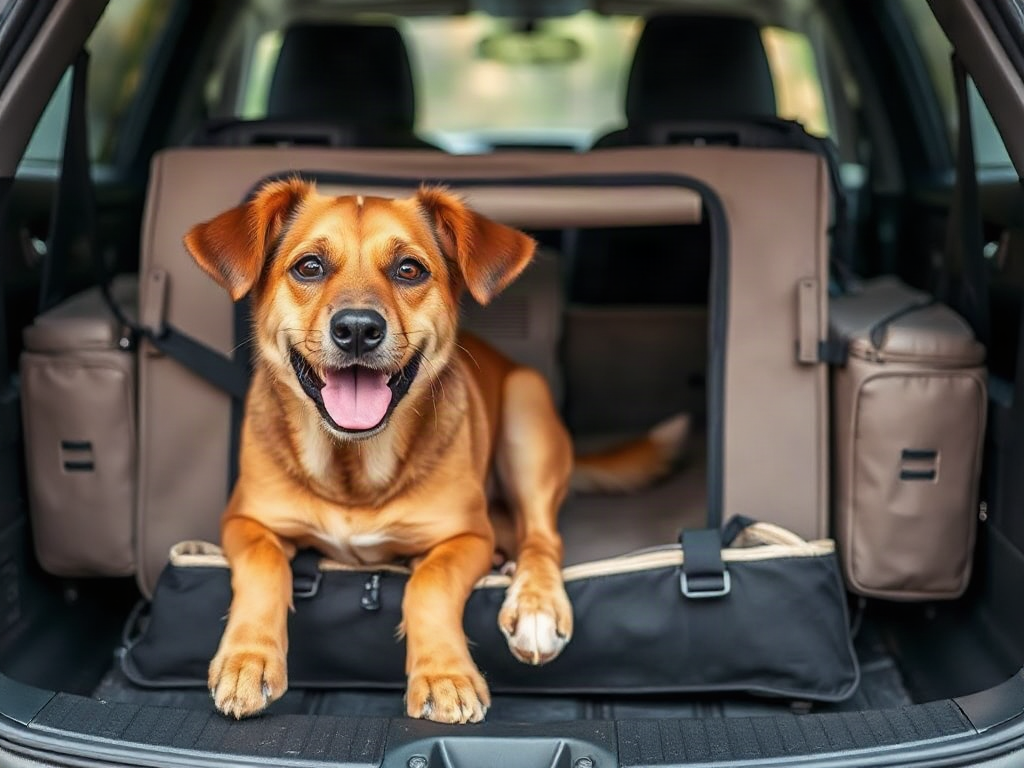
Soft dog crates that work for car travel need a stable vehicle fit, strong anchor points, secure zippers, and enough structural support to resist folding during routine braking and turns. Choose a crate that lets the dog stand, turn, and lie naturally without leaving excessive room to slide, then restrain it according to the manufacturer’s instructions. Mesh ventilation and washable bedding improve everyday comfort, but they do not make a crate crashworthy. A soft crate is most appropriate for a calm, crate-trained dog on ordinary drives; escape-prone dogs and situations requiring verified crash protection call for a more protective restraint system.
Where a Soft Crate Fits—and Where It Does Not
A soft-sided crate is primarily a containment and comfort enclosure, not automatically a crash-protection device. Its collapsible frame, fabric walls, and mesh panels make it convenient to carry and store, but those same components generally provide less impact protection than a purpose-built rigid travel crate or tested vehicle restraint. Unless a manufacturer documents a specific test protocol and installation method, do not assume labels such as “automotive,” “heavy duty,” or “travel ready” establish crashworthiness.
The best use case is a calm dog that already rests comfortably in an enclosed crate. On a routine drive to a trail, rental property, or family visit, a properly secured soft crate can limit roaming, keep paws away from vehicle controls, and give the dog a familiar resting area. It should not sit loose on a seat or in an open cargo area. During a sharp stop, an unsecured enclosure can move even if the dog remains inside.
Temperament changes the decision. A dog that claws mesh, bites zipper tracks, pushes forcefully against doors, or panics when confined can damage a soft crate quickly. Repeated scraping, stretched seams, or a zipper that separates under pressure are failure signs rather than training inconveniences. A rigid crate may be more appropriate for that dog, although no enclosure substitutes for gradual acclimation to confinement.
Vehicle layout matters as much as dog behavior. A soft crate may work well on a flat cargo floor in an SUV when the manufacturer permits that position and suitable tie-down points are available. It may be unstable on a deeply contoured rear seat, where the base bridges the cushion and tilts toward the footwell. Cargo placement behind the rear seat also requires careful attention to airflow, heat, and the risk posed by loose luggage.
Use Soft dog crates that work for car travel as a practical category rather than a blanket safety claim. Prioritize verified installation instructions, a compatible location, and honest limits. If documented crash performance is the main goal, compare the soft crate with rigid vehicle crates and restraint products whose makers clearly identify the testing standard, configuration, and size tested.
Measure the Dog and Vehicle Before Buying
Correct sizing balances natural posture against unnecessary movement. Measure the dog while standing from the floor to the highest point of the head or ears, whichever is taller, and from the nose to the base of the tail. Check shoulder width at the broadest point. Add enough clearance for the dog to enter, stand without crouching, turn around, and lie in a normal position, but avoid treating the largest crate that fits the vehicle as the safest choice.
Dog dimensions are only half of the fit calculation. Measure the intended installation area at its narrowest and lowest points, including the rear hatch opening, sloping seatbacks, wheel-well intrusion, roofline, and door clearance. Record the usable floor footprint rather than relying on the vehicle’s advertised cargo volume. A crate can fit inside the cargo compartment yet fail to pass through the hatch, or its door can become unusable once the liftgate closes.
Check the crate’s external dimensions in its assembled form. Product size labels may describe the nominal model or interior space, while hinges, handles, feet, and tensioned fabric add to the exterior envelope. If installing on a rear seat, inspect the cushion angle and front-seat position. A crate that fits only when the driver moves forward or when a head restraint is removed is not a dependable setup.
Consider a medium dog measuring 25 inches from nose to tail base and 23 inches to the ear tips. A crate with a 24-inch internal height may look suitable on a product page but leave almost no posture clearance once a padded mat is added. Moving up one size could solve the height problem while making the crate too wide for secure placement. The better answer may be a different model with a taller, narrower profile rather than a larger version of the same design.
Use a compact pre-purchase check:
- Dog fit: normal standing height, turning space, shoulder clearance, and lying length.
- Vehicle fit: floor footprint, opening dimensions, roof slope, seat contour, and closed-door clearance.
- Installation fit: reachable anchor locations and unobstructed restraint paths.
- Operating fit: usable crate door, visible ventilation panels, and access for emergency removal.
Return or exchange the crate if it rocks, twists, blocks the driver’s view, or cannot be restrained as instructed. Compressing the soft walls to force a fit can distort the frame and place constant stress on seams and zippers. Dimensions should leave enough clearance for proper assembly without allowing the enclosure to migrate around the cabin.
Inspect the Frame, Fabric, Doors, and Anchor Points
Construction quality determines whether a soft crate remains functional under ordinary vehicle movement. The frame should lock or tension into its operating shape without bowed rails, sharp exposed ends, or joints that collapse when the crate is nudged. Press gently at the roof corners and door frame. Some flex is expected, but the opening should retain its shape and the base should stay flat.
Fabric and mesh require separate inspection because they fail differently. Dense fabric around the lower walls can resist routine abrasion from nails, while open mesh supports airflow and visibility. Large mesh panels are comfortable for a settled dog but provide inviting surfaces for a dog that scratches. Look for reinforced stitching where mesh joins solid fabric, especially near door corners and frame sleeves. Loose thread loops, puckered seams, and exposed binding edges can worsen with repeated folding.
Zipper security deserves more attention than the number of doors. Two-way zippers make access convenient, but sliders that meet in the middle may be moved by a persistent nose or paw. A built-in zipper clip or another manufacturer-approved closure can reduce accidental opening. Do not improvise with hardware that creates a snag point inside the crate or prevents rapid access during an emergency. Run each zipper around the full track before use; resistance at a corner often becomes worse when the fabric is under tension.
Anchor points must be structural and specifically intended for restraint. A carry handle, accessory loop, mesh tab, or storage-pocket strap is not necessarily designed to hold the crate in place. Read the manual to identify approved attachment locations and whether a vehicle seat belt, tether, or cargo tie-down may be used. Pulling a belt tightly around unsupported fabric can crush the crate or obstruct its door without producing a reliable installation.
Removable floor inserts and washable covers improve cleanup after muddy walks or motion sickness. The floor should remain flat beneath the dog and should not slide out of position when the crate is tilted. Thick plush beds can reduce usable height, trap heat, and bunch against a door; a fitted, low-profile mat is usually easier to assess and wash. Inspect foam and panels after every spill because retained moisture can encourage odor and fabric deterioration.
A useful evaluation of Soft dog crates that work for car travel separates convenience features from containment features. Pockets, curtains, and multiple entrances improve usability, while intact seams, dependable closures, stable framing, and genuine restraint interfaces determine whether the crate performs its basic job. Reject any model whose manual does not explain assembly, weight or size limits, care, and intended restraint method clearly enough to follow.
Install and Test the Crate in the Car
Installation should follow the crate maker’s directions and the vehicle owner’s manual rather than a universal belt-routing trick. Place the assembled crate in the approved seating or cargo position, orient it as directed, and connect only to identified restraint points. Keep straps flat and free of twists. Tighten them enough to remove slack without deforming the frame or placing zipper tracks under uneven tension.
Run a stationary movement test before putting the dog inside. Push the crate forward, backward, and sideways with moderate hand pressure. The base should remain planted, the restraint should stay engaged, and the frame should not rotate into a door, window, or seatback. Recheck that the dog’s entry door opens fully and that a human can release the restraint promptly. A setup that requires unloading all luggage before reaching the crate creates a practical problem during an urgent stop.
Next, conduct a short drive with the empty crate. Include normal turns and gentle braking, then stop and inspect strap tension, base position, frame joints, and any contact marks. Rattling may indicate a loose frame component, while a crate that creeps across the seat suggests poor base contact or an unsuitable location. Do not test abrupt braking deliberately on public roads. The purpose is to uncover routine installation movement without creating a hazard.
When the empty setup remains stable, add the dog for a brief familiar route. Have another adult observe if possible, but never compromise the driver’s attention. Panting unrelated to temperature, repeated turning, frantic digging, drooling, vomiting, or sustained attempts to escape indicate that the drive or confinement setup needs adjustment. A quiet dog lying down and changing position without being thrown against the walls is a more useful success sign than simple silence, because a fearful dog may also become still.
Keep hard luggage, tools, water containers, and folding equipment from sharing unsecured space with the crate. During braking, those objects can strike the enclosure or block ventilation. Cargo barriers do not necessarily restrain individual items, so secure each load according to the vehicle and product instructions. Avoid placing the crate where side-curtain airbags or seat operation could be obstructed; consult the vehicle manual when the deployment zone is unclear.
Recheck installation after folding and reassembling the crate, switching vehicles, or changing seat positions. Fabric tension and strap routing can differ after storage. A photo of the correctly installed setup can help reproduce it, but it does not replace checking the manual. If the crate cannot be stabilized without improvised attachments, choose a different crate or restraint rather than accepting movement as an unavoidable feature of soft construction.
Manage Comfort, Heat, and Behavior on the Road
Comfort depends on airflow, temperature, posture, and prior crate experience—not padding alone. Position mesh panels where vehicle ventilation can reach them without exposing the dog to a forceful stream of hot or cold air. Sunlight through rear glass can warm a cargo area even when the front seats feel comfortable, so assess conditions where the crate actually sits. A fan or reflective cover should never be used as justification for leaving a dog unattended in a parked vehicle.
Acclimation should begin outside the car. Set up the crate at home, secure its frame, and allow the dog to enter voluntarily for short periods. Feed treats or a meal inside if that agrees with the dog, then practice closing the door briefly while remaining nearby. Move to sessions in the parked car with the climate controlled, followed by short drives. Pushing directly to a long road trip can turn ordinary vehicle motion, confinement, and unfamiliar sounds into one difficult experience.
Plan breaks around the individual dog’s age, health, bladder needs, and comfort rather than a rigid universal interval. Stops should allow controlled water access, toileting, and a brief movement break in a safe location. Attach the leash before opening the crate door if the vehicle layout permits, and keep exterior doors closed until the dog is under control. A soft crate door opening toward an open hatch can create a direct escape route at a busy rest area.
Motion sickness and travel anxiety may look similar but are not interchangeable. Drooling, lip licking, retching, vomiting, trembling, or refusal to enter the vehicle warrants attention, particularly when signs persist across gradual practice sessions. A veterinarian can help assess health, nausea, or anxiety concerns and discuss an appropriate plan. Do not give sedating or motion-sickness products without veterinary direction, and do not assume covering the crate will solve every stress response.
Inspect the enclosure at each break on a longer drive. Feel for unusual heat, check that mesh remains unobstructed, confirm zippers and clips are closed, and examine restraint tension. Look for frayed mesh, stretched seams, bent frame sections, damp bedding, or a base that has shifted. Retire the crate when damage affects containment or assembly; tape and household clips are poor substitutes for intact structural components.
Owners comparing Soft dog crates that work for car travel should treat calm behavior as part of compatibility, not proof that every setup is safe. A dog may enjoy the enclosure while the crate remains improperly anchored. Combine behavioral readiness with repeatable installation, adequate airflow, and a clear plan for loading, stops, and emergency access.
Frequently Asked Questions
Are soft dog crates safe for car travel?
They can provide everyday containment when properly sized and secured, but soft construction does not automatically provide crash protection. Check the maker’s documented testing and installation instructions rather than relying on a general safety label.
Can a soft crate be placed on a rear seat?
Only if the model permits that position, sits level on the seat, and can be attached through approved restraint points. Deeply contoured or narrow seats may make the installation unstable.
How much room should a dog have inside the crate?
The dog should be able to stand naturally, turn around, and lie comfortably. Avoid excessive unused space, and account for the height and floor area lost when adding a mat.
Can a seat belt be wrapped around any soft crate?
No. Use a seat belt only when the manufacturer identifies an approved routing method. Wrapping it around unsupported walls may crush the frame and does not establish reliable restraint.
Which dogs should not use a soft travel crate?
Persistent chewers, mesh scratchers, escape artists, and dogs that panic under confinement may need a sturdier alternative and a gradual behavior plan. Visible damage or repeated escape attempts mean the setup is failing.
Conclusion
A useful soft car crate must fit both the dog and the installation area without being squeezed into place. Measure the hatch and usable floor space, verify that the dog can move naturally, and inspect the frame, mesh seams, zipper controls, floor, and designated anchor points. Follow the manufacturer’s restraint method, test the empty installation, and then introduce short drives before attempting a longer route.
Convenient folding and ventilation make soft crates attractive, but neither feature establishes impact protection. Choose a rigid or otherwise documented restraint option when crash performance, destructive behavior, or unstable vehicle geometry makes soft construction a poor match. Before every departure, check attachment tension, airflow, nearby cargo, door access, and fabric damage. A setup is working only when it remains stable and the dog travels without overheating, distress, or attempts to break through the enclosure.