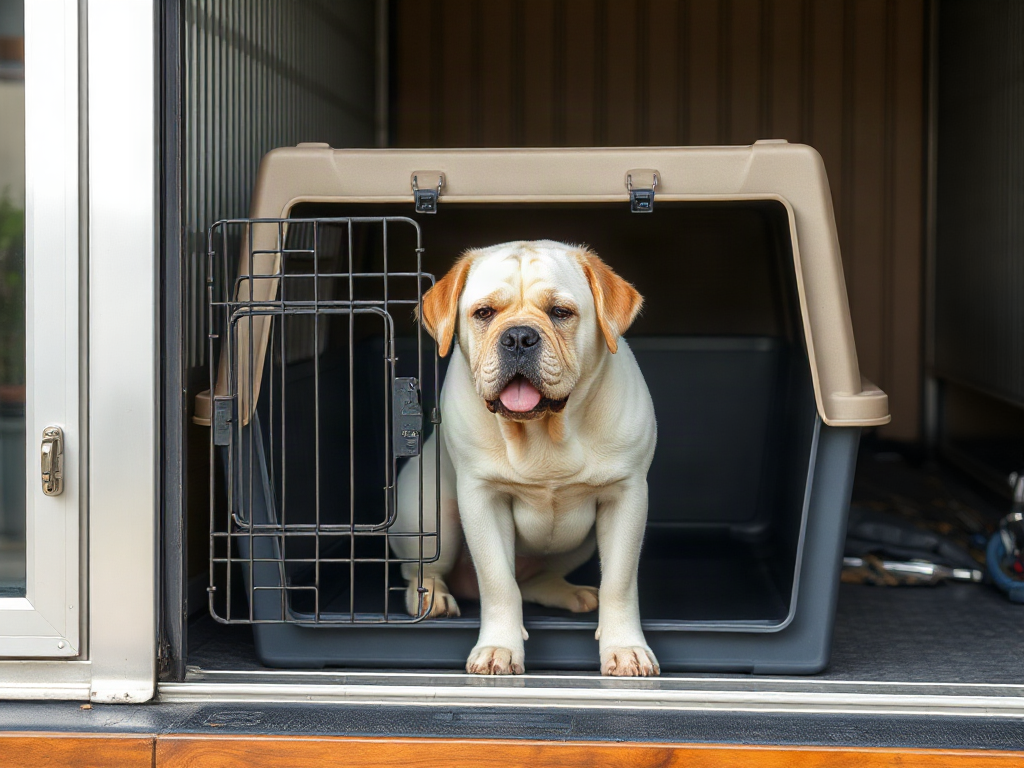
A dog crate is usually a compact enclosure designed for indoor confinement, training, sleeping, or transportation, while a kennel may mean either a larger stationary enclosure or a facility where dogs are housed. Crates commonly use wire, molded plastic, fabric, or metal and are sized for a dog to stand, turn, and lie down comfortably. Outdoor kennels generally provide more movement but require secure fencing, shelter, drainage, and weather protection. Because retailers and transport providers sometimes use both words for the same product, choose according to dimensions, construction, security, ventilation, and intended location rather than relying on the label alone.
What Crate and Kennel Usually Mean
The word crate normally describes a relatively compact enclosure that can be used inside a home or moved between locations. Familiar examples include folding wire crates, rigid plastic transport crates, soft-sided fabric crates, and reinforced metal models. A crate gives a dog enough room to assume natural resting positions, but it is not intended to function as an exercise area.
Kennel has a broader and less consistent meaning. It can describe an outdoor run attached to a sheltered sleeping area, a freestanding fenced enclosure, or a commercial boarding or breeding facility. Manufacturers and airlines may also call a rigid transport crate a kennel. A product listed as an “airline kennel,” for example, is generally a portable transport enclosure rather than a spacious outdoor run.
That overlap explains why the Difference between a dog crate and kennel cannot be determined from product names alone. The useful distinction comes from examining the object itself: Is it portable or permanently installed? Does it provide a resting compartment or room for extended movement? Will it be used indoors, in a vehicle, on an aircraft, or outdoors? Those questions reveal more than the noun printed on the packaging.
A common mistake is assuming that “kennel” automatically means larger, stronger, or more humane. A molded travel kennel may be smaller than a household wire crate, while a poorly built outdoor kennel may provide ample floor area but inadequate shelter or security. Neither term establishes quality. Dimensions, materials, fasteners, ventilation, floor design, and escape resistance determine whether the enclosure suits its actual job.
Context also changes what confinement means for the dog. A household crate may serve as a quiet sleeping location and a short-term management tool. An outdoor kennel gives more room to walk but exposes the dog to temperature changes, moisture, wildlife, noise, and possible digging or climbing. A boarding kennel is a managed service environment, not a product category. Readers comparing options should therefore treat “crate” as the more specific equipment term and “kennel” as a label that requires clarification.
How Their Construction and Space Differ
Crates are generally built around portability, controlled interior space, and convenient access. Folding wire models offer broad airflow and visibility, molded plastic models provide a more enclosed shell, and soft-sided versions reduce carrying weight. Reinforced metal crates place greater emphasis on resisting bending or escape attempts. These designs differ considerably, but most can be repositioned without dismantling a permanent structure.
A conventional crate should allow the dog to stand without crouching, turn around without becoming wedged, and lie in a natural posture. More space is not automatically better for every purpose. During housetraining, an oversized interior may let a puppy sleep at one end and eliminate at the other. During transport, excessive unused space can permit uncontrolled movement. A divider can make a wire crate more adaptable as a puppy grows, but it does not change the crate’s external footprint or make it suitable for every vehicle.
Outdoor kennels are designed around usable floor area and environmental exposure. Their panels may be made from welded wire, chain-link material, or rigid bars, often anchored to a frame or base. A complete setup may also need a roof, a sheltered sleeping compartment, shade, weather-resistant flooring, and drainage that prevents standing water. The enclosure must account for behaviors that a portable crate rarely faces, including digging beneath panels, climbing corners, pushing at gates, and chewing exposed connections.
Consider a medium-sized dog that rests calmly in a wire crate overnight but spends part of a mild afternoon in an outdoor run. The crate needs correct body clearance, a reliable latch, and a safe resting surface. The run needs enough area for movement plus protection from sun, rain, ground moisture, and unauthorized access. Substituting the crate for the run could create prolonged-confinement and weather concerns; substituting the run for the crate would not provide a practical restraint system inside the home or car.
Construction should also match the dog rather than an idealized breed profile. A determined escape artist may deform light wire, open a simple latch, or tear mesh fabric. A dog that chews bedding may ingest loose foam or fibers. Conversely, a heavy reinforced enclosure can be unnecessarily difficult to carry for a calm dog that only needs supervised indoor containment. Signs of poor matching include bent bars, clawing at seams, repeated latch contact, damaged teeth, persistent panic, or an inability to settle. Those signs call for reassessing the enclosure and the dog’s response, not merely buying a larger version of the same design.
Which Enclosure Fits Each Use
The intended activity should determine the enclosure before convenience, appearance, or terminology enters the decision. For sleeping and short periods of household management, a correctly sized crate is usually the practical format. It can limit access to hazards, create separation during deliveries, and provide a predictable resting place. It should not replace exercise, social contact, toilet breaks, or attention to distress.
Vehicle and air transport impose separate constraints. A collapsible household crate that works beside a bed is not automatically appropriate for a moving vehicle, and a soft carrier accepted in one travel setting may not meet another provider’s conditions. Vehicle placement, restraint or anchoring options, door security, ventilation, and structural behavior all matter. For flights, travelers should obtain the current carrier-specific requirements before purchasing because route, aircraft, animal, and handling arrangements can affect acceptance. A seller’s broad “airline approved” wording is not a substitute for confirmation from the operating airline.
An outdoor kennel is more appropriate when a dog needs a secure open-air area larger than a crate. It may work for supervised yard time, temporary separation from contractors, or controlled access to an unfenced property. It does not make heat, cold, storms, toxic plants, parasites, or theft irrelevant. Shade can shift during the day, metal surfaces can become hot, and a roof that blocks rain may still trap heat if airflow is poor. Long periods outdoors also require water, monitoring, sanitation, and suitable human contact.
A boarding kennel serves a different need altogether: temporary care by a business or organization. Owners evaluating one should look beyond the name and ask how dogs are housed, exercised, monitored, separated, and handled during feeding or emergencies. A facility’s individual sleeping compartments might themselves be called kennels, runs, or suites. Those labels reveal little about cleanliness, staffing practices, noise management, or the dog’s daily routine.
A useful use-case comparison is:
- Indoor rest or management: a household crate with appropriate dimensions and a secure door.
- Routine transportation: an enclosure selected for the vehicle or transport provider’s specific conditions.
- Outdoor movement: a properly installed kennel with shelter, drainage, shade, and escape controls.
- Care away from home: a boarding facility evaluated through its procedures rather than its name.
The mistake to avoid is buying one enclosure and expecting it to perform every role. A fabric crate may be convenient in a hotel for a dog already comfortable with confinement, yet unsuitable for an animal that scratches or chews when left alone. A large yard kennel may offer movement but cannot secure a dog during a road trip. Matching the enclosure to a single defined job produces a clearer and safer decision than searching for a universal product.
How to Evaluate a Crate or Kennel
Evaluation should begin with the dog, the setting, and the duration of use. Measure the dog in a natural standing position and compare those measurements with the manufacturer’s interior dimensions, not merely a broad weight range. Weight labels can be misleading because two dogs of equal weight may have very different height, body length, and proportions. For travel, confirm how exterior dimensions affect placement or acceptance as well.
Next, inspect the containment points. Doors should close without alignment problems, and latches should be inaccessible or difficult for the particular dog to manipulate. Wire ends, sharp edges, narrow gaps, protruding fasteners, and unstable floors deserve close attention. Ventilation openings should provide airflow without creating spaces that can catch a collar, jaw, paw, or claw. Removing collars or harnesses may reduce snagging risk in some unattended enclosure situations, but travel providers may have their own identification and handling instructions.
Use this compact decision check before buying or installing either option:
- Define the job: indoor rest, household management, road transport, air transport, outdoor access, or boarding.
- Verify usable dimensions: check standing height, body length, turning room, doorway size, and any external space limit.
- Match construction to behavior: account for chewing, pushing, digging, climbing, latch manipulation, and separation distress.
- Assess the environment: review airflow, temperature, shade, drainage, anchoring, vehicle placement, and supervision.
- Test gradually: observe entry, settling, posture, breathing, vocalization, and attempts to escape before relying on extended use.
A suitable setup is indicated by comfortable posture, normal entry and exit, the ability to settle, intact hardware, and stable placement. Repeated frantic escape behavior, heavy drooling unrelated to heat, self-injury, damaged teeth, torn fabric, bent panels, or refusal to enter signals a problem. Those reactions may reflect fear, isolation distress, inadequate acclimation, physical discomfort, or an unsuitable enclosure. Forcing longer confinement can worsen both the behavior and the injury risk; a veterinarian or qualified behavior professional may be needed when distress is intense or persistent.
Maintenance is part of suitability. Check hinges, locks, seams, wire joints, plastic cracks, corrosion, anchors, roofing, and flooring on a regular schedule. Clean with products appropriate for the material, rinse residues as directed, and dry the enclosure before reuse. Outdoor installations need additional checks after severe weather and as the ground shifts. A gate that worked smoothly at installation can bind later, while a small gap under a panel can become an escape route after digging or erosion.
Price should be considered against expected use rather than treated as a direct measure of safety. Frequent travelers may benefit from durable hardware and easy-clean surfaces; occasional supervised users may not need the heaviest model. The practical lesson from the Difference between a dog crate and kennel is to prioritize verified function, fit, and condition over category labels or marketing claims.
Frequently Asked Questions
Can the words crate and kennel refer to the same product?
Yes. Retailers, airlines, and owners sometimes call a rigid portable enclosure either a crate or a kennel. Check its dimensions, materials, and stated use instead of relying on the product name.
Is a kennel always bigger than a crate?
No. An outdoor kennel is usually larger than a household crate, but a “travel kennel” may simply be a compact molded crate. The context determines the meaning.
Can a dog stay in an outdoor kennel all day?
An outdoor enclosure does not remove the need for exercise, social contact, water, sanitation, shelter, and weather monitoring. Appropriate duration varies with the dog, conditions, setup, and level of supervision.
Can a household crate be used for air travel?
Only if it satisfies the operating airline’s current requirements for that trip. Confirm dimensions, construction, ventilation, hardware, and documentation directly with the carrier before departure.
How can I tell whether an enclosure is too small?
The dog should be able to stand without crouching, turn without becoming wedged, and lie in a natural position. Measure the dog and compare the figures with usable interior dimensions.
Conclusion
Choose by function rather than by whether a seller uses “crate” or “kennel.” Define where the enclosure will be used, measure the dog, inspect the door and hardware, and account for behavior such as chewing, digging, climbing, or latch manipulation. A portable crate commonly fits indoor management or a specified transport role, while a stationary kennel can provide a larger outdoor area when it includes secure installation, shelter, drainage, and weather protection.
Test any new setup during short, observed sessions before depending on it. Comfortable posture and calm settling suggest the arrangement is workable; panic, injury, damaged components, overheating, or repeated escape attempts require prompt reassessment. For travel, verify current provider requirements directly. For persistent confinement distress, seek veterinary or qualified behavioral guidance rather than assuming a stronger enclosure will solve the underlying problem.