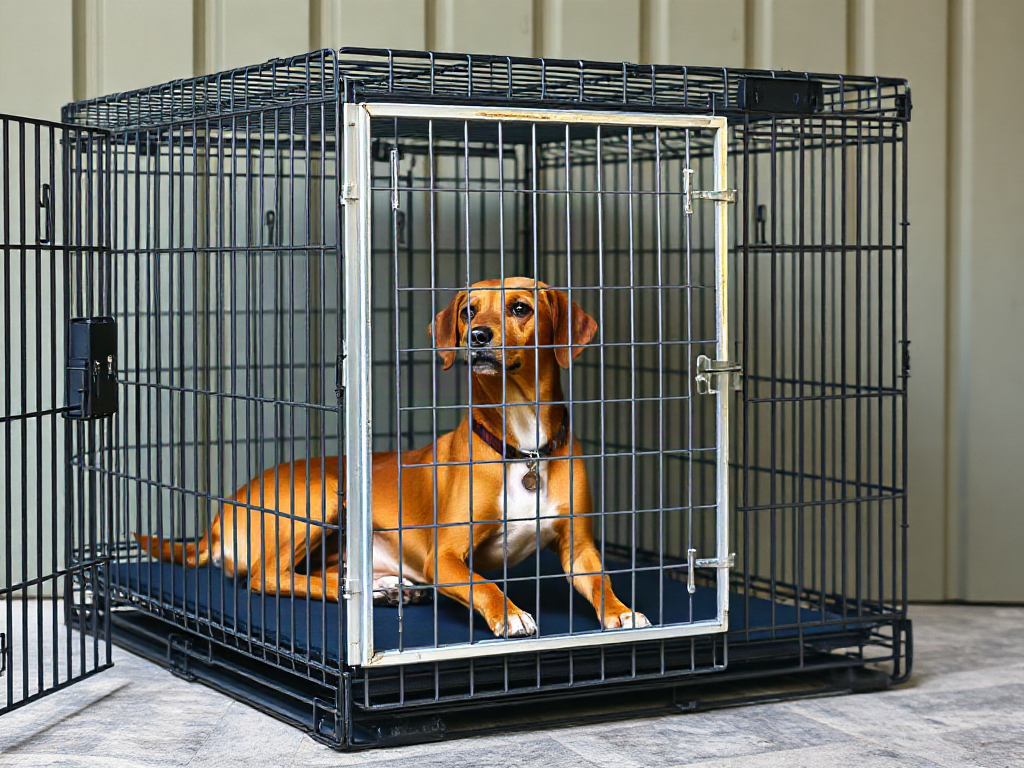
A used large dog crate is worth purchasing only after its frame, door, latch, floor, fasteners, and interior surfaces pass a hands-on safety inspection. Reject wire crates with spreading welds or sharp corrosion, plastic models with structural cracks, and reinforced crates with bent panels or unreliable hardware. Confirm that the assembled crate stays square, the door cannot lift free or spring open, and the floor supports the dog without bowing or sliding. Measure the usable interior rather than trusting the label, ask about prior damage or escape attempts, and disinfect an acceptable crate before introducing it to your dog.
Confirm the Crate’s History, Size, and Intended Use
A seller’s description rarely reveals how much stress a large crate has experienced. Ask whether it housed a calm crate-trained dog, an anxious escape artist, or several animals over time. Repeated biting, body-slamming, digging, and outdoor storage create different damage patterns. A crate that looks acceptable in a dim garage may have weakened welds, sun-brittled plastic, absorbed urine, or replacement hardware that does not match the original design.
Request the manufacturer, model name, approximate age, and reason for sale before traveling to inspect it. Original assembly instructions are useful because they show which clips, bolts, pins, braces, and floor components should be present. If the model cannot be identified, evaluate it as an unknown structure rather than assuming a familiar-looking latch or panel is original. Homemade repairs are not automatically unsafe, but wire ties, mismatched bolts, adhesive patches, and improvised clips deserve close scrutiny because they may conceal a failed connection.
Measure the crate’s actual interior length, width, and height. Size labels such as “large” and “extra-large” are inconsistent, while sloped walls, raised thresholds, and thick floor lips reduce usable space. The dog should be able to stand without lowering the head unnaturally, turn around without being compressed against the sides, and lie in a normal resting position. Excess space may be manageable for a relaxed adult dog, but it does not compensate for a low roof or narrow turning area.
Intended use changes the buying threshold. A stationary crate for supervised rest does not face the same loads as one carried through doorways or placed in a vehicle. Folding wire models offer ventilation and convenient storage, but worn hinges and panel hooks may loosen after repeated folding. Molded plastic shells provide more visual enclosure, yet impact cracks can spread around handles and fasteners. Reinforced metal designs may resist chewing, although their weight makes bent casters, damaged handles, and missing bolts especially consequential.
Bring the dog’s measurements and a tape measure rather than bringing the dog to an uncertain seller location. The broader principles in Used large dog crates: safety checks before purchase begin with matching the specific animal and use case, not merely finding a low price. Walk away if the seller will not allow full assembly, opening, measuring, or inspection.
Inspect the Frame and Structural Connections
The frame must remain rigid enough to keep panels aligned when a large dog leans, shifts, or pushes against them. Begin at one corner and follow every structural edge with your eyes and a gloved hand. Look for bent tubes, distorted wire grids, separated welds, cracked plastic ribs, elongated bolt holes, and areas that have been ground down or repainted. Fresh paint can improve appearance while hiding corrosion or repair work, so compare the finish around joints with less exposed areas.
On a wire crate, press moderately on the center of each panel and watch the weld intersections. Normal wire panels may flex slightly, but individual wires should not move independently or separate at their crossing points. Pay particular attention near the door, corners, folding hinges, and lower edge, where pushing and digging concentrate force. Rust-colored staining may be superficial, while flaky metal, pitting, thinning wire, or swelling beneath a coating indicates material loss. Sanding and repainting cannot restore metal that has already become structurally thin.
For a molded plastic crate, inspect both shell halves around ventilation openings, screw holes, handle mounts, and the door frame. A surface scratch is usually cosmetic; a crack that reaches an opening, edge, fastener, or molded rib can propagate when the shell is lifted. Press gently beside a suspected crack. Movement, whitening, or a faint opening under pressure suggests more than superficial marking. Avoid drilling new holes or trusting adhesive alone in a load-bearing area.
Reinforced aluminum or steel crates require attention to seams, rivets, bolts, and panel distortion. Set the unit on level ground. All feet or casters should contact the surface without rocking, and opposite corners should appear square. A bent body can prevent the door from seating consistently even if the material itself remains thick. Missing proprietary connectors are another warning sign; a hardware-store substitute may have the wrong diameter, head profile, thread engagement, or corrosion resistance.
A practical comparison helps: a lightly scratched crate with intact connections is generally a better candidate than a clean-looking crate with one spreading weld beside the door. Cosmetic wear affects appearance, but failed load paths affect containment. Use the structural portion of this Used large dog crates: safety checks before purchase inspection before negotiating price. If pushing one panel changes the door gap or makes a latch bind, the frame is no longer behaving as a stable assembly.
Test Doors, Latches, and Escape Points
The closure system should resist movement from inside without creating pinch or snag hazards. Open and close every door repeatedly while the crate sits fully assembled on a level surface. The door should travel smoothly, enter its frame without lifting or force, and remain aligned when light pressure is applied to an adjacent panel. Scraping, dropped hinges, or changing gaps may point to a bent door, distorted frame, or incorrectly assembled shell.
Operate every latch through its complete range. Sliding bolts should enter their receivers deeply and remain there when the door is pushed outward, pulled inward, and lifted slightly. Rotary or squeeze latches should return positively rather than hovering between positions. A latch that works only after the door is pulled into alignment is not dependable; normal floor movement or pressure from a dog could recreate the misalignment. Check whether a paw, nose, collar tag, or tooth could reach the mechanism through a wide gap.
Large doors may use two or more latches because the panel can flex between closure points. Test each latch separately, then secure all of them and press around the door perimeter. Watch the top and bottom corners rather than staring only at the handles. A dog does not need to open the main bolt if pushing a flexible corner produces enough space for a muzzle or paw. Conversely, adding a padlock or carabiner is not a sound repair for loose hinges, fractured plastic, or a warped frame.
Inspect hinge rods, hinge loops, removable pins, and door stops. A wire door should not lift off its hinges during ordinary upward movement. Plastic crate doors often seat in holes or sockets in the shell; cracked sockets or a shortened replacement pin can allow the door to disengage. On reinforced models, verify that hinge fasteners are tight and that sharp thread ends do not project into the occupied space.
Use a compact six-step closure test:
- Close the door normally without pulling the frame into position.
- Engage every latch and confirm full travel into its receiver.
- Push outward at the center and all four corners.
- Lift and lower the door while it remains latched.
- Check internal gaps for reachable hardware or collar-snag points.
- Repeat after folding and reassembling the crate, if applicable.
Do not place a dog inside to test a questionable closure. Hands-on pressure from outside exposes alignment problems without risking escape or injury. A secure result feels repeatable, not dependent on a special angle, extra clip, or reminder to “push hard before locking.”
Examine the Floor, Interior, and Contamination Risks
The occupied area must be smooth, supported, cleanable, and free from remnants of prior use. Remove bedding and pull out any tray so the lower frame is visible. Sellers may unintentionally or deliberately cover chewed corners, broken tray rails, corrosion, or dried residue. Use a flashlight to inspect beneath lips, around seams, inside hollow edges, and at panel intersections where hair and organic material collect.
A removable plastic tray should lie flat, slide through its opening without catching, and remain retained when the crate is moved. Look for splits around molded handles, chewed edges, sharp notches, and areas made brittle by age or sun exposure. Press across the tray while it is installed. Some flex is expected, but it should not drop through the supports, expose a gap along the side, or tip when weight shifts toward a corner. A replacement tray may make sense if the frame and tray rails are sound and a correctly sized part is readily available.
Solid metal floors deserve a different inspection. Search for raised burrs, peeling coatings, corrosion around seams, and deformation that creates unstable footing. Bare metal edges can cut paws, while a bowed panel may rock or collect liquid. Mats and bedding improve comfort but should not be used to disguise sharp, unstable, or contaminated flooring. Check every internal bolt, wire end, tie, and repair patch with a cloth; fabric catching on a point is a practical sign that fur, skin, or a collar could catch there too.
Odor provides useful information but is not a complete hygiene test. A strongly perfumed crate may still contain residue, while an odor-free surface can carry dirt or pests. Look for flea debris, insect activity, mold-like growth, urine scale, fecal material, and extensive chew residue. Porous wood additions, cracked foam, fabric covers, and deeply scored plastic are harder to clean reliably than intact nonporous surfaces. When contamination occupies inaccessible seams or absorbent components, replacement is often more sensible than aggressive chemical treatment.
Clean an acceptable purchase away from the dog’s living area. Remove loose debris, wash with a product appropriate for the crate material, rinse as directed, and allow every component to dry fully. Never mix cleaning chemicals, and do not assume a stronger odor means better disinfection. Recheck for exposed damage after cleaning because dirt can hide cracks and corrosion. For more context, Used large dog crates: safety checks before purchase should treat sanitation as a second gate after structural acceptance, not a method for rescuing an unsafe structure.
Perform a Final Assembly and Transport Test
A crate that passes a static inspection can still fail during folding, lifting, or vehicle loading. Assemble it exactly as it would be used, with all braces, clips, shell fasteners, tray stops, and doors installed. Do not accept “it is usually fine without that piece” as evidence that a missing component is optional. Compare the parts with the manufacturer’s instructions when those instructions can be identified.
For a folding wire model, collapse and reopen it once. Panel hooks should seat fully, locking clips should engage, and no wire should be forced into place with excessive bending. Repeated folding can enlarge hinge loops and weaken clips even when the standing crate initially looks square. After reassembly, repeat the door test because altered alignment often appears only after the frame has been moved.
Lift an empty crate only by handles or grasping points intended for that purpose. Watch for shell separation, handle movement, rattling fasteners, or a floor that begins sliding out. Never assume a top handle means the crate is designed to be carried with a dog inside. Large occupied crates can be awkward and heavily loaded, and many products are intended to contain an animal while stationary rather than function as hand-carried carriers.
If the crate is intended for road travel, verify that it physically fits the planned cargo area while level, fully assembled, and clear of door operation. A crate wedged at an angle, placed against a hot surface, or positioned where ventilation is blocked is a poor fit even if its interior dimensions suit the dog. Vehicle restraint and crash performance cannot be inferred from thickness, weight, or the seller’s description. Look for model-specific manufacturer instructions and credible independent testing rather than treating any household crate as crash-protective equipment.
Calculate the true cost before paying. Add the price of a correct tray, proprietary fasteners, divider, replacement latch, cleaning supplies, and transportation. Minor replaceable wear can support a lower offer; structural cracks, failed welds, distorted door openings, unknown repairs, or unavailable safety-critical parts support rejection. The inspection is working when the crate assembles consistently, stands without distortion, closes the same way after movement, and contains no reachable hazards. It is failing when safe operation relies on improvised hardware, careful positioning, or future repairs that have not been priced or verified.
Frequently Asked Questions
Is surface rust acceptable on a used wire crate?
Light discoloration may be cosmetic, but flaking, pitting, thinning wire, swollen coating, or rust around welds indicates material loss. Reject the crate if corrosion affects structural joints or leaves rough internal surfaces.
Can a cracked plastic crate be repaired safely?
A superficial scratch differs from a structural crack. Cracks reaching door frames, ventilation openings, handles, fasteners, edges, or molded ribs can spread under load; replacement is usually safer than relying on adhesive.
Should I buy a used crate without seeing it assembled?
No. Full assembly is necessary to reveal missing connectors, distorted panels, unstable footing, and door misalignment. Photographs of stacked or folded parts cannot establish safe operation.
How should I disinfect a secondhand dog crate?
Remove debris, wash each component with a cleaner suitable for its material, rinse according to the product directions, and dry it completely. Do not mix chemicals, and discard absorbent accessories that cannot be cleaned adequately.
Is a heavy metal crate automatically safer for a large dog?
No. Weight and thick panels do not correct bent doors, failed fasteners, sharp edges, weak welds, or poor vehicle placement. Safety depends on the complete structure, closure system, condition, fit, and intended use.
Conclusion
A worthwhile secondhand crate should remain square through assembly and movement, close reliably without special handling, and provide a smooth interior with a stable floor. Prioritize structural joints and door security over appearance; scratches are usually less consequential than spreading welds, cracked hinge sockets, corrosion, or improvised fasteners. Confirm usable dimensions for the individual dog, then account for how the crate will be folded, lifted, positioned, or transported.
Inspect the unit in person with a tape measure, gloves, flashlight, and the model instructions when available. Price required replacement parts before agreeing to the sale, and reject damage that affects load-bearing areas or containment. Once the crate passes those tests, clean and dry every component before use. A bargain stops being economical when uncertain repairs, unavailable hardware, or hidden contamination leave the dog exposed to avoidable risk.