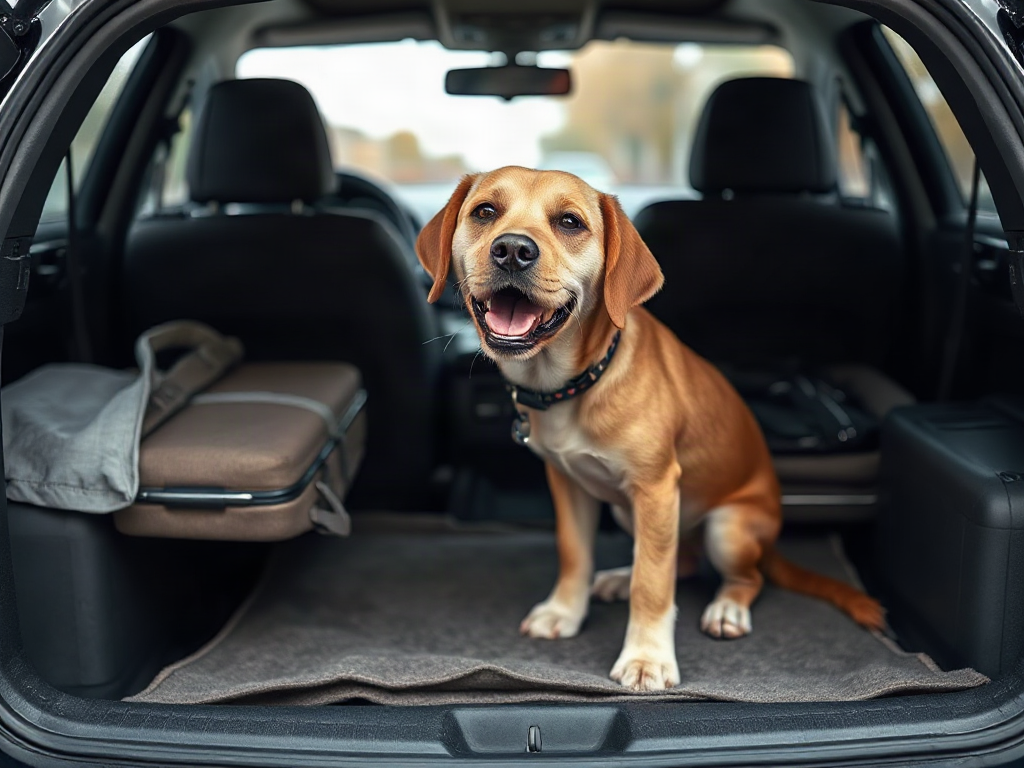
The car safety features that matter most for dog carriers are secure vehicle anchoring, a rigid load-bearing frame, dependable door latches, protected ventilation, and enough interior space for stable positioning. A carrier should remain restrained during hard braking without collapsing, rotating, or allowing the dog to strike an exposed buckle or door. Check that the attachment method matches the carrier instructions and vehicle seating position rather than assuming a seat belt threaded through any handle is adequate. Strong construction cannot compensate for poor installation, excessive interior space, damaged hardware, or placement beside an active airbag.
Start With a Carrier That Can Be Restrained Properly
A useful vehicle restraint begins with defined attachment points, not a convenient-looking handle. Look for belt paths, anchor straps, lower-anchor connectors, or another installation method specifically described by the carrier manufacturer. The instructions should identify permitted orientations and seating positions. If the product documentation discusses carrying the dog but never explains vehicle installation, do not assume the carrier is intended to function as a car restraint.
The attachment points must transfer force into the carrier’s structural shell or reinforced frame. A shoulder strap ring, fabric grab handle, or luggage sleeve may hold the carrier during ordinary handling yet tear away when the vehicle stops abruptly. Similarly, wrapping a seat belt around the outside can appear secure while leaving the carrier free to rotate or slide from beneath the belt. Follow the designated routing exactly, remove slack, and check that the belt remains locked when pulled firmly.
Restraint claims also deserve careful reading. Terms such as “automotive,” “seat-belt compatible,” and “for car use” do not all establish the same level of performance. Look for a clearly identified test protocol, the carrier size tested, the test conditions, and whether the complete enclosure remained attached and closed. A vague image of a belted carrier is not equivalent to documented dynamic testing. Testing does not guarantee protection in every collision, but transparent information gives buyers more decision value than an unexplained safety label.
Consider a soft-sided carrier with one webbing loop sewn into its rear panel. It may stay still during a gentle turn, but that single loop can concentrate force in a small area during emergency braking. A design with reinforced belt paths connected across the base distributes the load more broadly. The latter still needs correct installation; reinforcement cannot work if the belt bypasses it.
Before buying, compare the carrier manual with your vehicle owner’s manual. Confirm that the seat belt or permitted anchor system is available in the intended position and that the carrier fits flat on the seat or cargo floor. The broader principles in Car safety features that matter for dog carriers should always be applied through the instructions for the exact product and vehicle.
Inspect the Frame, Door, and Hardware as One System
The enclosure is only as dependable as its weakest load path. A rigid shell may resist deformation, but that advantage disappears if the door opens, the hinge pulls free, or the upper and lower shell sections separate. Examine how the base, walls, roof, door frame, hinges, and attachment points connect rather than judging safety from thick plastic or heavy metal alone.
Rigid carriers generally offer better resistance to intrusion than unstructured fabric models, although material alone does not establish crash performance. Molded plastic can crack around fasteners or ventilation openings, while metal can bend, expose sharp edges, or add substantial weight. Soft carriers are easier to carry and may fit smaller spaces, but their flexible walls provide less separation from surrounding objects. Choose based on documented use, dog size, installation compatibility, and handling needs rather than treating “hard” or “soft” as a complete safety rating.
The door needs at least one positive latch that cannot be released by routine pawing or pressure against the panel. Check whether the latch fully engages without forcing the door into alignment. Hinges and latch pins should sit firmly in their sockets, and the door should not bow enough to release them. On zippered models, paired zipper pulls should have a method of being secured together because an anxious dog may nose apart unsecured sliders. A small tether inside the carrier is not a substitute for a closed door and can create an entanglement hazard if used contrary to the manufacturer’s directions.
Inspect all joining hardware before each substantial drive. Tighten only components the instructions permit users to adjust; overtightening plastic fasteners can damage the surrounding shell. Replace a carrier if cracks radiate from bolt holes, the base no longer sits flat, a latch engages inconsistently, webbing is cut or badly abraded, or corrosion interferes with a hinge. Tape, cable ties, and improvised clips may conceal a failure without restoring the original load capacity.
A common mistake is focusing on escape resistance while ignoring vehicle forces. A heavily reinforced door may contain a determined chewer, yet the entire carrier can still become a projectile if its anchor points are weak. Conversely, a firmly anchored enclosure with an unreliable door may release the dog into the cabin. Treat containment, structural integrity, and vehicle restraint as one connected system. If any part fails a stationary inspection, do not rely on the other features to compensate.
Match Interior Fit and Ventilation to Car Travel
Correct interior dimensions limit uncontrolled movement without forcing the dog into a cramped posture. The dog should generally be able to enter, stand naturally, turn around, and lie down in a normal position. A carrier far larger than necessary gives the animal more distance to move before contacting an interior surface during sudden braking. Padding can improve comfort and traction, but loose cushions do not correct an oversized enclosure and may obstruct vents.
Measure the dog and compare those measurements with the manufacturer’s internal dimensions, not merely an exterior size label or weight range. Weight limits may describe what the base can hold without confirming that a long-backed, tall, or broad-chested dog fits. Test the carrier at home: the dog should not need to crouch continuously, press against the door, or curl unnaturally to lie down. At the other extreme, repeated sliding during ordinary stops suggests excessive space, a slippery floor, poor installation, or some combination of the three.
Ventilation openings should remain usable after the carrier is installed. Multiple openings on different sides can maintain airflow when one panel is near a seatback, but exposed openings must not be so large or weak that paws, tags, or surrounding cargo can enter. Never cover vents with coats or luggage. In warm conditions, vehicle climate control and direct observation matter more than the carrier’s mesh area alone; a ventilated enclosure does not make a parked car safe.
Interior surfaces deserve the same scrutiny. Choose a stable, low-profile mat that fits the floor and does not bunch against the door. Remove or secure bowls and accessories that could move around unless they are designed for that carrier and necessary for the trip. Collars, tags, leashes, and internal tethers can snag on wire or ventilation holes. Whether equipment should be removed depends on the carrier instructions and the dog’s needs, so inspect for reachable projections before departure.
Acclimation provides an early warning about fit and function. Short stationary sessions followed by brief drives can reveal panting unrelated to temperature, frantic turning, persistent pawing at hardware, motion-related distress, or a mat that slides. These signs do not automatically identify a carrier defect, but they justify stopping and checking fit, airflow, installation, and the dog’s condition. For persistent travel anxiety or motion sickness, seek veterinary guidance rather than modifying the enclosure with unapproved restraints or sedatives.
Choose a Safe Position and Verify the Installation
A restrained carrier needs a stable location away from front airbags, loose cargo, and direct driver interference. A rear seating position is commonly more appropriate than the front passenger seat, provided the carrier can be installed there according to both manuals. Never place a carrier where an active airbag could deploy into it. Vehicle layouts vary, so consult the owner’s manual for airbag zones, folding-seat limitations, and approved child-restraint or cargo anchor use.
Placement on a cargo floor may reduce elevation and provide a flatter surface, but only when the area is part of the occupied cabin, offers an approved restraint method, and protects the carrier from shifting objects. An open carrier in an unrestrained cargo area is not secured simply because it fits tightly between luggage. In a pickup, a dog carrier should not ride unsecured in the open bed. Temperature exposure, road debris, shifting cargo, and lack of appropriate occupant protection make that a poor substitute for an installed enclosure inside the cab.
Use this nine-step inspection before driving:
- Read the carrier and vehicle installation instructions.
- Check the shell, seams, frame, webbing, and base for damage.
- Confirm that every hinge and latch engages fully.
- Place the carrier in an approved position away from airbag deployment paths.
- Route the belt or anchor through only the designated attachment points.
- Remove slack without deforming the enclosure.
- Push and pull at the base to check for sliding, tipping, or rotation.
- Verify that vents and the door remain unobstructed.
- Secure other cabin objects that could strike the carrier.
A small amount of cushion movement may occur, but obvious rotation, belt migration, seat compression that releases tension, or a carrier lifting away from its base indicates a poor installation. Re-route the restraint, select another approved seating position, or choose a compatible carrier. Do not wedge the enclosure with bags as a repair; those bags can shift and may block ventilation or the door.
Recheck the setup after loading the dog and after the first few minutes of a new installation. Added weight can change how the carrier settles into the seat. During longer trips, inspect the belt tension, latch, airflow, and floor mat at safe stops. Replace the carrier after a serious impact unless its manufacturer supplies explicit inspection and reuse criteria. Damage can exist around fasteners or inside layered materials even when the exterior looks acceptable. These installation checks turn Car safety features that matter for dog carriers from a shopping phrase into a repeatable pre-drive routine.
Frequently Asked Questions
Is a seat-belt loop enough to make a dog carrier safe for the car?
Not by itself. The loop should be reinforced, connected to the carrier's structure, and identified for vehicle installation. Use it only with the belt routing and seating positions specified by the manufacturer.
Is a hard-sided carrier always safer than a soft carrier?
No. A rigid shell may resist intrusion better, but door integrity, anchor strength, fit, installation, and documented testing also matter. A poorly restrained hard carrier can still move dangerously.
How much should an installed carrier move?
Follow the product instructions and test at the base. Clear sliding, tipping, belt migration, or rotation means the setup needs correction, even if the carrier seems stable during normal driving.
Can a dog carrier go on the front passenger seat?
Avoid positions exposed to an active front airbag. Check both manuals for approved locations; a properly installed rear seating position is commonly the more suitable choice.
Should a carrier be replaced after a car accident?
Replacement is prudent after a serious impact unless the manufacturer provides specific inspection and reuse instructions. Hidden damage near anchors, seams, or fasteners may not be visible.
Conclusion
Evaluate a vehicle carrier as a complete restraint system rather than a portable box with a belt wrapped around it. Begin with manufacturer-defined anchor points and a seating position permitted by the vehicle manual. Then inspect the structural shell, door, hinges, closures, ventilation, and interior fit for weaknesses that could undermine the installation.
Before every drive, remove belt slack, test for rotation and tipping, keep airbag paths and vents clear, and secure nearby objects. Watch how the setup behaves with the dog inside; sliding, hardware movement, obstructed airflow, or persistent distress calls for a pause and reassessment. If the current carrier lacks clear vehicle instructions or cannot remain stable in an approved location, changing the carrier or its position is safer than relying on improvised straps, luggage, or repairs.