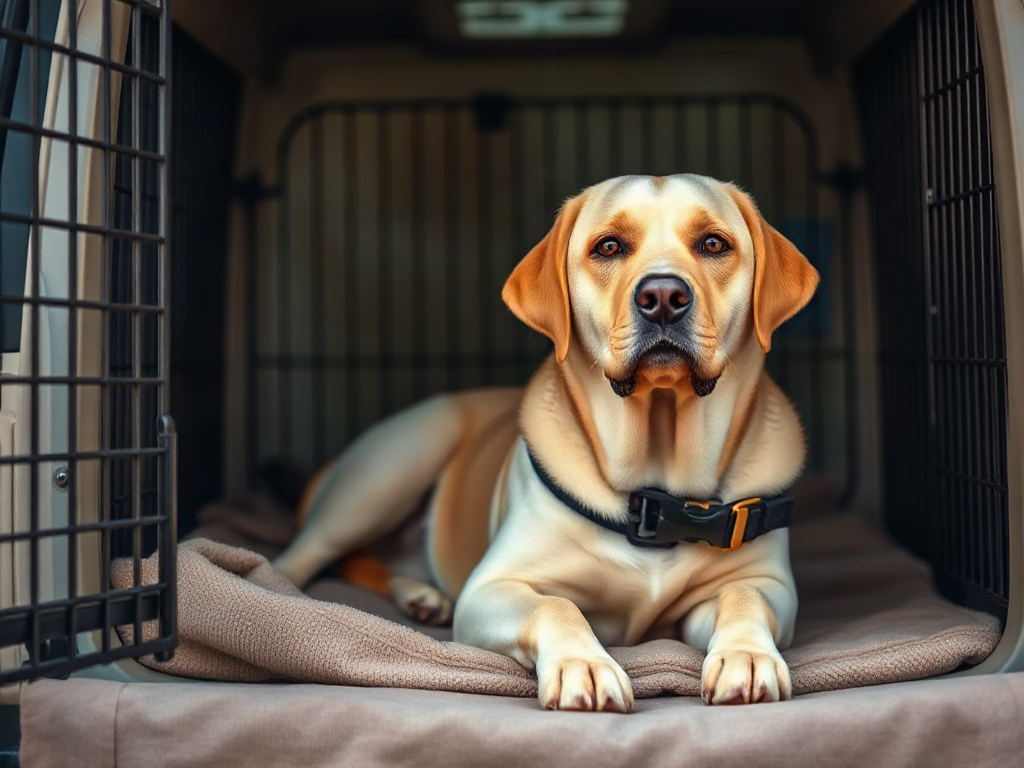
Breed-specific crate sizing for Labrador dogs should be based on the individual Labrador’s standing height, nose-to-rump length, adult growth stage, and ability to turn around and lie naturally. Many adult Labs fit a 42-inch crate, but compact females may need less space and tall, long-bodied males may need more, so breed averages cannot replace measurements. Add roughly 2 to 4 inches to the dog’s measured height and length, then compare those figures with the crate’s internal dimensions rather than its model name. A correct fit permits relaxed postures without excessive unused floor area, while puppies need an adjustable divider to prevent an oversized sleeping space.
Why Labrador Build Matters More Than Weight
Labrador Retrievers vary enough in height, body length, chest depth, and head carriage that weight alone is a poor crate-sizing tool. Two Labs at the same weight can require different interior dimensions: one may be short and broad, while another is taller with longer legs and a longer torso. Product weight limits indicate what a crate can safely support; they do not show whether a particular dog can stand or rest comfortably inside it.
Most adult Labradors are commonly matched with a crate sold in the 42-inch class. That label normally describes approximate exterior length, however, and usable interior space varies with wall thickness, sloping sides, door hardware, and floor lips. A molded plastic kennel can feel noticeably smaller than a rectangular wire model carrying the same nominal length. Always compare the Labrador’s measurements with the manufacturer’s published internal length, width, and height.
Body position reveals why all three dimensions matter. A Labrador should be able to enter without crouching sharply, stand with its head in a natural position, turn without becoming wedged, and lie on its side with its legs comfortably arranged. The crate does not need to accommodate a full running stretch, but the dog should not have to curl tightly whenever it rests. Broad shoulders also need enough width for an easy turn.
More room is not automatically better. An excessively large home-training crate may let a puppy sleep at one end and eliminate at the other, weakening the crate’s role as a defined resting area. During vehicle transport, surplus room can allow more uncontrolled movement during braking or cornering. Conversely, sizing down to save floor or cargo space can produce rubbing, persistent crouching, reluctance to enter, and poor ventilation around a warm, heavily built dog.
The practical priority is individual geometry rather than a breed chart. Use Breed-specific crate sizing for Labrador dogs as a starting framework, then verify the dog’s posture inside the assembled model before treating any size recommendation as final.
How to Measure a Labrador for a Crate
Accurate measurements come from a calm Labrador standing squarely on a level surface. A fabric tape can follow body contours and exaggerate the result, so a rigid tape measure or yardstick usually produces a cleaner straight-line dimension. Having one person hold a treat at nose level while another measures can keep the dog from sitting, twisting, or stretching forward.
Measure length from the tip of the nose to the base of the tail, not to the tail’s end. The tail must fit when the dog turns, but including its full length can add substantial unnecessary floor space. For height, measure from the floor to the highest point the dog naturally carries while standing. On many Labs that is the top of the head or ears rather than the shoulders. Measure width across the broadest part of the body, usually the shoulders or rib cage.
Add approximately 2 to 4 inches to the measured length and standing height as a working allowance. This is not a universal formula: a very broad Labrador may need extra turning width, while a dog that habitually sleeps curled may not need as much added length as a long, side-sleeping dog. Thick bedding also reduces effective headroom, so include the planned mat when judging the assembled interior.
- Record standing length: nose tip to tail base.
- Record natural height: floor to the highest normally carried point.
- Check body width: measure the broadest shoulder or rib-cage span.
- Add working clearance: generally 2 to 4 inches for length and height.
- Compare internal specifications: account for sloped walls, door frames, and bedding.
Repeat uncertain measurements rather than rounding aggressively. For example, a Labrador measuring near the upper limit of a crate’s interior height may technically fit while standing still but strike the roof when stepping over the threshold. In that borderline case, observe the entrance height and turning width before moving to a larger model. A crate with a higher, wider doorway may solve the problem without adding considerable exterior length.
A common mistake is measuring a sleeping dog and assuming that position represents required space. Resting length misses standing height, turning clearance, and the room occupied during entry. Measurements establish the shortlist; an actual posture check determines whether the crate works.
Choosing Among 36-, 42-, and 48-Inch Crates
The familiar 36-, 42-, and 48-inch labels describe product classes, not guaranteed Labrador fits. A 36-inch crate may suit a smaller adolescent or unusually compact adult, but it is frequently too short or low for a typical full-grown Lab. A 42-inch model is the most useful comparison point for many adults. A 48-inch crate may be justified for an exceptionally tall or long individual, although it occupies substantially more household and vehicle space.
Consider a compact adult female that measures 35 inches from nose to tail base and 25 inches to the top of her naturally held head. A crate with about 38 inches of usable length and 28 inches of internal height may allow comfortable movement even if its retail label says 42 inches. A large male measuring 41 inches long and 29 inches high would need a different model; a nominal 42-inch crate with only 27 inches of interior height would force him to lower his head.
Wire crates usually provide squared corners, strong airflow, and a clear view of the room. They are convenient for home use and often include dividers, but their open design may not suit a dog that settles better with reduced visual stimulation. Plastic kennels create a more enclosed interior and are commonly associated with transport, yet curved walls and tapered roofs reduce usable space. Soft-sided crates are easier to carry but are generally inappropriate for a powerful Labrador that scratches, pushes against panels, or has not already learned to rest calmly in confinement.
Door arrangement deserves equal attention. A side door can simplify placement beside furniture or in a vehicle cargo area, while a front-only entrance may leave too little turning room outside the crate. Measure the intended location, including door swing and ventilation clearance, before ordering. Choosing a larger crate that cannot be positioned securely is not a functional upgrade.
Price should be considered after fit, construction, and intended use. Buying a small temporary crate followed by an adult model can cost more than purchasing a sturdy adult-size wire crate with a divider. That approach works only if the divider can create a properly proportioned puppy area without leaving gaps where a collar, paw, or jaw could become caught. For more model-specific decisions, the measurements described in Breed-specific crate sizing for Labrador dogs should be checked against the exact manufacturer diagram.
Sizing for Puppies, Home Use, and Transportation
A Labrador puppy should be sized for its current body inside a crate capable of accommodating expected adult growth. The safest practical setup is often an adult-length crate with a secure divider that can be moved as the puppy grows. The occupied section should permit standing, turning, and comfortable sleep while remaining compact enough to function as a distinct resting area.
Check the divider frequently during rapid growth. A puppy that brushed neither end last month may now hunch while turning or avoid lying on its side. Move the panel when the puppy loses natural posture, not according to a fixed calendar. Collars and tags can catch on wire or divider hardware, so assess snag hazards and follow the crate maker’s instructions about unattended use.
Home crates and transport enclosures solve different problems. At home, comfort, placement, cleaning, and quiet rest often dominate the decision. In a vehicle, secure installation, structural design, door retention, airflow, and compatibility with the available cargo area become central. A loose wire crate that fits the Labrador does not become a safe transport arrangement merely because it fits behind the seats. Follow the vehicle and crate manufacturers’ anchoring instructions, and do not block air circulation around the enclosure.
Air travel introduces separate constraints. Airlines may impose route-, aircraft-, and kennel-specific requirements, and acceptance cannot be inferred from a general Labrador size chart. Confirm current rules directly with the operating airline before purchasing a kennel. External dimensions matter for aircraft loading, while the Labrador still needs the posture and movement clearance required by the carrier’s stated policy. Codeshare itineraries can involve more than one operator, making written confirmation especially valuable.
Bedding creates another tradeoff. A thin, nonslip mat preserves interior height and gives the dog stable footing. A deep bed may look comfortable but can make a borderline crate too low, bunch against the door, or become hot. Labradors that chew fabric may need a simpler surface until they can use bedding without tearing and swallowing material.
Signs the setup is working include voluntary entry, easy turns, relaxed side or curled sleeping, and a level standing posture. Repeated panting in a cool environment, frantic attempts to escape, drooling, vocal distress, or refusal to enter may indicate heat, fear, inadequate conditioning, poor fit, or another concern. Increasing crate size will not resolve separation distress or a medical problem; persistent behavioral or physical signs warrant guidance from a veterinarian or qualified behavior professional.
Final Fit Checklist and Warning Signs
The final decision should be made with the Labrador inside the fully assembled crate, including its normal mat. Watch the complete sequence of entering, standing, turning, lowering into a resting position, and exiting. A single photograph of the dog sitting upright can hide limited turning width, a low doorway, or insufficient lying length.
- Standing: the head and ears do not press against the roof.
- Turning: the shoulders and hips clear the walls without squeezing.
- Resting: the dog can lie in a normal preferred posture.
- Entry: the Labrador crosses the threshold without a deep crouch or collision.
- Environment: bedding, bowls, and attachments do not consume needed clearance.
A crate is probably too small if the dog must remain curled, cannot turn smoothly, rubs its back on the roof, or repeatedly catches its shoulders at the entrance. Worn fur or pressure marks should not be dismissed as normal crate use. A crate may be unnecessarily large if a puppy consistently toilets away from its bed despite an appropriate schedule, or if the enclosure shifts because its exterior dimensions prevent secure placement.
Behavior must be interpreted carefully. Hesitation can result from a rattling floor, slippery tray, unstable crate, unpleasant past experience, or rushed introduction rather than dimensions alone. Test fit separately from crate training: stabilize the unit, keep the door secured open during supervised exploration, and reward calm voluntary entry. Never force the Labrador inside to prove that a measured size works.
Recheck fit after growth, weight change, orthopedic limitations, or a change in bedding. An older Labrador with stiff hips may need a low threshold and more turning room even if its body measurements have not changed. The most reliable Breed-specific crate sizing for Labrador dogs therefore combines measured clearance with direct observation of movement and comfort.
Frequently Asked Questions
What crate size fits most adult Labradors?
Many adult Labradors fit a nominal 42-inch crate, but internal dimensions and individual measurements decide the fit. Smaller adults may need less room, while especially tall or long Labs may require a 48-inch model.
Is a 36-inch crate large enough for a Labrador?
It may fit a compact adult or growing adolescent, but many mature Labradors will find it too short or low. Confirm standing height, nose-to-tail-base length, turning room, and usable interior dimensions.
Should a Labrador be able to sit upright in a crate?
The dog should stand naturally without pressing its head against the roof, turn around, and lie comfortably. Sitting alone is not a sufficient fit test because it does not reveal restricted length or turning width.
Can I buy an adult-size crate for a Labrador puppy?
Yes, if the crate has a secure, correctly installed divider. Adjust the usable area as the puppy grows and inspect regularly for cramped posture, gaps, and hardware that could snag a paw or collar.
Does a Labrador need a larger crate for car or air transport?
Not automatically. The dog still needs normal posture and turning clearance, but transport also requires secure installation and compliance with the relevant carrier or airline specifications. Verify current requirements before buying.
Conclusion
A breed estimate can narrow the options, but the Labrador in front of you should determine the purchase. Record standing length, natural height, and body width; add modest clearance; then compare those figures with the manufacturer’s internal specifications. Treat 42 inches as a common comparison size rather than a universal answer.
Test the assembled crate with its intended mat and watch the dog enter, turn, stand, rest, and exit. Use a divider for a growing puppy, reassess it frequently, and distinguish household confinement from vehicle or airline requirements. If the Labrador crouches, rubs against the enclosure, cannot adopt a relaxed sleeping position, or shows persistent distress, investigate fit, temperature, crate stability, conditioning, and health instead of assuming extra time inside will solve the problem.