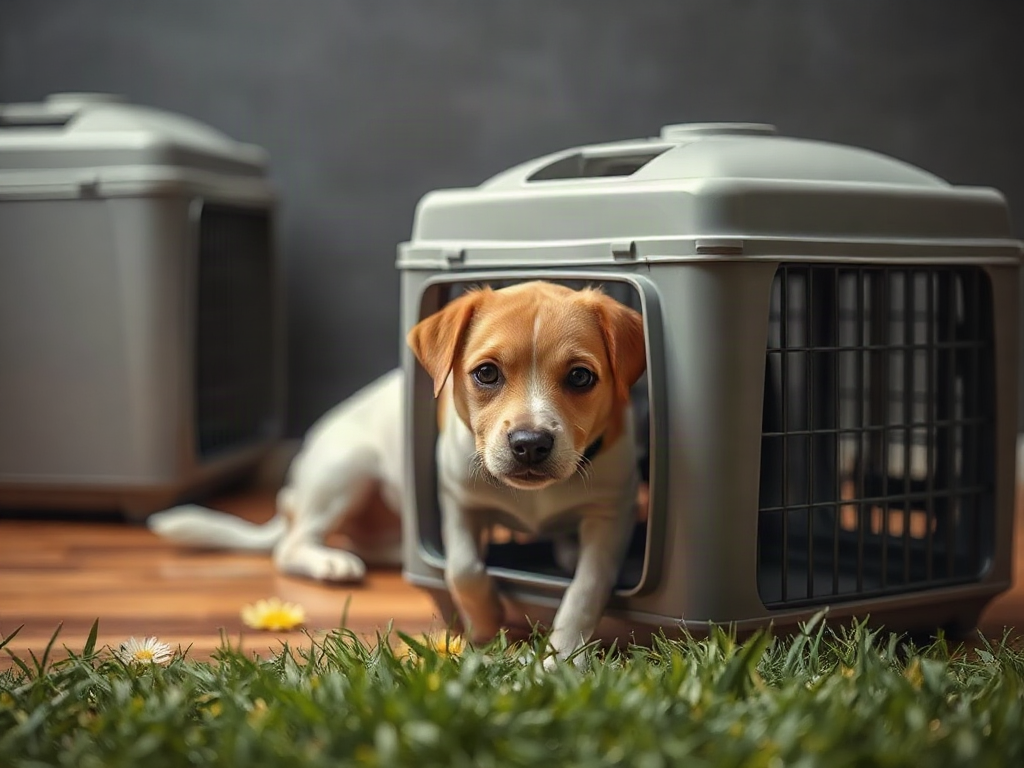
Travel crates for dogs with separation anxiety work best when the crate is introduced as a familiar resting place rather than used for the first time during departure. Choose a secure, well-ventilated model that allows normal standing and turning, then build positive associations through meals, brief door closures, and calm practice rides. Watch for escalating panting, drooling, frantic scratching, escape attempts, or refusal of food, because severe distress can cause injury and is not solved by a stronger crate alone. Gradual conditioning, careful temperature control, and guidance from a veterinarian or qualified behavior professional should take priority over forcing longer confinement.
What Kind of Crate Should You Choose?
A suitable crate must contain the dog safely without making confinement physically uncomfortable. The dog should be able to stand without crouching, turn around without becoming wedged, and lie in a natural position. Excess space is not automatically better: an oversized crate can allow a dog to be thrown against the sides during sudden braking, while a cramped one restricts posture and airflow. Measure the dog rather than relying only on breed labels or manufacturer weight ranges.
Construction should match the dog’s behavior under stress. A soft-sided crate may suit a small dog that already settles quietly and does not chew or push at mesh panels. It is a poor choice for a dog that claws, bites fabric, or repeatedly drives its body into the door. A rigid plastic travel kennel provides more enclosure and fewer chewable surfaces, while a well-built metal crate offers visibility and airflow. Metal wire models can rattle, expose paws near gaps, and feel too open for some dogs, however, so a securely attached breathable cover may help if it does not obstruct ventilation.
Inspect the door, latches, seams, ventilation openings, and interior projections. A pan that shifts under the dog, a collar tag that catches on wire, or a loose clip can become hazardous when panic escalates. Remove collars, tags, harnesses, and leashes inside the crate unless a particular transport rule requires otherwise and safe attachment has been professionally assessed. Never tether a dog to the crate interior. For vehicle use, follow the restraint instructions supplied for the specific product and vehicle position rather than assuming any crate is crash-protective.
Bedding involves a practical tradeoff. A thick bed can improve comfort for a dog that lies down, but it can retain heat, bunch against the door, or give a destructive dog material to swallow. Begin with a flat, washable mat that the dog has already used safely at home. Familiar scent may support settling, but adding an untested blanket immediately before departure introduces a chewing or entanglement risk.
A common purchasing mistake is choosing the strongest-looking crate without asking why the dog is trying to escape. Reinforced construction may reduce the chance of a door failing, but it does not reduce panic by itself. If a dog bends bars, damages teeth, tears nails, or forces its face against ventilation slots, the immediate priority is professional assessment and a safer travel plan—not a succession of increasingly restrictive containers.
How Do You Introduce the Crate Before Travel?
Crate conditioning should begin away from departure cues and moving vehicles. Place the crate in a comfortable household area with the door secured open, then allow voluntary investigation. Meals can be served near the entrance and gradually moved farther inside. A dog that enters, eats, and leaves calmly is providing more useful information than one that can be physically placed inside but remains tense.
Progress from voluntary entry to very brief door movement, then to short closures while the person remains nearby. Open the door before mild uncertainty becomes frantic behavior. Later sessions can include taking one step away, leaving sight briefly, lifting or moving the crate if appropriate, sitting in a parked vehicle, and finally taking a short drive. Change only one meaningful difficulty at a time. Combining a locked door, owner disappearance, engine noise, and a long ride makes it impossible to identify what triggered the reaction.
A compact progression can keep practice focused:
- Build voluntary entry: Let the dog approach, eat, and rest with the door open.
- Add momentary closure: Close and reopen the door while the dog remains loose-bodied and able to take food.
- Practice small separations: Increase distance and absence in increments the dog can tolerate.
- Introduce the vehicle: Start while parked, then use short trips before attempting a necessary journey.
Signs of workable progress include choosing to re-enter, taking treats gently, lying down, responding to familiar cues, and recovering quickly after the door opens. Food refusal does not always prove panic, especially in a moving car, but it matters when combined with rigid posture, persistent scanning, heavy panting in a cool setting, vocalization, drooling, or escape behavior. Video from a safely positioned camera can reveal whether distress starts when the door closes, when the person disappears, or when the vehicle moves.
Do not use a trip deadline to justify large jumps. For example, a dog comfortable with a closed crate for two minutes in the living room is not necessarily ready for an hour alone in a hotel room or a full day of driving. If necessary travel is approaching faster than training is progressing, consider another caregiver, a shorter route with support, or veterinary guidance. Repeated exposure above the dog’s tolerance can strengthen the association between confinement and panic rather than producing adaptation.
Another mistake is releasing the dog only at the peak of scratching or barking during every session. Yet waiting out severe distress is also unsafe. The better approach is to design easier repetitions that can end during a calm pause, before the dog loses control. A behavior professional can help separate ordinary protest or frustration from a true anxiety response and set increments appropriate to the individual dog.
How Should You Manage the Trip?
Travel-day management should protect the training already established rather than test its limits. Give the dog an appropriate opportunity to exercise, eliminate, and drink before loading, but avoid exhausting activity or an unusually large meal immediately before motion. Keep departure handling quiet and predictable. Repeatedly opening the crate, apologizing, or reacting dramatically to every sound may add stimulation without resolving the underlying discomfort.
Place the crate where temperature and airflow can be monitored and where luggage cannot collapse ventilation areas. Secure it according to the manufacturer’s instructions so that it cannot slide, tip, or become a projectile during braking. Direct sun through a window can heat one side even when the front cabin feels comfortable. A fabric cover should never block essential openings, and battery fans or cooling accessories are not substitutes for a safely climate-controlled environment.
Plan breaks around the dog’s demonstrated tolerance, physical needs, weather, and route rather than a rigid universal interval. Stop in a secure location before opening the door. Attach the leash in a controlled way and prevent the dog from surging into traffic or an unfamiliar parking area. For a dog prone to bolting, loading and unloading may be more dangerous than the quiet portion of the ride, so identification and properly fitted handling equipment matter whenever the dog is outside the crate.
Consider two different scenarios. A dog that rests at home but becomes nauseated and drools only after the vehicle starts may be reacting primarily to motion, not separation. A dog that begins screaming as the owner walks away from a stationary crate may have a different trigger. The first pattern warrants a veterinary discussion about motion-related symptoms; the second points toward separation-focused behavior work. Treating both as a crate-selection problem delays the more relevant response.
Do not leave an anxious dog unattended in a parked vehicle, even for a planned short errand. Temperature can change, equipment can fail, and distress can escalate without anyone present to intervene. Similar caution applies at lodging: a dog that tolerates a crate while family members are visible may panic when left alone in an unfamiliar room. Confirm property rules, arrange supervision, and rehearse brief separations only if the dog remains below its distress threshold.
Track observable details after practice journeys: when symptoms began, whether the dog accepted food, whether it lay down, the vehicle temperature, trip duration, and recovery afterward. Improvement looks like reduced intensity and faster recovery across comparable sessions, not merely completing a longer drive. If each outing produces earlier or stronger agitation, shorten the next exposure and reassess the trigger instead of pushing forward.
When Is a Crate Not Enough?
A crate is not an adequate stand-alone response when confinement produces sustained panic or self-injury risk. Separation anxiety is a behavior and welfare concern, while the crate is only a transport enclosure. Some dogs feel more secure in a familiar enclosed space; others experience confinement as an additional trigger. The dog’s observed response should decide whether the crate is part of the solution.
Pause crate-based travel practice and seek veterinary advice when a dog attempts to break out forcefully, injures its mouth or paws, vomits repeatedly, collapses, has breathing difficulty, or shows distress that does not settle after the trigger ends. Urgent physical symptoms require prompt veterinary attention. A veterinarian can assess whether pain, respiratory limitations, gastrointestinal illness, motion sensitivity, or another medical issue may be contributing. This is particularly relevant when the behavior appears suddenly in a dog that previously traveled comfortably.
Medication may be discussed by a veterinarian for some dogs, but it should not be improvised or first tested on a major trip. Sedation and anxiety relief are not interchangeable, and a dog that appears quieter may still be distressed. Any prescribed plan needs veterinary direction, an opportunity to observe the individual response, and consideration of the transport setting. Never give human medication or another animal’s prescription.
Qualified behavior support is useful when the dog cannot remain calm during very small separation steps or when owners cannot safely identify a workable starting point. Bring specific observations or video rather than describing the dog only as “bad in the crate.” Useful details include whether distress occurs with confinement while people remain present, with departure regardless of confinement, or only after vehicle movement begins. Those distinctions affect the training plan and may reveal that a gated area, supervised restraint arrangement, alternate caregiver, or delayed trip is safer.
Air travel adds constraints beyond ordinary crate conditioning. Carrier dimensions, construction, documentation, weather restrictions, and animal-acceptance policies can vary by operator and itinerary. Confirm current requirements directly with the carrier before buying equipment, and do not assume that an airline-compliant container makes flying suitable for a dog with severe distress. If the dog cannot remain safe during unavoidable handling and separation, ground travel with supervision or postponement may be the more responsible choice.
The most damaging assumption is that escape attempts prove the dog needs stricter confinement. Stronger hardware may prevent escape while increasing the opportunity for injury. A safer decision accounts for the severity of behavior, the necessity of the trip, available supervision, and the dog’s progress during controlled practice. When those pieces do not support safe confinement, changing the travel arrangement is a valid outcome rather than a training failure.
Frequently Asked Questions
Are hard or soft travel crates better for an anxious dog?
Hard-sided models are generally more appropriate for dogs that scratch, chew, or push at panels. A soft crate may suit a dog that already settles reliably, but fabric and mesh should not be trusted to contain active escape behavior.
Should I cover my dog’s travel crate?
A partial cover may reduce visual stimulation for some dogs, provided airflow and temperature monitoring remain unobstructed. Test it during calm practice because other dogs become more distressed when their view is restricted.
Can I leave a chew toy in the crate during travel?
Use only an item the dog has handled safely under supervision, and avoid anything that can splinter, lodge in the mouth, or break into swallowable pieces. A panicked or motion-sick dog may use familiar items differently than it does at home.
Why does my dog tolerate the crate at home but panic in the car?
Vehicle motion, vibration, engine noise, heat, nausea, and travel-specific cues may be the trigger rather than the crate itself. Compare behavior in a parked vehicle with behavior after movement begins and discuss physical symptoms with a veterinarian.
Will a stronger crate fix separation anxiety?
A stronger enclosure may reduce equipment failure, but it does not address the fear driving escape behavior. Forceful attempts to bend, bite, or claw through a crate call for a safer travel arrangement and professional assessment.
Conclusion
Safe crate travel depends on matching the enclosure and training process to the individual dog’s behavior. Measure for functional fit, choose materials that can withstand the dog’s demonstrated habits, remove snag hazards, and secure the crate as its manufacturer directs. Build tolerance through voluntary entry, brief closures, manageable separation, parked-car sessions, and short rides rather than combining every challenge at once.
Use the dog’s body language and recovery as the decision criteria. Calm re-entry and settling support gradual progression; worsening panting, drooling, food refusal, vocalization, or escape behavior signal that the plan needs to become easier. Severe distress, sudden behavioral change, or self-injury warrants veterinary input, with qualified behavior support when needed. If a necessary journey exceeds the dog’s current tolerance, change the supervision, route, timing, or travel method instead of treating forced confinement as the only option.
Further Reading
Authoritative Sources
- Best High Anxiety Dog Crates - Waggle
mywaggle.comFind the best high anxiety dog crates for large breeds. Learn what actually works for separation anxiety and how to choose a crate that ...
- Learning How To Crate Train a Dog With Separation Anxiety
rockcreekcrates.comSet the crate up in a quiet area of the home. Wait until your dog is already in their crate, approach the crate with a treat, feed the treat, ...
- Why Crates Reduce Travel Stress for Reactive Dogs
impactdogcrates.comLearn how the right crate setup can keep reactive dogs calmer and safer during stressful travel experiences.
- Best Dog Carriers for Safe and Comfortable Travel
susanhartzler.comExpandable carriers can be wonderful for dogs who become stressed during confinement because they provide extra resting space during airport waits, hotel stays, ...