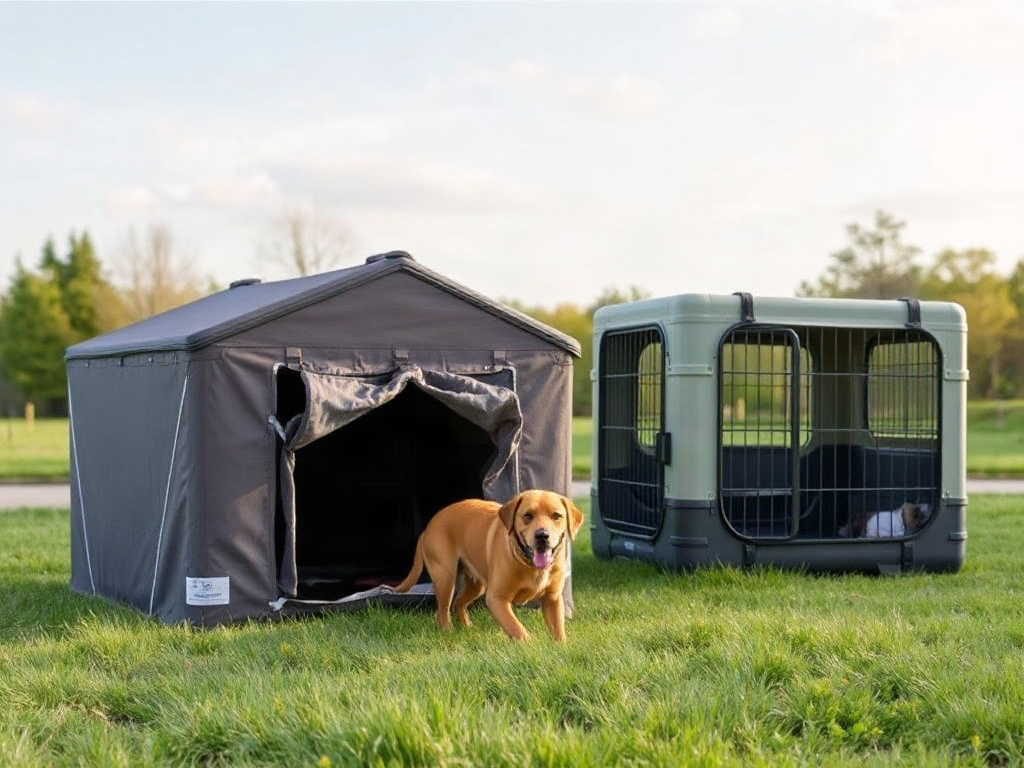
A portable dog house is primarily a sheltered resting space, while a travel crate is designed to confine and transport a dog more securely during movement. Choose the house for supervised campsites, outdoor breaks, or temporary shade; choose the crate for vehicle travel, lodging containment, and situations where doors, rigid structure, ventilation, and restraint compatibility matter. A collapsible fabric house should not be treated as crash protection or used wherever an escape could put the dog at risk. Measure standing height, turning room, floor stability, airflow, and packed size before buying, then confirm any carrier rules imposed by an airline, hotel, campground, or transport provider.
The Functional Difference Between Shelter and Containment
A portable dog house and a travel crate may look similar when folded or displayed online, but they solve different problems. A portable house creates a familiar resting area protected from light, mild wind, visual stimulation, or direct contact with the ground. A travel crate limits movement and helps keep the dog contained while people, luggage, doors, and vehicles are moving around it.
Portable houses commonly use fabric stretched over a folding frame, lightweight panels, or a tent-like structure. Some have an open doorway, while others include a mesh flap or zipper. Their low weight and broad floor area can make them convenient at a campsite, vacation rental, show ground, or family gathering. That convenience comes with a structural limitation: flexible walls may fold, tip, tear, or shift if a dog pushes against them. An enclosure that stays upright for a sleeping dog may not contain one that scratches, chews, or lunges at the entrance.
Travel crates are usually built around a closable door and a more defined frame. Wire, molded plastic, reinforced fabric, and metal designs offer different levels of rigidity. A crate can help prevent a dog from roaming through a hotel room, jumping out when a vehicle door opens, or interfering with the driver. A crate alone should not be assumed to provide crash protection, however. Vehicle performance depends on the product’s construction, positioning, anchoring method, and any credible testing claimed by its manufacturer.
Consider a calm senior dog resting beside its owner under a campground awning. A breathable portable house may provide a quieter retreat without requiring a heavy structure. Put the same enclosure in a cargo area with loose bags around it, and its weaknesses become relevant: the frame can shift, the entrance may open, and luggage can obstruct ventilation. A secured crate is the more appropriate category for that moving environment.
The misleading assumption is that a zippered door automatically turns a portable house into transportation equipment. Inspect the intended use stated by the manufacturer rather than relying on appearance. If the listing describes the product as a bed, shelter, play tent, or indoor hideaway, it should not be promoted to a transport role merely because the dog fits inside. Readers comparing a Portable dog house versus travel crate should begin with function: stationary comfort or controlled containment.
Which Option Matches Each Part of a Trip?
The trip stage matters more than the product label. Transit exposes an enclosure to braking, turning, busy loading areas, unfamiliar noises, and repeated door openings. Rest stops and destinations introduce different needs, including shade, a washable sleeping surface, household protection, and a place where the dog can settle while supervised.
For road travel, a correctly sized crate is generally the more useful option because it confines the dog and can prevent movement into the driver’s space. It should sit on a level surface and be positioned so surrounding baggage cannot collapse a soft wall or cover ventilation. Secure it according to the vehicle and crate manufacturers’ directions. Do not improvise by threading a seat belt through a handle unless that attachment method is explicitly intended; carrying handles are not necessarily engineered as restraint points.
At a rest stop, neither enclosure replaces a leash and attentive handler. Opening a crate in a parking area can create an escape opportunity, so attach the leash before allowing the dog to exit whenever the design permits safe access. A portable house is rarely worth assembling for a brief bathroom break. It becomes more useful during a longer, supervised pause in a safe area, where it can provide a defined resting spot after the dog has walked and had water.
Lodging creates a closer contest. A house may suit a dog that reliably settles, does not chew fabric, and only needs a familiar bed-like retreat. A crate is more appropriate for a dog that might rush an opened hotel door, investigate electrical cords, damage furnishings, or become unsettled when left alone. Hotel permission should never be interpreted as permission to leave a dog unattended; property rules vary, and an anxious dog can injure itself trying to escape either enclosure.
Air travel requires a separate decision based on the carrier’s current rules, route, aircraft, and the dog’s circumstances. A recreational portable house is not an airline carrier. Airlines may specify dimensions, ventilation, materials, closures, and placement, and acceptance can differ between cabin and hold arrangements. Confirm requirements directly before travel rather than trusting a product page that uses broad phrases such as “airline friendly.”
A simple use-case split keeps the choice clear:
- Moving vehicle or controlled hotel confinement: favor an appropriate travel crate.
- Supervised campsite or destination retreat: consider a portable house.
- Commercial transport: follow the provider’s exact carrier requirements.
- Dog with chewing or escape behavior: avoid lightweight fabric as the primary barrier.
The common failure is buying one lightweight enclosure and expecting it to perform every role. Some travelers carry both: a transport crate for the journey and a compact shelter for supervised destination use. That adds luggage, but it avoids forcing a comfort product to perform a containment job it was not designed to handle.
Safety, Fit, Ventilation, and Escape Risk
Usable fit requires enough interior room for the dog to stand naturally, turn around, reposition, and lie in a comfortable posture. Exterior dimensions can be misleading because frames, sloped walls, raised floors, and thick padding reduce the actual space available. Measure the dog and compare those measurements with the product’s interior dimensions, not simply a broad small, medium, or large label.
More space is not automatically safer during transit. An oversized enclosure can allow excessive movement during abrupt maneuvers, while an undersized one restricts posture and can create pressure points. For a portable house used at a destination, extra floor area may be welcome because the purpose is comfortable rest. This difference explains why the ideal dimensions for a campsite shelter may not match those of a transport enclosure.
Ventilation needs to remain open after the crate or house is packed into the real setting. Mesh on three sides offers little benefit if two sides are pressed against suitcases and the third faces a seat back. Heat can also build in parked vehicles and enclosed tents; shade panels and mesh do not make those spaces safe for unattended dogs. Check airflow from the dog’s height after loading the vehicle, and keep bedding from bunching against low vents.
Escape risk depends on both material and behavior. Fabric walls and mesh are vulnerable to persistent claws and teeth. Wire enclosures may present snag or pinch points if damaged, and poorly latched doors can be nudged open. Molded crates can offer greater wall rigidity, but their doors and fasteners still need inspection. Before departure, look for bent wires, torn seams, loose frame joints, damaged zippers, sharp edges, and latches that no longer close cleanly.
For example, a dog that sleeps peacefully in a soft house at home may begin pawing at mesh when exposed to traffic noise in an unfamiliar rental. Familiarity with the enclosure does not guarantee the same response under travel stress. Practice short, supervised sessions before the trip and watch for frantic digging, heavy drooling unrelated to heat, repeated biting, forceful door pushing, or an inability to settle. Those signs mean the setup or training plan needs reassessment rather than a longer period of unattended confinement.
Success looks quieter: the dog enters without being forced, changes position comfortably, rests with normal breathing, and exits without scrambling. Add a thin, nonslip, washable mat if it does not crowd the interior or obstruct airflow. Remove collars or dangling tags when snagging is a credible concern, while maintaining whatever identification and control plan is appropriate outside the enclosure. The safest comparison of Portable dog house versus travel crate accounts for the individual dog’s behavior, not just published weight capacity.
A Practical Buying and Packing Decision
Buying should begin with the strictest environment on the itinerary. If the dog must be contained during a drive, transported by a commercial provider, or secured in unfamiliar lodging, evaluate a suitable crate first. If transportation is already handled and the remaining need is a light resting shelter at the destination, a portable house may be the more efficient purchase.
Test the product at home while returns are still possible. Assemble and collapse it several times, place it on the type of surface expected during the trip, and check whether the base slides when the dog turns. Sit at dog level to assess airflow and visibility. Operate every zipper and latch with one hand, because arrivals often involve holding a leash or luggage. A mechanism that is awkward in a quiet room will be harder to manage beside traffic or in bad weather.
Use this compact pre-trip check:
- Confirm purpose: verify whether the manufacturer identifies the product for shelter, containment, vehicle use, or commercial transport.
- Measure usable space: compare the dog’s standing height and body length with interior dimensions.
- Inspect structure: test the frame, floor, seams, door, latches, and intended anchor points.
- Load realistically: place the enclosure with the luggage and confirm that vents and doors remain accessible.
- Observe the dog: complete short practice sessions and stop if escape attempts or distress escalate.
- Verify destination rules: contact the airline, hotel, campground, or transport company when its policies control acceptance.
Portability has several dimensions beyond product weight. Packed length determines whether the enclosure fits in a trunk or overhead storage area; setup time matters during rain or crowded arrivals; and washable surfaces matter after muddy stops or accidents. A light fabric model may save lifting effort but require more careful placement. A rigid crate consumes more cargo room yet may tolerate loading and repeated handling better.
Budget comparisons should include replacement risk and role coverage. A low-cost house is poor value if a dog tears the mesh on the first trip, while an expensive crate is unnecessary for a dog that only needs supervised shade beside an owner. Avoid paying for vague travel language without checking construction and permitted use. Product claims such as crash-tested or airline-approved deserve closer scrutiny: identify who conducted any testing, what model and size were evaluated, and whether the transport provider still accepts that configuration.
The decision is working if the enclosure remains stable, accessible, ventilated, and intact while the dog can rest without repeated escape behavior. It is failing if walls bow, the base skids, vents become blocked, the dog cannot change posture, or the door hardware loosens under ordinary use. Reassess immediately rather than adding clips, straps, or structural modifications that the maker has not authorized. A focused Portable dog house versus travel crate comparison should end with a product matched to one defined job, not the option with the longest feature list.
Frequently Asked Questions
Can a portable dog house be used in a moving vehicle?
Only use it that way if the manufacturer specifically permits vehicle use and provides suitable installation instructions. A lightweight shelter should not be assumed to restrain a dog or withstand abrupt movement.
Is a soft travel crate the same as a portable dog house?
No. A soft crate normally has a closable containment design and reinforced frame, while a portable house may be intended only as a stationary retreat. Construction and stated use matter more than the fabric appearance.
Which option is better for camping?
A portable house can work for supervised relaxation in suitable weather. A crate is preferable when dependable containment is needed, especially around wildlife, neighboring campsites, cooking areas, or frequent vehicle access.
How much room should a dog have inside?
The dog should be able to stand naturally, turn, reposition, and lie comfortably. Compare the dog's measurements with usable interior space, accounting for sloped walls, frames, mats, and bowls.
Can either enclosure be left in a parked car?
Neither a house nor a crate makes an unattended parked vehicle safe. Ventilation panels do not stop dangerous heat buildup, and an enclosure can limit the dog's ability to reach a cooler area.
Further Reading
Authoritative Sources
- USDA APHIS Pet Travel
aphis.usda.govOfficial destination and transport information helps travelers identify requirements that a recreational portable shelter may not satisfy
- IATA Traveler's Pet Corner
iata.orgThis resource explains why air transport containers must be chosen around carrier and journey requirements rather than general travel labeling
- AVMA Traveling With Your Pet FAQ
avma.orgThe veterinary association's travel information covers preparation and health considerations relevant to dogs using carriers or crates
Conclusion
Match the enclosure to the hardest job it must perform. Transit, busy loading areas, and unfamiliar lodging usually call for dependable containment, a sound door, stable construction, adequate ventilation, and installation consistent with manufacturer instructions. Supervised destination use may favor the lower weight and roomier resting area of a portable house.
Measure the dog and usable interior, inspect hardware and fabric, load the vehicle as it will actually travel, and complete several calm practice sessions. Treat chewing, frantic scratching, blocked vents, sliding floors, and deformed walls as reasons to change the setup. Before commercial transportation, verify current requirements directly with the provider. Choosing by environment and dog behavior—not by a broad product label—produces a more practical setup and avoids asking a temporary shelter to perform as transportation equipment.