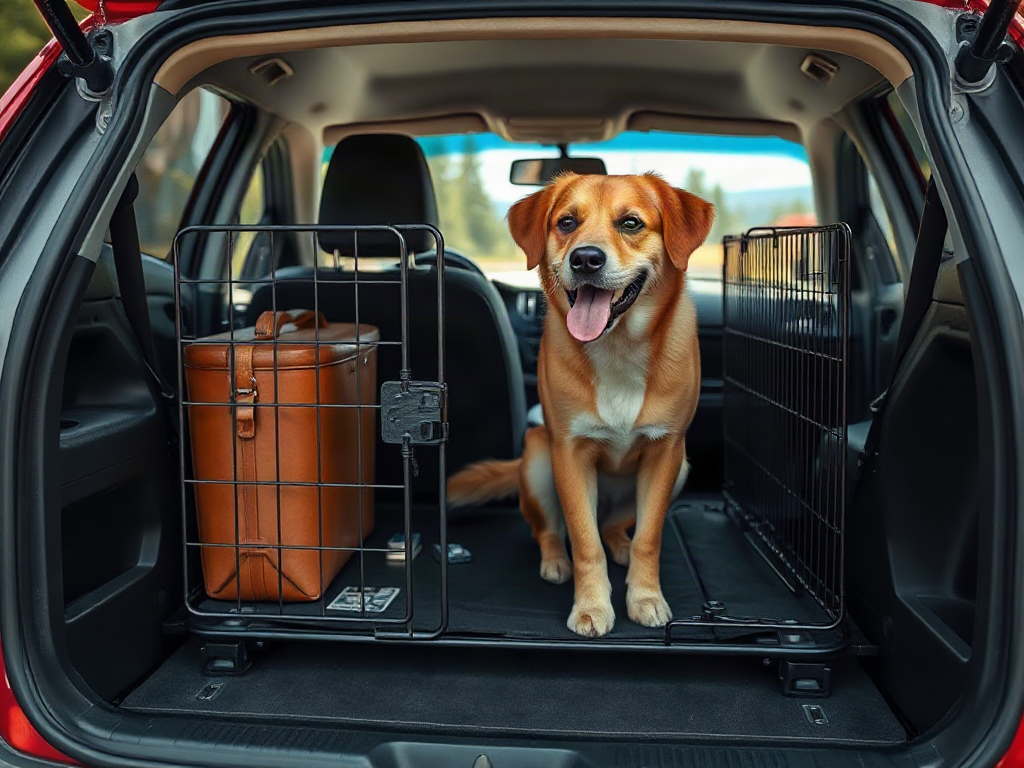
A secured crate generally provides more complete car restraint than a pet gate because it contains the animal, limits movement during sudden braking, and can reduce access to doors, windows, and the driver. A gate mainly separates the cargo area from the passenger compartment; it may protect occupants from distraction or a pet moving forward, but it does not necessarily restrain the pet within that cargo space. Crate performance still depends on construction, vehicle attachment, orientation, and correct sizing. Choose only after checking the pet’s dimensions, available anchor points, gate or crate compatibility, and evidence supporting the product’s intended automotive use.
How Gates and Crates Manage Movement Differently
A pet gate and a crate control different parts of the travel environment. A vehicle gate, often described as a cargo barrier, blocks access between the rear cargo compartment and the seats ahead. The pet may still stand, turn, pace, or slide within the cargo area. A crate creates a smaller enclosed space, but only becomes part of an effective restraint setup when the crate itself is attached securely to suitable vehicle anchor points.
That distinction matters during more than a severe collision. An abrupt stop, evasive turn, steep driveway, or open tailgate can expose weaknesses in an otherwise convenient arrangement. A gate may stop a large pet from climbing toward the driver, yet it does not stop the animal from striking the side of the cargo compartment. A loose crate can move with the pet inside it, creating another heavy object in the vehicle.
Gate designs also vary. A pressure-mounted barrier relies on compression against interior surfaces, while a model-specific barrier may bolt to designated fittings or attach more firmly to the vehicle structure. Pressure mounting can be practical for everyday separation, but trim panels, headliners, and seat backs are not automatically suitable load-bearing surfaces. A gate that stays upright when a pet leans against it has not necessarily demonstrated how it will behave under abrupt deceleration.
Crates differ just as much. Soft-sided carriers offer light weight and convenient storage, but flexible fabric and zipper closures serve a different purpose from a rigid enclosure designed for vehicle use. Wire crates provide ventilation and visibility, although their folding joints, doors, and attachment points require careful inspection. Rigid plastic, composite, and metal models may offer stronger containment, but material alone does not establish crash performance. Product-specific testing, attachment instructions, and stated limitations are more informative than labels such as “heavy duty.”
The practical comparison is therefore not gate versus crate in isolation. It is an open cargo zone behind a barrier versus a contained animal inside an anchored enclosure. Readers comparing Pet gate versus crate for car restraint should first decide whether their priority is cabin separation, animal containment, or both. Some vehicles can accommodate a secured crate behind a properly installed barrier, but the two devices must not obstruct one another, emergency access, or the crate’s approved attachment method.
Which Option Fits Your Pet and Vehicle
A crate is usually the more relevant choice when the goal is to limit the pet’s travel inside the vehicle, while a gate suits situations where cabin separation is the primary need. Neither choice should be made from pet size alone. Temperament, body proportions, mobility, vehicle layout, cargo anchors, climate control, and evacuation access all affect whether a setup is workable.
Consider a calm medium-size dog riding in an SUV. A barrier may keep the dog away from the driver, but the animal still occupies the full cargo floor and may lose footing around corners. A correctly sized, secured crate limits that movement and provides defined boundaries. By contrast, a giant dog may not fit an appropriate crate without folding the rear seats or eliminating needed passenger space. A vehicle-specific barrier could be more practical for routine separation, although the owner should recognize that it is not equivalent to individual containment.
Cats and small pets present a different problem. A cargo gate leaves openings around seats, trim, or roof edges that may permit escape, and opening the hatch can expose the entire cargo area. An enclosed carrier is generally more manageable for loading and unloading because the door can remain closed until the carrier is inside a secure destination. The enclosure still needs adequate ventilation, functional latches, and a stable attachment that does not crush or distort it.
Pet behavior can disqualify an otherwise sensible option. A dog that repeatedly bites wire, claws fabric, or throws its weight against a door needs an enclosure whose closures and materials can tolerate that behavior. A pet showing persistent panic, heavy drooling, frantic escape attempts, or self-injury should not simply be placed in a stronger box without addressing the distress. Gradual acclimation and veterinary guidance may be appropriate, particularly when travel anxiety or motion sickness is suspected.
Vehicle geometry creates equally firm limits. Measure the narrowest hatch opening rather than only the cargo floor. Account for a sloping rear window, raised wheel wells, seat recline, and the space required to operate the crate door. Check whether the vehicle manual permits the intended anchor points to be used for cargo restraint and whether the product manufacturer specifies an orientation. Child-seat anchors, head restraints, and convenience hooks should not be treated as interchangeable cargo anchors without explicit documentation.
Local requirements may govern loose animals, driver obstruction, or cargo securement, and rules can differ by location. A product should not be assumed to satisfy a legal requirement merely because it is marketed for automotive use. The strongest choice is the one that fits the specific pet and vehicle while preserving visibility, ventilation, passenger protection, and a reliable exit route.
Installation and Fit Checklist
Good installation begins with eliminating avoidable movement rather than forcing a device into the available space. Before buying, record the pet’s standing height, body length, shoulder width, and usual travel posture. Then measure the cargo opening and usable interior volume with the seats positioned as they will be during travel. A crate should permit a normal standing, resting, and turning posture without leaving so much unused space that the pet can build momentum across the enclosure.
Use this compact check before the first drive:
- Confirm the intended use. Read whether the product is meant for vehicle transport, simple containment, or cabin separation, and look for clear installation limitations.
- Identify approved attachment locations. Consult the vehicle and product instructions rather than looping straps around convenient plastic fittings or seat mechanisms.
- Test every closure. Engage door latches, gate locks, folding joints, and secondary catches; replace damaged or poorly aligned parts.
- Check surrounding clearance. Keep ventilation openings, side-curtain airbag zones, rear visibility, and hatch operation unobstructed.
- Perform a stationary movement test. Push and pull from several directions. Excessive shifting, strap slack, trim deformation, or a gate walking out of position requires correction.
For a crate, attachment should follow the manufacturer’s specified points and strap path. Routing a strap across a door, ventilation panel, or weak handle can interfere with escape access or load a component that was never intended to hold the enclosure. Straps should not have sharp edges beneath them, and metal hardware should not rest where it can contact the pet. Recheck tension after the first short drive because webbing and cargo can settle.
For a gate, verify contact at every mounting location and ensure the locking mechanism cannot be released by the pet. A universal gate that appears to fit may leave a low side gap large enough for a small animal’s head or paw. Roof pressure that visibly compresses the headliner is another warning, not evidence of extra security. Vehicle-specific fit is often easier to assess because the attachment locations are defined, but installation still needs periodic inspection.
Introduce the completed arrangement while the vehicle is parked. Let the pet enter without immediately closing the hatch, reward calm settling, and rehearse opening only after a pause. Follow with a brief drive on familiar roads before attempting a long outing. Signs of a workable setup include stable hardware, normal breathing after initial excitement, an unchanged resting posture, and calm unloading. Repeated shifting, rattling, heat buildup, tangled bedding, damaged latches, or escalating agitation indicate that the setup needs adjustment.
A more detailed Pet gate versus crate for car restraint comparison should include loading practice as well as hardware. Even a firmly mounted enclosure becomes difficult to use if the door faces a wall, luggage blocks the latch, or the pet must jump across a bumper it cannot safely negotiate.
Common Restraint Failures and Warning Signs
The most misleading failure is a setup that feels solid during parking-lot inspection but relies on weak surfaces or incomplete fastening. A gate can remain quiet for months while being held mainly by friction against interior trim. A crate can sit snugly between luggage yet become mobile when those bags shift. Normal driving provides only limited evidence about how equipment will handle sudden forces.
Loose objects around the pet are another concern. Tools, water containers, folding chairs, and suitcases can move into a crate or strike an animal behind a gate. Cargo should be secured independently rather than packed around the enclosure as improvised bracing. Avoid placing hard items on top of a crate unless both the crate instructions and cargo arrangement support that use. Bedding should improve footing without bunching against ventilation openings or creating a loop that could catch a paw.
Heat and airflow deserve direct inspection. The rear of a vehicle may receive less conditioned air than the passenger seats, especially when a tall barrier, stacked cargo, or covered crate interrupts circulation. Feel the air at the pet’s position before departure and during breaks. Shade and an open window are not reliable substitutes for active temperature management, and a parked vehicle can become unsafe rapidly even when outside conditions seem moderate.
Convenience can also erode the setup over time. Owners may stop attaching both crate straps for a short errand, leave a gate partially latched, or clip a leash to a crate as an extra tether. Unapproved modifications can change how doors, walls, and attachment points carry force. If a harness is used inside or instead of an enclosure, it should be selected and installed as its own vehicle restraint system; attaching a collar or ordinary walking leash to fixed hardware can place dangerous force on the neck.
Inspect equipment after hard braking, a minor impact, chewing, corrosion, or visible deformation. Retire or replace parts according to the manufacturer’s instructions rather than bending frames or substituting household fasteners. Cracked plastic, stretched webbing, sprung doors, whitening around plastic stress points, missing gate feet, and latches that no longer align are meaningful defects.
A failing arrangement often gives smaller warnings first: the gate needs frequent retightening, the crate migrates across the floor, straps abrade where they cross an edge, or the pet arrives with rubbed fur and broken nails. Treat those observations as design feedback. Re-measure, change the attachment path only if instructions permit it, adjust enclosure size, or choose a different product category. Familiarity with a weak setup does not make it protective.
Frequently Asked Questions
Does a pet gate count as a car restraint?
A gate primarily separates the cargo and passenger areas. Unless its manufacturer explicitly documents another function, do not assume it restrains the pet within the cargo compartment.
Is any secured crate safer than a gate?
No. A poorly constructed, incorrectly sized, or inadequately anchored crate can fail or move. Compare documented automotive use, installation requirements, closures, condition, and fit rather than relying on enclosure alone.
Can I use a pet gate and crate together?
They may be compatible when each is installed as directed and neither blocks ventilation, visibility, emergency access, or the other product’s attachment points. Confirm that the vehicle has enough clearance.
Where should a crate be placed in a car?
Use a stable location with suitable anchor points, adequate airflow, and the orientation specified by the crate maker. Vehicle and product manuals should govern placement rather than convenience alone.
How often should gates and crates be inspected?
Check mounting, latches, straps, joints, and visible damage before travel. Perform an additional inspection after hard braking, impact, chewing, unusual movement, or any change to the vehicle layout.
Further Reading
Authoritative Sources
- ASPCA Pet Care
aspca.orgHumane animal care, behavior, and safety resources
- AAHA Pet Health Resources
aaha.orgPet-health guidance from the American Animal Hospital Association
- AVMA Pet Owner Resources
avma.orgVeterinary-backed pet health, safety, and care guidance
Conclusion
Choose between a gate and crate by defining the job the equipment must perform. A gate can preserve separation between the cargo area and occupants, but the pet may remain free to move within that space. A crate adds containment only when its structure, dimensions, orientation, and vehicle attachment all work together.
Measure the animal and vehicle, consult both manuals, inspect the available anchors, and reject installations that depend on plastic trim, loose luggage, or improvised straps. Test the finished arrangement while parked, then use a short drive to check movement, airflow, noise, and the pet’s response. Reassess any setup that shifts, loosens, obstructs ventilation, or causes distress. The next step is not simply buying the stronger-looking product; it is selecting a documented, compatible system and installing every component exactly as intended.