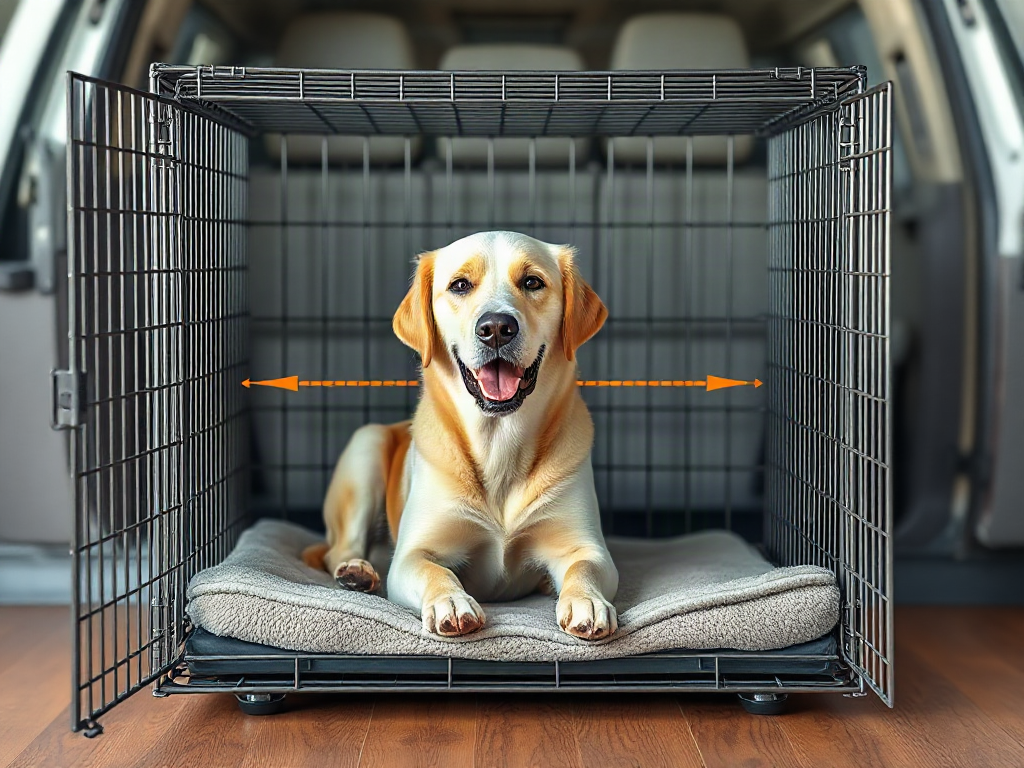
Airline-approved large dog crate measurements should be based on the dog’s body dimensions rather than weight or breed alone, with enough internal length to accommodate the nose-to-tail-base measurement plus part of the front-leg length. Internal height must allow the dog to stand naturally without its ears or head touching the roof, while width should permit an unrestricted turn. Measure the assembled crate’s exterior separately because airlines use outside dimensions for aircraft compatibility. A crate labeled “large” or “giant” is not automatically acceptable; airline rules, ventilation, hardware, route, and aircraft limitations still require confirmation before departure.
The Four Measurements That Determine Crate Size
A reliable fit assessment begins with the dog standing squarely on a level floor. Measuring a curled, seated, or reclining dog produces dimensions that do not represent the space needed to stand and reposition during transport. Use a soft tape or a rigid ruler held alongside the body, and have another person keep the dog facing forward without stretching its neck.
Record four body dimensions commonly described as A, B, C, and D in live-animal transport guidance. Measurement A runs from the tip of the nose to the root of the tail, not to the end of the tail. Measurement B is the height of the front leg from the floor to the elbow joint. Measurement C spans the dog at its widest point, usually across the shoulders or torso. Measurement D runs from the floor to the highest natural point of the head or ears.
The highest point deserves careful judgment. A large dog with upright ears may need substantially more vertical clearance than a similar-weight dog with folded ears. If the dog normally carries its ears erect, measure to their tips without pressing them down. For a dog whose head rises above its ears, measure to the top of the head. The resulting height should reflect a normal standing posture rather than an exaggerated upward stretch.
Repeat every measurement at least twice. Thick coats can hide the tail root and shoulder width, while an anxious dog may crouch during the first attempt. Part the coat where necessary and write down the largest credible result. Rounding down creates a predictable failure point: a dog that fits only when crouching does not have adequate standing clearance.
Weight remains relevant to the crate’s structural rating and airline handling, but it is a poor substitute for body measurements. A tall, narrow dog and a compact, broad dog can weigh the same while needing different crate proportions. Breed-based shopping has the same weakness because adult size and body shape vary within a breed.
The first fit check is physical rather than numerical. The dog should enter without ducking excessively, stand with a natural head position, turn around without becoming wedged, and lie down in a normal posture. If the ears scrape the roof, the shoulders rub both sides, or turning requires folding the body tightly, move up a size even if a product chart suggests the smaller model.
Turning Dog Measurements Into Internal Crate Dimensions
The body measurements become useful only after they are translated into minimum internal space. A commonly used sizing method sets crate length at A plus one-half of B, width at twice C, and height at D. These calculations provide a starting minimum for many dogs, but the finished selection must still pass the standing, turning, and lying-down test.
- Minimum internal length: A + ½B
- Minimum internal width: C × 2
- Minimum internal height: D
Consider a large dog with an 89 cm nose-to-tail-base length, a 30 cm floor-to-elbow measurement, a 25 cm body width, and a 76 cm standing height. The calculated internal target is at least 104 cm long, 50 cm wide, and 76 cm high. If a crate’s interior is 102 cm long, its exterior length of 110 cm does not solve the shortfall; the dog occupies the interior, so 102 cm is the number that matters for fit.
Flat-faced dogs and mixed breeds with shortened muzzles may be subject to additional airline restrictions, route limitations, or larger-crate expectations. The formula should not be treated as permission to choose the tightest possible enclosure. More room may be appropriate where an airline specifies it, but excessive empty space also has a tradeoff: a much larger container is harder to handle, may exceed aircraft loading limits, and gives the dog more room to be thrown off balance during movement.
For that reason, “size up” should mean selecting the next suitable crate that provides natural clearance, not automatically buying the largest model available. Compare the calculated minimum with each manufacturer’s verified internal dimensions. Product names such as XL, 500, 700, or giant are not standardized across brands and cannot be compared without measurements.
A common mistake is adding half the front-leg length to the tail measurement rather than to the nose-to-tail-base measurement. Another is measuring to the tail tip, which can overstate required length without improving usable posture. Follow the anatomical landmarks consistently, then test the actual dog in the assembled unit.
Keep the measurement sheet with booking records and photograph the dog standing inside the crate from the side and front. Those images do not guarantee acceptance, but they make it easier to identify a marginal fit before reaching the terminal. For a focused reference while comparing models, save the calculated figures alongside the Airline-approved large dog crate measurements you obtain from each product listing.
Internal Space Versus Published Exterior Dimensions
Internal dimensions determine whether the dog fits, while exterior dimensions determine whether the assembled crate can be accepted and loaded. These numbers are not interchangeable. Walls, door frames, ventilation rims, handles, wheel housings, and projecting fasteners can reduce interior room or increase the outside footprint.
Manufacturer listings frequently emphasize exterior length, width, and height because those measurements describe the product’s overall footprint. A molded plastic shell may lose several centimeters internally at the curved roof, tapered floor, and joining rim. The narrowest usable point—not the widest outside point—controls shoulder and ear clearance.
Measure the assembled crate yourself whenever possible. For the exterior length and width, include fixed projections that cannot be removed for transport. Measure height from the floor-contact point to the highest fixed component. Wheels usually need to be removed or securely disabled under carrier-specific rules, so confirm whether the published height includes them and whether the airline permits the particular wheel system.
Inside, measure the floor from the closed door to the rear wall, the narrowest width available to the dog, and the lowest roof clearance along the area where the dog stands. A crate with a domed top may provide adequate height in the center but insufficient room near the sides for a broad dog with erect ears. Door openings also matter: a suitable interior is of little use if the dog must be forced through a narrow entrance.
Aircraft compatibility introduces a separate constraint. A crate may satisfy the dog’s needs yet be too large for the aircraft type scheduled on a route. Large and giant kennels are especially vulnerable to cargo-door, compartment-height, transfer-station, and ground-handling limitations. Airline approval is therefore conditional rather than a permanent feature printed on a crate label.
Imagine an itinerary with a wide-body aircraft on the long-haul segment and a smaller aircraft on the connecting segment. The crate might fit the first aircraft but be rejected for the second. Codeshare travel can add another layer because the operating carrier’s rules may control the flight. Confirm every segment using the crate’s exterior dimensions, total loaded weight, and exact model rather than relying only on the marketing phrase “airline approved.”
The best comparison table has two lines for every candidate: calculated internal minimums for the dog and verified assembled exterior dimensions for the airline. Keeping those values separate prevents the most consequential purchasing error—choosing a container that satisfies only one side of the trip.
Airline Acceptance Checks Before Buying or Flying
No universal approval stamp guarantees that a large dog crate will be accepted on every airline or aircraft. International live-animal transport guidance influences many carrier policies, but each airline controls bookings, embargoes, route restrictions, crate construction details, and documentation. The operating airline should confirm the final requirements.
Contact the airline before purchasing a nonreturnable crate or finalizing the itinerary. Provide the dog’s breed or mix, age, weight, standing dimensions, crate exterior measurements, loaded weight estimate, route, and flight numbers. Ask whether the animal travels as checked baggage or manifested cargo, because the applicable process and acceptance location may differ.
Construction must be evaluated alongside measurements. Many large-dog movements call for a rigid, escape-resistant crate with ventilation on the required sides, a secure metal door, leak-resistant flooring, and hardware capable of keeping the upper and lower shells joined. Some carriers reject plastic clips as the sole means of joining shell halves and may require metal nuts and bolts. Door fasteners, ventilation openings, food and water arrangements, handles, and cable-tie procedures can also be airline-specific.
A compact preflight check should cover the following:
- Reconfirm the operating carrier and aircraft on every segment.
- Match the dog’s measurements against the crate’s usable interior.
- Report assembled exterior dimensions and loaded weight accurately.
- Verify shell hardware, door security, ventilation, bowls, bedding, and labeling.
- Check seasonal, breed, temperature, destination, and transfer restrictions.
Perform a trial assembly several days before departure. Install the required hardware, remove prohibited or unnecessary wheels, attach empty bowls as directed, and ensure no sharp bolt ends project into the occupied space. Let the dog stand and turn inside while the door is closed briefly under supervision. Successful fit looks unforced: the back and ears remain clear of the roof, the sides do not compress the shoulders, and the dog can lower itself to the floor without becoming trapped against a wall.
Failure signs include bent ears, a lowered head, repeated shoulder contact, an inability to pivot, flexing shell joints, or a door that can be pushed outward. Do not attempt to solve a small crate by trimming coat, pressing ears down, or presenting only favorable photographs. Replace the crate or revise the itinerary if the appropriately sized model exceeds the aircraft’s limits.
Recheck requirements shortly before travel because schedules, aircraft assignments, weather restrictions, and acceptance procedures may change. Bring written confirmation where available, but expect airport or cargo staff to inspect the actual animal and container. A detailed comparison of Airline-approved large dog crate measurements should support that inspection, not replace the carrier’s current decision.
Frequently Asked Questions
Are airline-approved crate sizes based on a dog’s weight?
No. Weight helps determine structural and handling limits, but body length, leg height, width, and standing height determine fit. Dogs of equal weight can require different crate shapes.
Should crate dimensions be measured inside or outside?
Use internal dimensions to evaluate the dog’s space and assembled exterior dimensions to confirm aircraft and airline compatibility. Record both sets because neither can substitute for the other.
Can a dog’s ears touch the top of an airline crate?
The dog should be able to stand naturally without its head or normally erect ears contacting the roof. Persistent contact indicates inadequate usable height.
Does an “airline approved” label guarantee acceptance?
No. Acceptance depends on the operating carrier, route, aircraft, crate construction, dog, loaded weight, weather restrictions, and current airline policy.
What if the correct crate is too large for the scheduled aircraft?
Do not downsize the crate below the dog’s needs. Ask the airline about a different aircraft, routing, date, cargo arrangement, or qualified animal-transport service.
Further Reading
Authoritative Sources
- IATA Live Animals Regulations
iata.orgIATA explains the live-animal transport framework used by many airlines, including container and handling considerations
- USDA APHIS Pet Travel
aphis.usda.govUSDA APHIS provides official information about animal travel requirements and destination-specific planning
- U.S. Department of Transportation: Traveling With Animals
transportation.govThis federal resource outlines practical questions and consumer considerations for animals transported by air
- International Pet and Animal Transportation Association
ipata.orgIPATA offers resources for locating professional animal shippers when a large-dog itinerary requires specialist handling
Conclusion
Accurate crate selection requires two separate decisions: whether the interior fits the dog and whether the exterior fits the airline’s operating limits. Measure the dog while standing naturally, calculate the minimum internal space, and test turning, standing, and lying down in the assembled crate. Then document the crate’s true outside dimensions, fixed projections, hardware, and loaded weight for the airline.
Treat manufacturer size names and “airline approved” claims as starting points rather than final clearance. Confirm every flight segment with the operating carrier, especially when a large kennel, connection, codeshare, upright-eared dog, or restricted breed is involved. If suitable dimensions conflict with aircraft limits, change the itinerary instead of forcing the dog into a smaller enclosure.