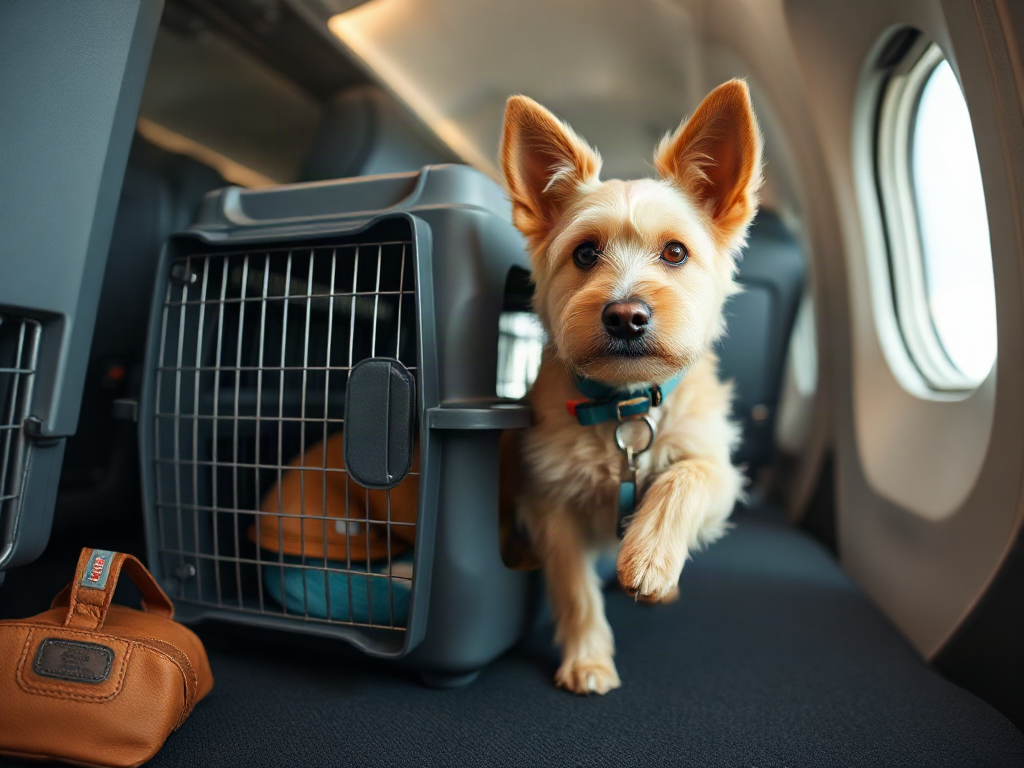
The best dog kennel styles for air travel are airline-sized soft carriers for eligible cabin dogs and rigid, securely fastened plastic kennels for dogs transported in the aircraft hold. Cabin carriers must fit beneath the assigned seat while giving the dog enough usable space to settle, and hold kennels need ventilation, a secure metal door, leak-resistant flooring, and adequate standing and turning room. Wheeled, collapsible, and wire kennels are convenient on the ground but are frequently unsuitable for aircraft transport. Confirm the operating airline’s dimensions, route restrictions, and kennel rules before buying because acceptance standards and aircraft clearances vary.
Match the Kennel Style to Cabin or Hold Transport
The first decision is not brand or price; it is where the dog will travel. A small dog accepted in the passenger cabin needs a carrier that fits beneath the seat specified by the operating airline. A dog traveling as checked animal transport or manifest cargo generally needs a rigid kennel built for handling outside the cabin. These environments impose different demands, so a design that performs well in one may be rejected in the other.
Cabin space is constrained by the aircraft and seat assignment. Soft-sided carriers are commonly favored because their upper panels can compress slightly during placement beneath a seat. That flexibility does not make an oversized carrier acceptable, however. The dog still needs usable interior space, and the carrier cannot obstruct the aisle or be forced into a space that collapses its ventilation panels. Under-seat measurements advertised by a retailer should be treated as a starting point rather than airline approval.
Transport in the hold introduces baggage handling, movement on service vehicles, temperature exposure during transfers, and the possibility of other items being positioned nearby. A rigid shell protects the dog’s space more reliably than fabric. Secure hardware, ventilation openings, a projecting rim or spacer, and a door that cannot be pushed open become more consequential than portability or storage convenience.
Route details can change the answer. A trip sold by one airline may include a flight operated by another carrier with different aircraft and animal policies. International travel may also involve destination permits, health documentation, seasonal restrictions, or an animal-handling agent. A kennel described as compliant by a seller does not override those requirements.
Start by obtaining written dimensions and animal-transport conditions for every operating carrier. Then decide whether the dog can realistically use the allowed cabin space. If not, investigate the airline’s hold or cargo program before purchasing a kennel. The broader comparison of Best dog kennel styles for air travel should always be narrowed by the actual route, aircraft, and booking method.
Soft-Sided Cabin Carriers: Flexible but Size-Sensitive
A structured soft-sided carrier is usually the most workable cabin style for a small dog because it balances under-seat flexibility with a defined interior. Look for a firm base, mesh ventilation on multiple sides, secure zipper closures, and enough panel structure to keep fabric away from the dog’s face. A carrier that folds flat for storage but sags around the dog during use is a weaker choice.
Usable interior dimensions matter more than the exterior length printed on a product page. Thick padding, inward-sloping walls, wheel housings, and storage pockets can reduce the space available to the dog. Measure the dog while standing naturally and while lying in the position used for resting. Compare those measurements with the carrier’s interior, then compare its exterior with the airline’s stated limit. If the dog can enter only by crouching sharply or cannot reposition without becoming wedged, the model is too small even if it fits beneath the seat.
Consider a short-nosed dog traveling in a carrier with mesh only on the top. Once that top panel sits close to the seat structure, airflow may be restricted. A model with substantial side and end ventilation preserves more open mesh in the installed position. Ventilation should not be covered by a large accessory pocket, blanket, or privacy flap during the flight.
Security deserves close inspection. Zippers should meet at a point that can be clipped together if the airline permits it, and seams around the mesh should resist a dog that scratches or pushes. An internal tether can reduce escape risk while the carrier is open, but it should attach to a harness rather than a collar and should not remain so short that it restricts normal positioning. The kennel must stay closed while under the seat unless crew instructions allow otherwise.
Expandable side panels are useful in an airport waiting area only when there is safe room to deploy them. They generally must be closed for boarding and in-flight stowage. Backpack straps and shoulder straps can simplify terminal movement, but they should tuck away rather than trail into the aisle. Choose these conveniences after confirming fit, ventilation, and closure strength—not instead of them.
Rigid Plastic Kennels for Transport in the Hold
A rigid plastic kennel with a metal door is the standard style to investigate when a dog cannot travel in the cabin. Its shell maintains a protected volume around the animal and offers attachment points for secure assembly. The best candidate has a solid, leak-resistant floor, ventilation on the required sides, no sharp interior projections, and a door that closes positively without relying on a simple twist latch that could be bumped open.
Shell construction should be examined rather than assumed. Press on the roof and side walls; excessive flex can distort the doorway or loosen the joint between the upper and lower halves. Check that the door sits squarely in its frame and that its pins engage fully. Many animal-transport programs require the shell halves to be joined with metal nuts and bolts rather than plastic clips alone. Airline instructions govern, so replace hardware only in a manner the carrier accepts.
Correct sizing gives the dog room to stand naturally without the head or ears contacting the roof, turn around, and lie in a normal position. External dimensions can mislead because the roof may curve inward and the floor may narrow at the base. Test the assembled kennel with the dog inside rather than calculating from a weight label. Breed-based size charts are especially unreliable for dogs with unusually long bodies, upright ears, broad shoulders, or tall legs.
For example, two dogs of equal weight may require different kennels: a compact, broad dog may need more width, while a lightly built, long-legged dog needs greater height. Buying according to the maximum weight printed on the box can leave either dog poorly fitted. Moving up a size may solve the problem, but the larger kennel must still fall within the airline and aircraft limits.
Food and water containers, absorbent lining, exterior identification, and live-animal labels may be specified by the airline or route. Bedding should not create loose folds that block ventilation or expose material likely to be shredded and swallowed. Crate-training should occur well before departure so the kennel is a familiar resting place, but familiarity cannot compensate for defective hardware or inadequate dimensions.
Styles and Features That Commonly Cause Problems
Convenient household kennel styles are not automatically suitable for an aircraft. Wire crates provide generous ventilation at home, yet they offer little shielding from adjacent objects and may have folding joints that shift during handling. Fabric pop-up crates lack a protective shell. Decorative wooden kennels are heavy, poorly ventilated for transport, and difficult to inspect. Unless an airline expressly approves an unusual design, these styles should remain at home.
Wheels create another tradeoff. They make a large kennel easier to move through a terminal, but fixed wheels can allow uncontrolled rolling and may increase the kennel’s overall height. Some airlines require wheels to be removed or securely disabled. If selecting a wheeled model, verify that removal leaves no sharp posts and does not weaken the base. A separate kennel trolley is often easier to detach before handover.
Collapsible plastic kennels require careful scrutiny. A folding design may save storage space, but each hinge and locking panel introduces another potential movement point. Confirm that all walls lock rigidly and ask whether the exact construction is accepted for the booked service. A molded two-piece shell is less compact at home but usually easier to inspect for correct assembly.
“Airline approved” is one of the weakest assumptions a buyer can make. There is no single product label that guarantees acceptance by every airline, aircraft, country, or itinerary. Policies may address dimensions, ventilation placement, door material, bolt type, handles, wheel removal, feeding dishes, and breed restrictions. A product listing may reflect common design expectations without accounting for the operating carrier’s current rules.
Avoid modifying a kennel in ways that compromise the shell. Drilling ventilation holes too close together can weaken plastic, while attaching accessories through the wall can create interior projections. Zip ties may be requested as secondary closure security on some routes, but they should not substitute for proper bolts or a functioning door latch. Compare any prospective design against official instructions before purchase; a detailed resource on Best dog kennel styles for air travel cannot replace route-specific confirmation.
Final Fit and Airline-Acceptance Checklist
A useful inspection recreates the conditions under which the kennel will be used. Assemble every panel, insert the intended pad and bowls, and place the dog inside. Observe whether the animal can stand, rotate, and settle without the body being pressed against the walls. For a cabin carrier, measure it while packed as it will be on departure day rather than while empty and compressed.
Complete these checks before the airline’s booking or documentation deadline:
- Verify the operating flight: confirm which carrier operates every segment and whether dogs are accepted through the intended cabin, hold, or cargo program.
- Record exact limits: obtain the permitted exterior dimensions, kennel construction rules, combined weight conditions, and check-in location directly from the carrier.
- Test the dog’s space: assess standing height, turning room, resting position, ventilation clearance, and the effect of pads or bowls on usable area.
- Inspect every closure: test zippers, door pins, bolts, shell joints, handles, and wheel removal without the dog inside first.
- Practice calmly: build duration in the closed kennel at home and conduct a short carried or trolley-based rehearsal without using the flight day as the first full test.
Signs of a workable match include a kennel that stays structurally stable when lifted, ventilation that remains exposed in the travel position, and a dog that can change posture without scraping the roof or becoming trapped against a narrowing wall. Repeated escape attempts, persistent fabric collapse, disengaging door pins, or a base that bows under the dog’s weight indicate a design or conditioning problem that should be resolved before departure.
Leave time for replacement. An airline employee may reject a kennel that is damaged, incorrectly assembled, too small, or inconsistent with the booked service. Taking photographs of the product label and assembled hardware can make preflight questions clearer, but only the airline can confirm acceptance. Recheck the policy shortly before travel because equipment, route, and seasonal conditions may affect animal transport.
Frequently Asked Questions
Are soft or hard kennels better for flying with a dog?
Soft-sided carriers are generally more practical for eligible cabin dogs because they fit constrained under-seat spaces. Rigid plastic kennels are usually the appropriate style for hold or cargo transport because they preserve a protected interior.
Does an airline-approved label guarantee that a kennel will be accepted?
No. Acceptance depends on the operating airline, route, aircraft, dog, dimensions, hardware, and transport program. Compare the exact kennel with the carrier’s current written requirements.
How much room should a dog have in an air-travel kennel?
The dog should be able to stand naturally, turn around, and lie in a normal resting position. Measure usable interior space because curved walls, padding, and bowls can reduce room.
Can a wire dog crate be used for air travel?
Wire household crates are commonly unsuitable for aircraft holds because they provide limited shielding and may fold or shift. Use one only if the operating airline explicitly accepts its exact construction.
Should kennel wheels be removed before a flight?
Airlines may require wheels to be removed or made inoperable so the kennel cannot roll. Check the policy and test removal in advance to ensure no sharp or unstable parts remain.
Further Reading
Authoritative Sources
- USDA APHIS Pet Travel
aphis.usda.govOfficial information on animal travel requirements, documentation, and destination-specific planning for trips involving the United States
- U.S. Department of Transportation: Traveling With Animals
transportation.govConsumer guidance covering airline animal policies and questions travelers should resolve before flying with a dog
- IATA Traveler’s Pet Corner
iata.orgIndustry information explaining core planning issues for pets transported by air and the role of airline-specific requirements
Conclusion
Choose the kennel around the dog’s booked transport environment rather than a retailer’s broad approval claim. A structured soft carrier suits cabin use only when its packed exterior fits beneath the assigned seat and its interior still allows safe positioning. For hold transport, prioritize a rigid plastic shell, secure metal door, sound fasteners, exposed ventilation, and a size matched to the dog’s actual proportions.
Confirm every flight segment with the operating airline before buying, then inspect the assembled kennel with the pad, bowls, and removable accessories installed. Replace any model that collapses around the dog, flexes at the doorway, blocks airflow, or relies on questionable closures. Early route verification and a realistic fit test prevent more problems than added pockets, wheels, or other convenience features.