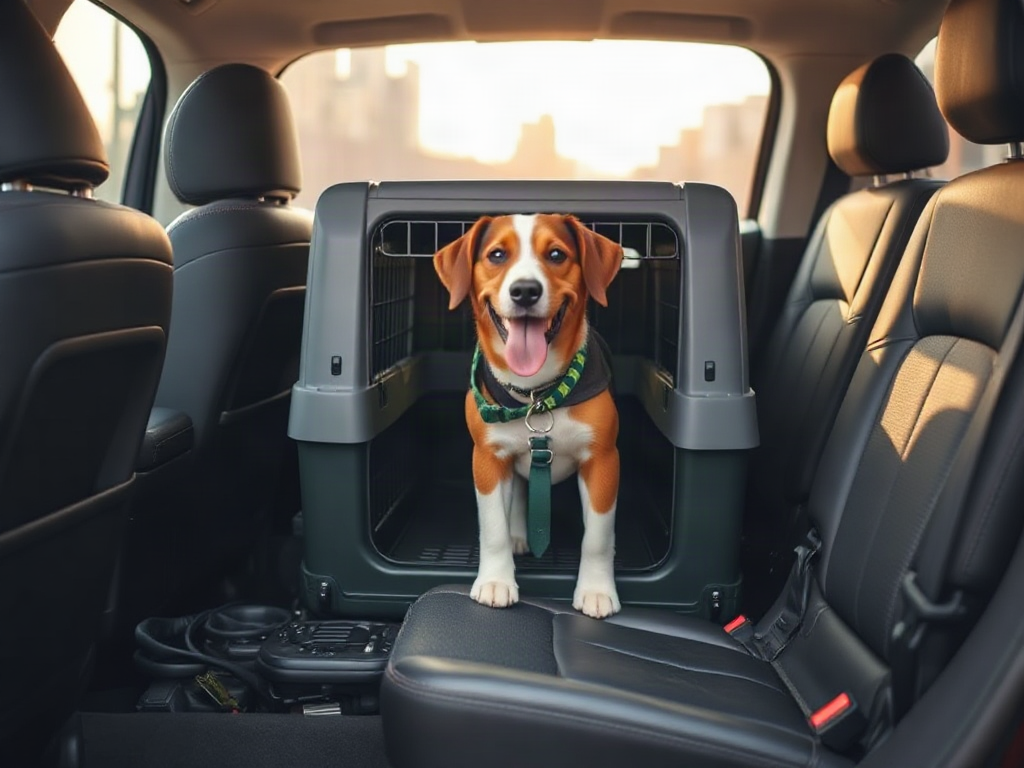
The safest dog crate designs for car travel combine a rigid, impact-resistant shell with secure door hardware, restrained attachment points, and dimensions that limit the dog’s movement without crowding. A crate should be anchored according to its manufacturer’s instructions so it cannot slide, rotate, or become a projectile during sudden braking. Crash-test evidence from an independent organization is more informative than labels such as “heavy duty” or “automotive grade,” which do not establish performance by themselves. Correct vehicle placement, adequate ventilation, protected edges, and a fit that lets the dog stand, turn, and lie naturally complete the safety setup.
Crate Structures That Manage Collision Forces
A car crate should be judged as a restraint system rather than as a portable enclosure. During hard braking or a collision, the structure must contend with the dog’s forward motion, loads transferred through its anchors, and possible contact with seats or interior trim. Thick-looking walls alone do not reveal whether the entire assembly can remain intact under those combined forces.
Rigid crates made from reinforced polymers, aluminum, steel, or carefully engineered combinations of those materials may provide useful protection, but material names are not performance ratings. A strong metal frame can still fail at a weak weld, hinge, latch, or anchor. A plastic shell may absorb some energy yet split around fasteners if its load paths are poorly designed. Inspect how the roof, floor, walls, door frame, and attachment points connect rather than evaluating one panel in isolation.
Purpose-built automotive crates often use reinforced corners, recessed hardware, limited door openings, and shaped frames intended to preserve an occupied space. Some are designed to deform in a controlled way rather than remain perfectly rigid. Controlled deformation may reduce transferred force, but only when it is part of a tested design; visible flexibility in an ordinary crate should not be assumed to provide the same benefit.
Wire crates offer airflow and visibility, but many folding models rely on removable pans, hooked panels, and collapsible joints. Those qualities are convenient at home and less reassuring in a vehicle, where panels may distort or separate under load. Soft-sided crates are useful for carrying a calm dog through a hotel or terminal, yet fabric walls and zipper closures generally provide limited collision containment. Neither design should be treated as crash protection without credible model-specific evidence.
Look for independent testing that identifies the exact model and size, describes the attachment method, and publishes a test protocol or result. A vague statement that a crate was “tested” does not say what conditions it faced or whether it passed. Certification also should not be transferred from one size to an entire product family unless the testing body explicitly covers those versions. Readers comparing the safest dog crate designs for car travel should place documented performance above decorative padding, storage pockets, or a rugged appearance.
The practical priority is structural continuity: strong walls, a door frame that resists spreading, hardware that remains engaged, and anchors integrated into load-bearing parts. A failure at any one of those points can negate strength elsewhere. Check for cracks, bent rails, loose rivets, corrosion, or distorted latch alignment before every long trip and after any abrupt vehicle incident.
Anchoring, Door Security, and Escape Resistance
Even a well-built crate cannot protect effectively if it moves freely through the cabin. An unrestrained enclosure may strike a seat, window, passenger, or cargo area during a sudden stop. The correct restraint arrangement is the one specified for that crate and vehicle position, not an improvised cord looped around whichever handle is easiest to reach.
Some automotive crates attach through rated straps, built-in tie-down rails, cargo hooks, or vehicle-specific mounting systems. Attachment points should connect to structural areas identified by the manufacturer. Carry handles, ventilation slots, removable wire panels, and thin plastic lips may break when used as anchors. Household bungee cords are intended to manage light cargo movement, not collision loads, and their hooks may release or become hazardous.
Restrain movement in multiple directions. A setup that stops forward sliding may still allow the crate to tip, rotate, or move sideways during an evasive maneuver. Once installed, push firmly at the top and base from several angles. Minor compliance in a designed mounting system may be normal, but obvious travel, lifting, or strap slippage signals that the installation needs correction. Straps should lie flat, avoid sharp edges, and remain accessible for periodic tension checks.
Door construction deserves equal attention because the opening interrupts the crate’s frame. Multi-point latches can distribute closure loads better than one small bolt, provided every latch engages completely. Hinges should not expose large gaps or removable pins that a paw can manipulate. A secondary lock may deter an escape-prone dog, but it must not obstruct rapid human access after an incident. Padlocks and complicated clips can delay release when seconds matter.
Consider a rear-impact scenario in a hatchback: a crate placed directly against the liftgate has little buffer behind it, and a door facing the hatch may become inaccessible if the vehicle is damaged. A side or emergency exit can provide another route, although an extra opening also adds hinges and latches that require inspection. The value depends on the vehicle layout and the tested design, not simply the number of doors.
Do not attach an internal leash to the dog’s collar while the crate is moving. A tether can wrap around the neck or limbs as the dog changes position. Remove loose bowls, toys, and heavy accessories that could become impact objects. If water is needed on a long drive, use a securely mounted container during stops or choose a low-profile unit approved for that crate rather than leaving a full household bowl on the floor.
Sizing and Positioning the Crate Inside a Vehicle
Safe sizing balances normal posture against excessive travel inside the enclosure. The dog should be able to stand without hunching, turn around, and lie in a natural position. A much larger crate creates more distance over which the dog can accelerate before contacting an interior surface, while an undersized crate can force awkward posture, restrict ventilation around the body, and make longer drives stressful.
Measure the dog rather than relying only on breed labels or body weight. Record nose-to-rump body length, floor-to-top-of-head or ear height in a normal standing posture, and shoulder width. Compare those measurements with the manufacturer’s usable internal dimensions, accounting for sloped walls, door frames, wheel-well cutouts, and any installed mat. External dimensions matter separately because they determine whether the unit fits through the vehicle opening and sits level in its intended location.
A thick bed can quietly create a sizing problem. It reduces headroom, shifts the dog higher in the crate, and may block low ventilation openings. Use a thin, non-slip mat that does not bunch under braking, unless the crate maker specifies another insert. Large cushions, loose blankets, and chewable foam add snagging or ingestion risks. Comfort should come from stable footing, suitable temperature, and gradual acclimation rather than deep bedding.
Position the crate where it can be anchored securely and kept away from foreseeable hazards. The cargo area of an SUV may provide usable tie-down geometry, but it can also expose the crate to liftgate intrusion, direct sun through rear glass, or unrestrained luggage. A rear seat may work for a small model only when the manufacturer authorizes that installation and the base sits securely; placing a crate on a seat and running a belt around it is not automatically safe.
Front passenger placement should generally be avoided because of dashboard proximity and airbag deployment risk. Never place the enclosure where it interferes with the driver, blocks mirrors, obstructs an exit, or rests on a folded surface that cannot support it consistently. Vehicle airbags and child-restraint anchors have specific intended uses, so do not assume they can secure a dog crate unless both vehicle and crate instructions explicitly support the arrangement.
Airflow must remain open on all specified sides. A powerful rear climate vent does not guarantee safe conditions if luggage blocks the crate or the engine is off in warm weather. Check the dog directly during stops for heavy panting, drooling, agitation, lethargy, or unusual breathing. These signs require prompt attention and may reflect heat, distress, or illness rather than a simple dislike of travel. Vehicle fit, thermal exposure, and anchor access should therefore be evaluated together when reviewing safest dog crate designs for car travel.
Car-Crate Safety Inspection Checklist
A useful inspection follows the path from vehicle structure to dog, because each connection affects the next. Perform the full check when installing a crate, repeat it before a major trip, and make a shorter visual check before routine drives. Reinspect after emergency braking, a minor collision, or any event that shifts the enclosure or surrounding cargo.
- Confirm model-specific evidence: Find the exact crate size in independent test information, not merely a brand-wide marketing claim.
- Verify vehicle fit: Close every door or hatch slowly and confirm that the crate does not contact glass, latches, seat mechanisms, or controls.
- Inspect the structure: Look for cracked shells, bent frames, sharp edges, loose fasteners, damaged welds, or panels that no longer align.
- Test doors and latches: Engage every closure, pull firmly on the door, and ensure an adult can operate the release promptly.
- Check each restraint: Confirm that straps or mounts follow the instructions, remain properly tensioned, and attach only to approved points.
- Clear the surrounding area: Restrain luggage and remove tools, bottles, or equipment that could strike or block the crate.
- Assess the dog’s fit: Watch the dog enter, turn, stand, and settle without catching paws, ears, tags, or coat on hardware.
A parked-vehicle test can reveal installation faults without creating road risk. Load the crate, secure it, close the vehicle, then push at the base and upper corners. Open each intended human exit and confirm that emergency access to the dog remains possible. Sit where passengers will ride to check that the crate does not alter seat locking, belt routing, or visibility.
Next, introduce the dog while the vehicle is stationary. A crate that is structurally suitable can still fail in practice if the dog panics, claws continuously, bites vents, or throws its body against the door. Build familiarity at home, feed treats inside with the door open, progress to brief closed-door periods, and then try short drives. Signs of progress include voluntary entry, relaxed posture, normal breathing, and the ability to settle. Escalating escape behavior, damaged teeth or nails, persistent vomiting, or severe distress calls for a pause and guidance from a veterinarian or qualified behavior professional.
Budget decisions should protect the core system first. Spend on credible testing, correct size, durable closures, and a compatible mounting method before paying for cosmetic finishes or convenience accessories. A used crate may reduce cost, but hidden collision damage, missing mounts, unavailable instructions, and obsolete replacement parts can erase that advantage. Ask for its history and compare every component with the current manufacturer documentation.
Retire a crate when deformation, cracks, door misalignment, damaged anchors, or manufacturer guidance indicates replacement. Repairs involving drilled holes, substituted bolts, welded frame changes, or homemade straps may alter how loads move through the design. Unless the manufacturer approves the repair, replacement is the safer assumption for a damaged safety-critical component.
Frequently Asked Questions
Are wire dog crates safe for car travel?
Folding wire crates provide ventilation but may deform or separate at joints during an impact. Use one as collision protection only if the exact model and size have credible test evidence and an approved vehicle-restraint method.
Should a dog crate face forward or sideways in a car?
Follow the crate manufacturer’s tested installation orientation. Direction alone cannot establish safety because anchor geometry, vehicle layout, crate design, and access after a collision all affect performance.
Can I secure a crate with the vehicle seat belt?
Only use a seat belt if the crate instructions specifically approve that routing and position. Wrapping a belt around an ordinary crate may crush it, allow rotation, or place force on parts not designed as anchors.
How much room should a dog have inside a car crate?
The dog needs enough usable space to stand normally, turn around, and lie comfortably. Avoid excessive extra length or height, and include the thickness of the mat when checking internal clearance.
Is a crash-tested crate guaranteed to protect a dog?
No crate can guarantee protection in every collision. Testing offers valuable comparative evidence, but outcome also depends on correct installation, impact conditions, vehicle deformation, crate condition, dog size, and nearby cargo.
Further Reading
Authoritative Sources
- Center for Pet Safety
centerforpetsafety.orgIts testing and certification information helps readers distinguish model-specific crash evidence from general product claims
- National Highway Traffic Safety Administration: Seat Belts
nhtsa.govThis vehicle-safety resource explains the broader role of occupant restraint and secure positioning during travel
- American Veterinary Medical Association: Traveling With Your Pet FAQ
avma.orgThis veterinary resource covers preparation, health documentation, identification, and welfare concerns related to pet travel
Conclusion
Choose a car crate by examining the complete restraint system: documented model-specific testing, structural connections, door integrity, compatible anchors, and an appropriately close fit for the dog. Confirm that the selected size fits through the vehicle opening, mounts in the approved orientation, stays clear of airbags and controls, and remains accessible if a hatch or door becomes damaged.
Before the next drive, remove loose accessories, restrain nearby luggage, test the installation from several directions, and watch the dog settle inside while parked. Replace damaged components rather than improvising structural repairs. A calm dog in a securely mounted crate with sound hardware and open ventilation is a better safety setup than a premium-looking enclosure that slides, flexes at its joints, or lacks meaningful performance evidence.