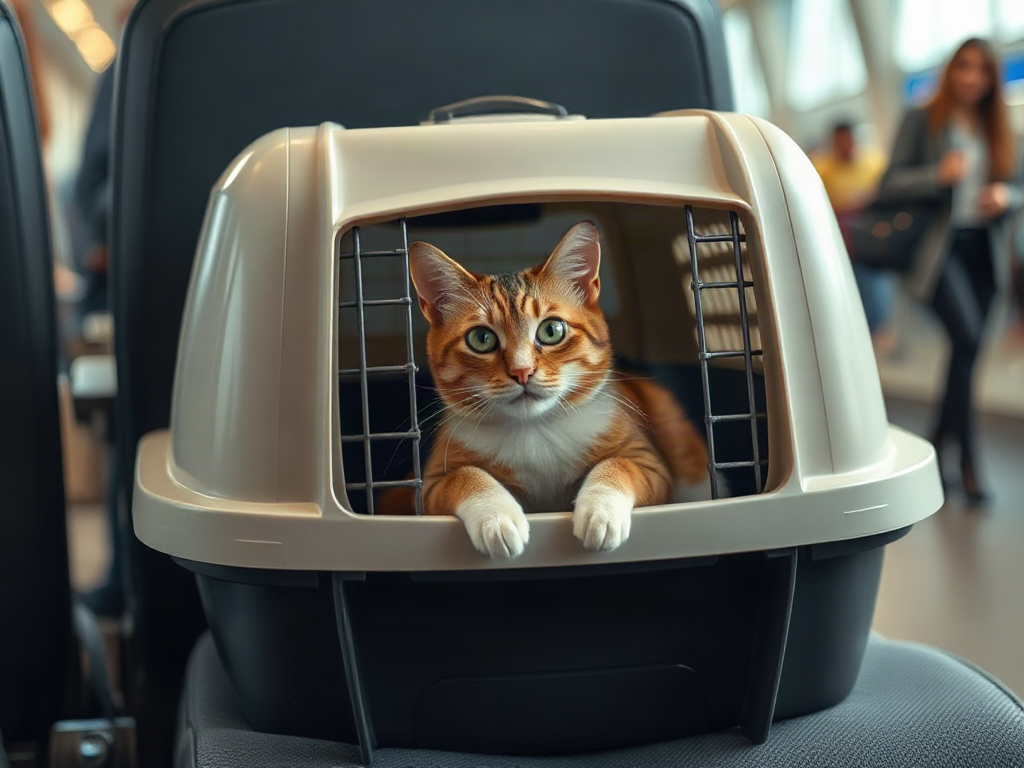
A comfortable airport cat carrier should fit the airline’s current under-seat limits while providing stable structure, generous ventilation, secure closures, and enough usable space for the cat to reposition naturally. A removable absorbent liner manages accidents, while a firm base prevents the floor from folding around the cat during terminal transfers. Look for locking zipper clips, an internal tether used only with a well-fitted harness, and openings that allow controlled access at security. Confirm the exact aircraft and itinerary rules before departure, because an expandable carrier or advertised “airline-approved” model may still be refused if its dimensions exceed the airline’s allowance.
Match the Carrier to Cabin and Cat
Airline dimensions and the cat’s usable interior space must be evaluated together. A carrier can fit beneath a seat yet be too cramped once its padded liner, sloping roof, and inward-bending sides reduce the interior. Conversely, a carrier that gives a cat abundant headroom at home may be too tall for the assigned aircraft. Measure the carrier while it is packed as it will be flown, then compare its external length, width, and height with the operating airline’s published limits.
Under-seat space is not uniform across airlines, aircraft, cabins, or seat locations. A codeshare creates another complication: the airline selling the ticket may not operate the flight. Confirm the rules with the operating carrier for every segment, including limits on combined animal-and-carrier weight where applicable. Labels such as “TSA approved” or “airline approved” do not guarantee acceptance. The Transportation Security Administration manages screening in the United States, while the airline determines whether the carrier and animal may enter the cabin.
Soft-sided designs are often practical for cabin travel because their upper edges can compress slightly beneath a seat. That flexibility has a limit. A carrier should not be crushed until its roof rests on the cat, its ventilation panels fold shut, or the base buckles. Rigid carriers retain shape better and may offer more impact protection, but their fixed dimensions leave little tolerance when under-seat height is tight. For most cabin itineraries, a structured soft-sided model balances limited flexibility with an interior that remains open.
Fit should be assessed when the cat is standing or repositioning, not only when curled asleep. The animal should be able to lie in a natural posture and adjust its body without being wedged against every surface. Airline size constraints can make ideal spaciousness impossible, especially for a large cat. If the only compliant carrier forces severe crowding, discuss alternatives with the airline rather than assuming a longer flight will be manageable.
Book the pet reservation before relying on a carrier purchase. Airlines commonly limit the number of in-cabin animals, and some seats cannot accommodate pet carriers. For a connection, verify each segment rather than checking only the longest flight. Readers comparing Cat carrier features for comfortable airport travel should treat itinerary compatibility as the first filter; premium padding cannot correct a carrier that is refused at check-in or cannot safely fit beneath the seat.
Prioritize Ventilation, Structure, and Floor Support
Airflow must remain available from more than one direction after the carrier is placed under the seat. Mesh on several sides lets air circulate even when one panel faces luggage, a seat support, or the owner’s leg. Inspect the actual open area rather than counting mesh panels: decorative fabric, storage pockets, and expandable sections may cover a surprising amount of ventilation. Dense mesh can resist claws well, but it should not be so heavy that it severely restricts airflow or visibility.
A darkened carrier may help some cats settle, yet fully covering the mesh can trap heat and reduce observation. If visual shielding is useful, choose a model with partial privacy panels or place a light cover over only part of the exterior while keeping vents open. Airport cabins and terminals vary in temperature, so the safer design allows privacy to be adjusted rather than permanently closing the cat in. Panting, pronounced restlessness, drooling, or persistent attempts to find an air opening require prompt attention; panting in cats can warrant urgent veterinary guidance.
Structure matters because soft fabric alone can sag into the occupied space. Look for a frame or reinforced seams that hold the roof away from the cat when the bag is carried. Press gently on an empty display model: the walls may flex, but they should return to shape without collapsing. A very rigid frame is not automatically better, since it may prevent the slight compression needed under a low seat. The useful middle ground is controlled flexibility around a stable interior.
The floor should stay level when the carrier is lifted by its handles or shoulder strap. A thin base can bow around the cat, making every terminal step unstable. A removable board or firm insert spreads weight across the carrier, while a non-slip padded liner gives the paws traction. Place an absorbent layer beneath a washable cover so urine does not immediately soak the cat’s coat. Thick bedding can feel inviting at home but may reduce headroom and hold heat, so test it inside the fully assembled carrier.
Carry balance is another overlooked comfort feature. Short handles that join above the center of gravity generally produce less swinging than a long, loose shoulder strap. A luggage sleeve can stabilize the bag on a rolling suitcase, provided the carrier remains upright and supervised. Never place loose belongings on top, and do not allow pockets to bulge inward. A useful floor-and-airflow check is simple:
- Lift: Confirm that the base stays flat and the walls remain clear of the cat.
- Place: Set the packed carrier beneath a chair and verify that vents remain open.
- Observe: Check whether the cat can settle without sliding toward one corner.
- Clean: Make sure the liner can be removed without dismantling the entire bag.
Choose Closures and Access Points That Limit Escape Risk
Secure closures should resist both accidental opening and persistent pawing. Two-way zippers are convenient, but zipper pulls that meet without a clip can separate as a cat pushes against the seam. Choose pulls that lock together with an integrated clasp or small removable fastener. Inspect the zipper track at corners, where strain is concentrated, and reject loose stitching, large gaps, or mesh that can be pulled away from its binding.
Multiple doors improve handling only when each one can be secured reliably. A top opening allows a reluctant cat to be lowered into the carrier with better body support, while a full side door suits cats trained to walk inside. A smaller hand-access panel can help with a liner adjustment, but it also creates an escape point if the owner reaches in casually in a noisy terminal. Open only one closure at a time, keep the cat’s body controlled, and close the panel before changing your grip.
An internal tether is a backup attachment, not a restraint to clip onto a collar. A sudden pull against a collar can injure the neck or allow the cat to slip free. If a tether is used, attach it to a properly fitted harness and keep it short enough to prevent the cat from reaching an open door, yet loose enough for a normal resting position. Remove or shorten an excessively long lead that could wrap around a leg. The carrier should remain closed during ordinary movement; the tether does not make an open bag safe.
Security screening deserves advance planning. In the United States, the carrier normally goes through the screening equipment without the cat inside, which means the animal must be controlled during the handoff. A harness and leash provide a second layer of control, but fit matters: a frightened cat can reverse out of a loose harness. Travelers concerned about handling a cat in an open checkpoint can ask screening personnel about available alternatives, such as a private screening room. Procedures can vary, so request assistance before opening the carrier rather than after the cat becomes distressed.
Expandable compartments offer extra room while waiting at the gate, but they should be treated as stationary features. An expanded panel can snag, tip, or open when the bag is lifted, and it may obstruct a walkway. Retract and secure it before moving or boarding. A carrier with fewer, stronger openings may be a better choice for an escape-prone cat than a feature-heavy model with many zippers. More access is useful only when it improves controlled handling.
Check Comfort and Airport Usability Before Departure
A carrier’s performance should be tested with the cat well before the airport. Leave it open in a familiar room with the flight liner installed, then allow voluntary exploration and short resting periods. Once the cat enters comfortably, practice closing the door briefly, lifting the bag, walking through the home, and taking a short vehicle ride. This sequence reveals sagging floors, noisy hardware, rubbing seams, and poor balance without adding terminal noise or a departure deadline.
Signs of progress are specific: the cat enters without being forced, can turn or settle, and recovers soon after brief movement. Repeated clawing at one mesh panel may indicate an escape habit, but it can also expose a weak seam or an interior obstruction. Sliding whenever the carrier is lifted points to inadequate floor grip. A roof that folds onto the animal under the shoulder strap indicates a structural problem, not something the cat should simply learn to tolerate.
Inspect practical airport details with the carrier loaded to travel weight. Exterior pockets should hold only flat necessities, such as documents, waste bags, and a spare absorbent pad; bulky containers can steal interior room. Handles need reinforced attachment points, and the shoulder strap should have hardware that cannot rotate open under tension. A luggage sleeve should fit the suitcase handle closely enough to prevent leaning. If the carrier shifts sharply when the suitcase turns, carry it separately.
Plan for cleaning without creating an escape opportunity. Pack at least one replacement liner in a sealed bag and another bag for soiled material. If an accident occurs, use a fully enclosed location when possible and keep the cat harnessed while changing the pad. Sprays, loose bowls, toys, and large blankets can become clutter inside a restricted cabin carrier. A familiar, thin liner often provides more practical comfort than several accessories that reduce space.
Before leaving home, complete a final operational check rather than relying on the product description:
- Confirm the operating airline, aircraft-specific allowance if available, pet reservation, and required documents.
- Measure the packed carrier externally and check that no pocket exceeds the limit.
- Examine every zipper, clip, mesh seam, handle, tether, and base insert.
- Fit the harness so the cat cannot back out, then identify how screening will be handled.
- Practice placing the carrier beneath a chair without blocking ventilation or crushing its frame.
Do not introduce an untested sedative solely for flight day. A veterinarian familiar with the cat’s health and itinerary can advise on motion sickness, severe anxiety, medical needs, and whether any prescribed medication should be trialed beforehand. Product design cannot compensate for respiratory distress, uncontrolled panic, or an animal that is medically unfit to fly. The strongest Cat carrier features for comfortable airport travel work as a system: cabin fit, stable construction, escape control, acclimation, and an itinerary-specific plan.
Frequently Asked Questions
Are Soft-Sided Cat Carriers Better for Cabin Travel?
Soft-sided carriers often fit limited under-seat spaces more easily, but they still need a firm base and a frame that does not collapse onto the cat. A rigid model may be preferable only when its fixed measurements comply with every flight segment.
What Does “Airline Approved” Mean on a Cat Carrier?
It is a manufacturer claim, not universal airline acceptance. Compare the packed carrier’s external measurements and weight with the operating airline’s current policy, then confirm the pet reservation and seat restrictions directly.
Should a Cat Carrier Have an Internal Tether?
A short tether can provide backup control when attached to a secure harness, never a collar. It should not be used to justify leaving a carrier open or be long enough to tangle around the cat.
How Much Ventilation Does an Airport Cat Carrier Need?
Choose substantial mesh or ventilation on multiple sides so airflow remains available when one surface is near a seat or bag. Check that pockets, covers, and compressed panels do not block those openings.
Can an Expandable Carrier Be Used Under an Airplane Seat?
The expansion should normally be closed for boarding, movement, and under-seat stowage unless the airline expressly permits otherwise. Use it only while stationary where it does not obstruct walkways or weaken escape control.
Further Reading
Authoritative Sources
- TSA Guidance for Small Pets
tsa.govExplains the United States security-screening process that affects how a cat is removed from its carrier at the checkpoint
- USDA APHIS Pet Travel
aphis.usda.govProvides official starting points for pet-travel requirements, particularly when an itinerary crosses national borders
- IATA Traveler’s Pet Corner
iata.orgOffers international air-transport context while emphasizing that passengers must confirm arrangements with their airline
Conclusion
Choose the itinerary first and the carrier second. Verify each operating airline’s limits, then assess the packed bag for usable interior room, unobstructed airflow, a level base, resilient structure, and closures a cat cannot work apart. Test those qualities with the cat inside before departure; lifting, short walks, and under-chair placement reveal failures that measurements alone miss.
Prepare separately for screening, accidents, and transfers. A secure harness, replacement liner, controlled access opening, and clear checkpoint plan reduce the need for rushed handling. If cabin dimensions cannot accommodate the cat without severe crowding, or practice exposes persistent distress, contact the airline and veterinarian before committing to the flight. Comfort comes from compatible dimensions and calm handling working together, not from padding or an approval label alone.