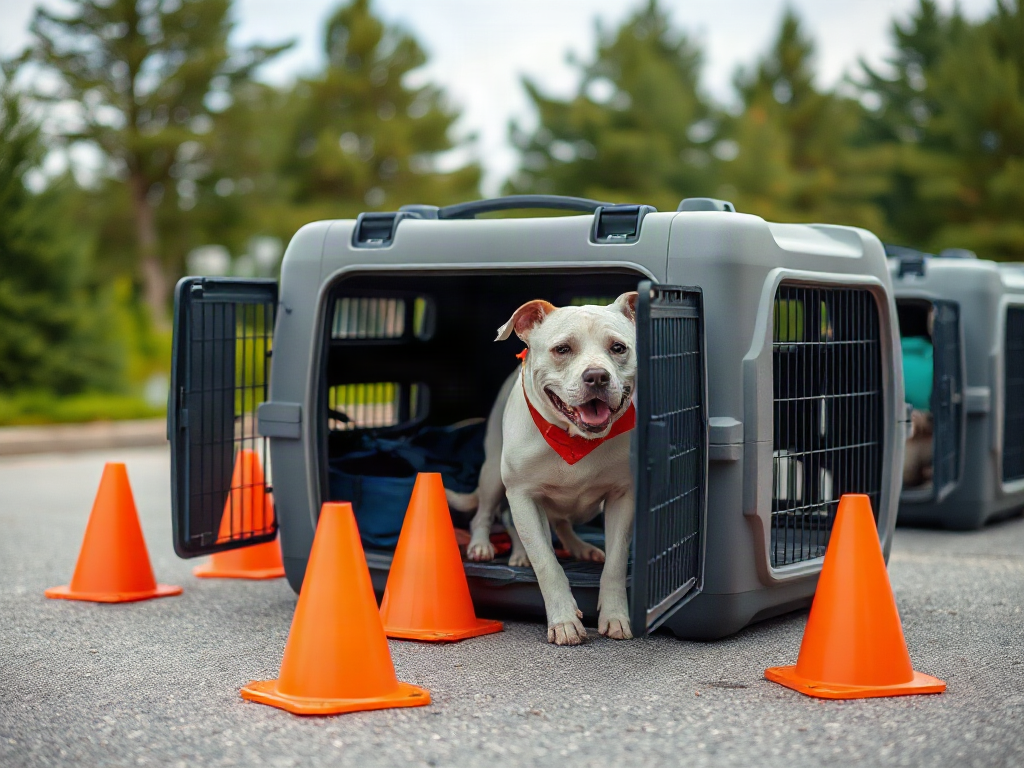
Travel crates for dogs wearing recovery cones should let the dog stand, turn, lie down, and pass through the door without the cone folding, catching, or pressing into the neck. Measure the dog while the prescribed cone is on, then compare the cone’s full width and forward reach with the crate’s internal dimensions and door opening. A rigid crate often keeps its shape better than a soft carrier when a wide cone touches the sides. Add a low, nonslip sleeping surface, secure the crate in the vehicle, and test it before departure.
How Should You Measure a Dog Wearing a Recovery Cone?
Crate sizing must account for the recovery cone as part of the dog’s occupied space. A crate that fits the dog normally may become too narrow at shoulder height, too short in front, or difficult to enter once a rigid cone is attached. Product weight limits do not reveal those clearance problems, so dimensions matter more than the maximum advertised pet weight.
Take measurements while the dog is standing naturally and wearing the exact cone prescribed or approved for recovery. Measure from the floor to the top of the head or ears, whichever is higher, and from the nose or front edge of the cone to the base of the tail. Then measure the cone at its widest point. Its outside diameter may exceed the dog’s shoulder width by several inches, and that extra width must clear both the crate walls and the doorway.
The door opening deserves a separate check because it is often smaller than the crate interior. A dog may technically fit inside yet be unable to enter without scraping the cone against the frame. Repeated contact can startle the dog, twist the collar attachment, or make the dog resist loading. Measure the clear opening after accounting for raised thresholds, projecting latches, and doors that do not swing completely out of the way.
| Measurement | Where to Measure | What It Reveals |
|---|---|---|
| Standing height | Floor to highest point of head or ears | Whether the dog can stand without crouching |
| Occupied length | Front edge of cone to base of tail | Whether the cone forces the dog against an end wall |
| Cone width | Widest outside edge to outside edge | Required side clearance for turning and resting |
| Door clearance | Usable width and height inside the frame | Whether entry is possible without bending the cone |
Do not compensate for a narrow crate by deliberately flexing a rigid cone each time the dog enters. That approach can change how the device sits around the neck and may weaken disposable plastic models. A better test is whether the dog can walk through the opening at a controlled pace with only light, occasional contact. If entry requires angling the head sharply, pushing the cone, or removing it without veterinary approval, the doorway is too restrictive.
More space is not automatically safer. An oversized crate can allow excessive movement during braking or turns, particularly if the dog is still unsteady after a procedure. Choose enough room for normal postures and cone clearance, then manage vehicle movement by securing the crate rather than buying a cavernous enclosure.
Which Crate Style Works Best With a Recovery Cone?
A rigid plastic crate is often the most practical starting point because its walls and roof do not collapse inward when the cone touches them. It also provides a defined doorway and a solid shell that can be secured according to the crate and vehicle manufacturers’ instructions. The limitation is that some molded crates have tapered sides or relatively narrow doors, so outside measurements can overstate usable space.
Wire crates offer broad visibility and usually have square internal dimensions. They can work well for calm dogs traveling in a vehicle with enough room for the assembled crate. However, the cone rim may catch against wire intersections, door hooks, or protruding hardware. Inspect every surface the cone can reach, and do not drape loose fabric through the bars where it could be pulled inside. A properly fitted crate cover may reduce visual stimulation, but ventilation must remain open and the fabric must stay beyond the dog’s reach.
Soft-sided carriers are less predictable for this situation. Their fabric walls may bow inward, reducing the advertised interior width, while mesh panels and zipper seams can become contact points for a cone edge. A structured soft carrier may suit a small, settled dog with a flexible veterinary-approved collar, but it should not be assumed to accommodate a broad rigid cone merely because the dog meets the carrier’s weight limit.
Door placement changes usability as much as construction. A top opening may help a small dog whose cone cannot pass comfortably through a low side door, provided lifting is consistent with the veterinarian’s activity restrictions. Larger dogs generally need a level, wide entrance because lifting can strain the handler and may conflict with restrictions after orthopedic or abdominal procedures. A two-door crate can make positioning easier, but each unused door must latch securely.
Consider the recovery device itself without substituting one on your own. Traditional plastic cones, soft fabric cones, inflatable collars, and recovery garments control access to different areas with varying reliability. A less bulky option may seem convenient for travel but may not protect the treatment site. Changes should be discussed with the treating clinic, especially when the device was selected to block access to a specific incision, paw, eye, or ear.
The best choice is therefore the crate that remains structurally stable, offers a usable opening, clears the prescribed device, and fits the intended vehicle location. Brand labels such as “large” or “airline style” are not reliable fit standards. Compare actual internal and door dimensions instead.
How Do You Prepare the Crate Interior for Recovery Travel?
The interior should provide traction and simple cushioning without creating a deep surface that traps the cone. Thick bolsters and high-sided beds reduce usable width at the exact height where a resting dog’s cone needs space. A low-profile pad covered by a washable, nonslip layer usually preserves more room and is easier to replace if it becomes soiled.
Place absorbent material beneath the top layer rather than leaving loose pads exposed. A dog that paws, circles, or backs up in the cone can bunch an unsecured pad against the doorway. The resulting ridge may catch a foot or make the dog hesitate to enter. Bedding should lie flat, stay dry, and contain no loose loops, torn foam, or fasteners accessible to the dog.
Food and water equipment requires similar judgment. Clip-on bowls may project into the cone’s turning path, while a floor bowl can slide or spill. For a short drive, follow the treating veterinarian’s feeding and hydration directions, particularly if medication, nausea, sedation, or a recent procedure affects the schedule. For longer travel, plan controlled stops in a secure setting rather than assuming the dog can comfortably eat or drink inside a cramped crate while wearing the cone.
Before loading the dog, run a hand around the crate interior and doorway. Check for sharp molding edges, bent wire, exposed zipper pulls, projecting bolts, and latch components that could snag the cone. Confirm that ventilation openings remain unobstructed after bedding is installed and after the crate is positioned in the vehicle. Heating and poor airflow can develop even when the crate looked adequately ventilated indoors.
A compact preparation check should cover the following points:
- Floor: flat, dry, nonslip, and lightly cushioned.
- Clearance: no bowls, toys, or bedding pressing into the cone’s path.
- Hardware: latches secure and snag points removed or avoided.
- Ventilation: openings clear on multiple sides.
- Vehicle placement: crate stable, restrained, and away from unsecured cargo.
Do not add chews or bulky toys simply to distract a restless dog. The cone may alter how the dog grasps an object, and extra items consume limited floor space. Calm handling, a familiar flat blanket, and a quiet loading process are usually more compatible with post-procedure confinement. Medication intended for calming should only be used as directed by the veterinarian who knows the dog’s condition and current prescriptions.
How Can You Test the Fit Before Traveling?
A stationary fit trial reveals problems that measurements cannot show. Set up the crate on a stable floor, open the door fully, and allow the dog to approach without being pushed from behind. The dog should be able to enter, stand squarely, turn with controlled movements, lower into a resting position, and exit without the cone wedging against the frame.
Watch the cone rather than focusing only on the dog’s body. Light brushing against a wall may be unavoidable, but repeated buckling, loud scraping, or pressure that shifts the neck fastening indicates inadequate clearance. The cone should not become pinned when the dog lies on its side or tries to face the door. Check the dog’s neck after the trial for new rubbing or displacement, while keeping the fastening adjusted according to veterinary instructions.
For example, a dog may enter a crate successfully but struggle when turning clockwise because the cone catches a mounted bowl or door hinge. Removing the obstruction may solve that specific problem; moving to a wider crate is appropriate when the cone contacts both side walls during an ordinary turn. Distinguishing a removable obstruction from inadequate structural width avoids buying unnecessary equipment while still addressing the actual failure point.
Next, place the empty crate in the vehicle and confirm that the door can open fully in its intended position. Secure it using attachment points and methods approved for the particular crate and vehicle. A crate that rocks on a folded seat, blocks the driver’s view, or sits beside loose luggage is not ready for travel. Do not rely on the dog’s weight to hold it in place.
Conduct a brief, low-stress trial before a necessary longer trip when the veterinarian has not restricted travel. Listen for continuous cone impacts during gentle turns and braking, and observe whether the dog can settle without panting, frantic pawing, repeated attempts to reverse out, or sustained vocal distress. Those signs can reflect discomfort, fear, pain, temperature, medication effects, or poor fit; they should not automatically be treated as a training problem.
Stop and reassess if the cone twists, the dog cannot change position, breathing appears abnormal, the incision or treated area is disturbed, or distress does not ease. Contact the veterinary clinic for condition-specific advice rather than removing a prescribed device during transit. A successful setup is quiet enough for the dog to rest, stable during normal vehicle movement, and accessible to the handler at safe stopping points.
Frequently Asked Questions
Should a recovery cone touch the sides of a travel crate?
Occasional light contact may occur, but the cone should not fold, wedge, scrape continuously, or shift around the dog’s neck. The dog must still be able to change position comfortably.
Can I remove the cone to make the dog fit in the crate?
Do not remove a prescribed cone without approval from the treating veterinarian. A larger crate, wider doorway, or veterinarian-approved alternative may be safer than leaving the treatment area accessible.
Is a soft carrier suitable for a dog wearing a cone?
It may suit a small, calm dog if the carrier holds its shape and clears the cone. Test the real internal width because fabric walls often bow inward under pressure.
How much larger should the crate be than usual?
There is no reliable universal size increase. Measure the cone’s diameter, forward reach, and required door clearance, then verify that the dog can stand, turn, lie down, and exit normally.
What should I do if my dog panics when the cone hits the crate?
Stop the trial, check for snagging and restricted movement, and retry only after correcting the setup. Persistent distress, apparent pain, or abnormal breathing warrants prompt veterinary guidance.
Conclusion
A workable recovery-travel setup is determined by usable clearance, not the crate’s weight rating or exterior size label. Measure the dog with the prescribed device in place, examine the true doorway dimensions, and choose a structure that does not collapse around the cone. Keep bedding low and secure, remove interior snag points, preserve airflow, and restrain the crate correctly in the vehicle.
Complete both a stationary movement check and, when permitted, a short vehicle trial before an essential journey. Scraping, wedging, displaced neck fastenings, inability to turn, or persistent distress means the arrangement needs correction. If the only apparent solution is removing or replacing the recovery device, ask the treating veterinarian whether another option can protect the affected area appropriately.