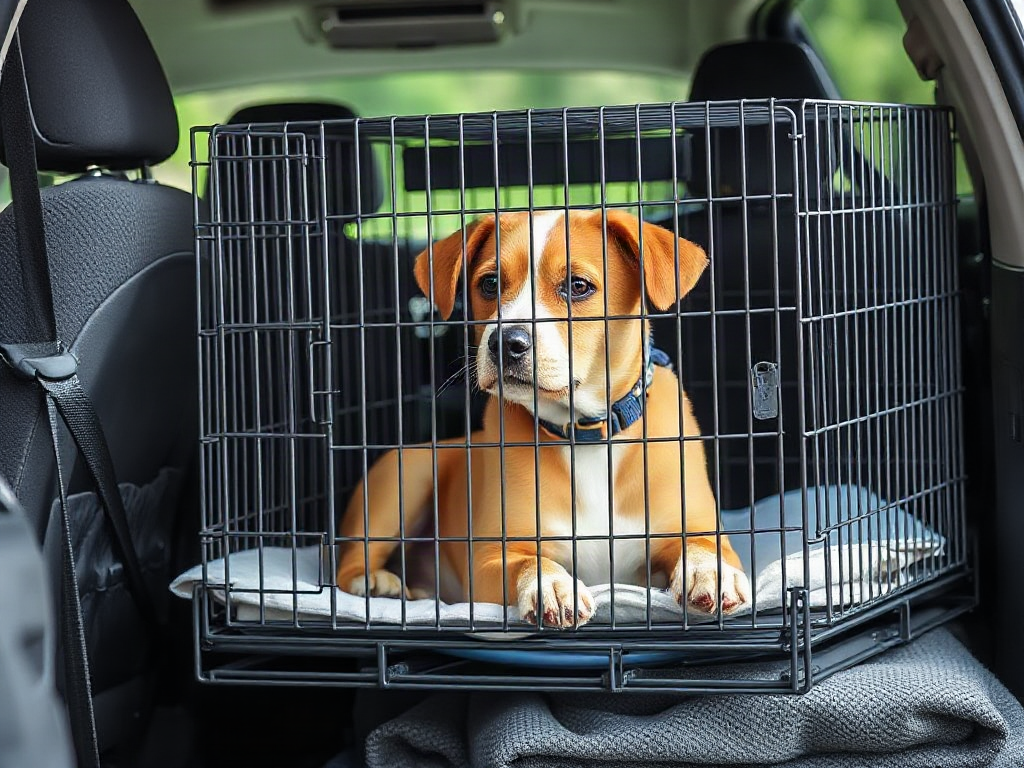
Wire dog crates for portable travel use make the most sense for road trips, temporary lodging, and destinations where a folding enclosure must be carried and stored between uses. A suitable model should provide enough standing and turning room, a rigid floor pan, secure door latches, and manageable folded dimensions without excessive weight. Wire construction offers airflow and visibility, but it does not automatically provide crash protection or meet airline-container requirements. Before traveling, verify the crate’s assembled stability, remove a collar that could catch on the mesh, secure the folded crate during transport, and choose a different enclosure if the dog bends wire, forces latches, or becomes distressed by surrounding activity.
Where a Folding Wire Crate Works—and Where It Does Not
A folding wire crate is primarily a portable enclosure for use after arrival, not a universal protective container for every stage of a trip. Its collapsible frame can be carried into a rental home, hotel room, campsite shelter, training venue, or family residence and opened without tools. Once assembled, it gives a crate-trained dog a familiar boundary while allowing generous airflow and a broad view of the surroundings.
That distinction matters in a vehicle. An ordinary wire crate may keep a dog from roaming around the cabin, but containment is not the same as tested crash protection. Thin wire panels, removable pans, folding joints, and household-style latches can deform or open under forces far beyond normal indoor use. Do not infer vehicle safety from phrases such as “heavy duty,” “travel-ready,” or “two-door.” If crash performance is a priority, examine model-specific test information and installation instructions rather than relying on the crate’s material or appearance.
Consider a family driving to a week-long cabin stay. The dog might ride in a vehicle restraint or transport enclosure selected for that specific purpose, while the folded wire crate travels secured with the luggage. At the cabin, the crate becomes a sleeping and management space. This separates two jobs: protection during transit and familiar confinement at the destination. Trying to make one lightweight folding product perform both jobs can create a compromise that serves neither well.
Standard wire crates are also generally unsuitable as a substitute for an airline kennel. Airlines commonly apply carrier-specific requirements involving rigid construction, ventilation, hardware, doors, labeling, and animal fit, with conditions varying by route and method of carriage. A collapsible wire enclosure should not be assumed acceptable for checked or cargo transport. Travelers must obtain current requirements directly from the airline before buying a container.
Temperament creates another limit. Wire walls provide little visual screening, and an unfamiliar room may expose the dog to hallway movement, other animals, or housekeeping activity. A breathable cover can reduce visual stimulation after ventilation and temperature have been assessed, but it will not correct panic, escape behavior, or destructive crate habits. Dogs that bite bars, push repeatedly at doors, or collapse panels need a more secure arrangement and behavior support—not a heavier blanket over the same enclosure.
The strongest use case for Wire dog crates for portable travel use is therefore controlled destination confinement for a dog already comfortable in a crate. Their weak points are impact protection, airline acceptance, weather exposure, and resistance to determined escape attempts. Match the enclosure to the actual phase of travel rather than treating “portable” as proof of suitability everywhere.
Sizing the Crate for Transport and Rest
Correct sizing gives the dog functional room without turning the enclosure into an awkward piece of oversized luggage. The dog should be able to stand naturally without pressing its head against the top, turn around without folding its body tightly, and lie on its side in a normal resting posture. Measure the individual dog rather than choosing solely from weight ranges or breed examples, which cannot account for long legs, deep chests, upright ears, or unusual body proportions.
Measure standing height from the floor to the highest natural point that must clear the roof, and body length from the nose area to the base of the tail while the dog stands normally. Compare those measurements with the crate’s internal assembled dimensions. Published exterior dimensions may include projecting handles, wire frames, or folded hardware and can overstate usable space. A thick travel mat also reduces headroom, so repeat the fit check with the bedding that will actually be used.
A crate that is too small produces obvious contact points: the dog ducks while standing, cannot reposition easily, or must curl tightly throughout a long rest period. Excessive space creates different problems. A large enclosure is harder to carry through doorways, occupies more cargo area, and may slide or flex more if it is not positioned securely. For destination use, a little extra resting room may be reasonable, but buying several sizes larger “for comfort” often makes portability worse without addressing what the dog actually needs.
Puppy owners face a separate decision. A divider can make an adult-size crate usable during growth, reducing the need to buy multiple frames. Check that the divider attaches firmly and leaves no sharp projections or widening gaps. Reassess its position as the puppy grows; a setting that worked a month earlier may restrict standing length or create an entrapment point. A divider is a space-management tool, not a structural brace.
Portability measurements deserve the same attention as animal fit. Before ordering, record the intended storage area, vehicle cargo opening, narrowest doorway at common destinations, and the folded crate’s length, width, thickness, and weight. A frame may fit inside a cargo compartment yet be impossible to load flat because the hatch opening is narrower than the interior. Likewise, a crate that one person can lift in a showroom may become difficult to manage while holding a leash and carrying bedding.
A practical pre-purchase check is short:
- Dog fit: standing height, turning clearance, and relaxed lying length.
- Route fit: doors, stairs, elevators, and vehicle openings.
- Storage fit: folded dimensions plus space for the pan and bedding.
- Handler fit: realistic carrying weight and a safe grip.
Successful sizing is visible when the dog changes position comfortably and the handler can move the collapsed unit without dragging, dropping, or forcing it through openings. If either side of that test fails, a smaller suitable crate, lighter gauge model, or different portable enclosure may be the more workable choice.
Construction Details That Affect Portability
Portable performance depends more on joints, latches, edges, and handling points than on wire thickness alone. A heavier frame may resist routine flexing, but it also increases carrying effort and can become cumbersome on stairs. A lighter model is easier to load yet may rack out of square when assembled on an uneven surface. The useful balance is enough rigidity for the dog’s behavior and body weight without making every transfer a two-person task.
Inspect the folding mechanism in both states. When open, panels should align without bowed corners, loose hooks, or a roof that lifts when the door moves. When collapsed, the frame should stay together through a positive retaining clip or secure carry arrangement. A folded crate that springs partly open can pinch fingers, strike nearby objects, or become difficult to control. Practice collapsing and reopening it at home until every panel sequence is familiar; a dark parking area is a poor place to interpret unfamiliar hardware.
Door count changes convenience rather than basic quality. A front door suits a narrow placement with clear access at one end. A second side door helps when furniture, a vehicle wall, or room layout blocks the front approach. The tradeoff is more hinges and latch points to inspect. Each closed door should sit square in its frame, and the latch should fully engage without relying on friction or a bent panel. Clips added by an owner must not create projections the dog can reach or delay emergency access.
The floor pan should lie flat, remain captured by its stop, and slide out only when intentionally released. Cracked plastic, curled corners, and a loose pan latch can expose feet to gaps or allow the dog to push the tray outward. Bedding should fit inside the pan rather than bunching against the door. For a dog that chews fabric, loose blankets and foam pads may create more risk than comfort; use bedding appropriate to the dog’s established habits.
Wire spacing and finish also warrant a hands-on check. Run a cloth carefully across accessible edges to detect burrs or rough welds, then inspect for corrosion, broken wires, and widened gaps. Pay particular attention near doors and folding hooks, where movement concentrates wear. Remove the dog’s collar and dangling tags during unattended crate time because hardware can catch on mesh. This precaution does not make an unsafe or damaged crate acceptable, but it removes a foreseeable snag point.
For frequent transfers, compare integrated handles with lifting the frame from its base. Some handles are intended for carrying an empty folded crate, not an occupied enclosure. Never assume a handle permits lifting the dog inside unless the manufacturer expressly describes that use. A useful inspection of Wire dog crates for portable travel use should therefore cover the complete load path—handle, folded retainer, panel hooks, door frame, pan stop, and feet—rather than focusing only on the visible mesh.
Setting Up and Using the Crate Away From Home
A stable setup begins with location, not bedding. Choose a level indoor surface away from direct sun, heaters, cooking equipment, exterior doors, cords, and areas where people could trip over an open door. Leave enough clearance for ventilation and full latch operation. Protect delicate flooring with a flat, non-slip layer if needed, but avoid thick or folded material that makes the base rock.
After unfolding the crate, confirm that every panel is seated and the floor pan is locked in its normal position. Press gently at opposite upper corners to check for excessive racking, then operate each door several times. A latch that worked before loading can bind if the frame is not square. Add familiar bedding only after the structure is stable, and place water according to trip duration, room conditions, the dog’s needs, and the likelihood of spills. Clip-on bowls should be positioned so their attachments do not form sharp interior projections.
Introduce the travel setup before departure. Assemble the crate in another room at home, use the planned mat, and allow the dog to enter during calm periods. Later, rehearse a short stay in a different familiar location. The purpose is to separate the novelty of a folding frame, changed bedding, and unfamiliar surroundings from the pressures of the actual trip. A dog that rests, changes position normally, accepts routine departures, and shows no persistent escape behavior is giving more useful feedback than a dog that merely enters for a treat.
At a hotel, place the crate where hallway noise and door movement are least likely to trigger vigilance. Confirm the property’s rules, and do not assume crating makes it acceptable to leave a dog unattended. Housekeeping access, alarms, temperature failures, and barking can turn a seemingly controlled arrangement into a welfare or property issue. At a campsite, a household wire crate offers exposure rather than shelter; it should not be treated as weather protection or a secure outdoor pen.
During vehicle transport, collapse and secure the empty crate so it cannot slide, unfold, or become a loose object. Keep the removable pan and divider captured with the frame or restrained separately. If using an assembled crate in a vehicle, follow the vehicle and crate manufacturers’ instructions and recognize that tie-down convenience does not establish crash performance. Improvised straps around weak wire sections can bend the enclosure without providing dependable occupant protection.
Stop using the setup when the dog pants heavily without an environmental explanation, drools unusually, vocalizes persistently, bites the mesh, forces the door, or repeatedly attempts to escape. Those signs call for reassessing temperature, toileting needs, duration, location, crate conditioning, and enclosure type. They should not be dismissed as disobedience. After each trip, wash and dry the pan, remove trapped hair from joints, check latch alignment, and store the frame dry. Repeated assembly gradually exposes loose hooks and damaged coatings, so inspection is part of travel use rather than an occasional repair task.
Frequently Asked Questions
Are folding wire crates safe for car travel?
They can provide everyday containment, but an ordinary folding wire crate should not be assumed to offer crash protection. Review model-specific test evidence, installation directions, and vehicle compatibility before relying on one during transit.
Can a wire dog crate be used for airline travel?
Do not assume so. Airline requirements vary, and collapsible wire construction often differs from the rigid kennels specified for checked or cargo transport. Confirm current rules directly with the operating airline before purchasing.
Should a dog wear a collar inside a wire crate?
Removing collars, tags, and dangling accessories reduces the chance of hardware catching on the mesh, particularly when the dog is unattended. Identification requirements outside the crate should be managed separately.
Is a one-door or two-door crate better for travel?
Two doors provide placement flexibility in tight rooms, while one door means fewer hinges and latches to inspect. Choose according to destination layout, then verify that every door closes squarely and latches fully.
How can I make a wire crate calmer in an unfamiliar room?
Use familiar bedding, select a low-traffic location, and rehearse with the crate before departure. A breathable partial cover may reduce visual stimulation, but ventilation, temperature, chewing behavior, and distress signals still require monitoring.
Conclusion
A folding wire crate earns its place in a travel kit when its job is clearly defined. Measure the dog and every relevant opening, compare folded weight with the handler’s ability, and inspect latches, panel hooks, wire finish, and the floor pan before departure. Treat the crate as a destination enclosure unless credible model-specific information supports another use.
Rehearse assembly and calm crate time at home, then evaluate the dog’s behavior in increasingly unfamiliar settings. Secure the empty folded frame during transport, remove snag-prone collars during confinement, and stop if bending, escape attempts, or sustained distress appear. If airline acceptance, crash protection, outdoor shelter, or resistance to a forceful dog is the priority, choose equipment designed and documented for that specific constraint rather than asking a portable household crate to cover every travel risk.